
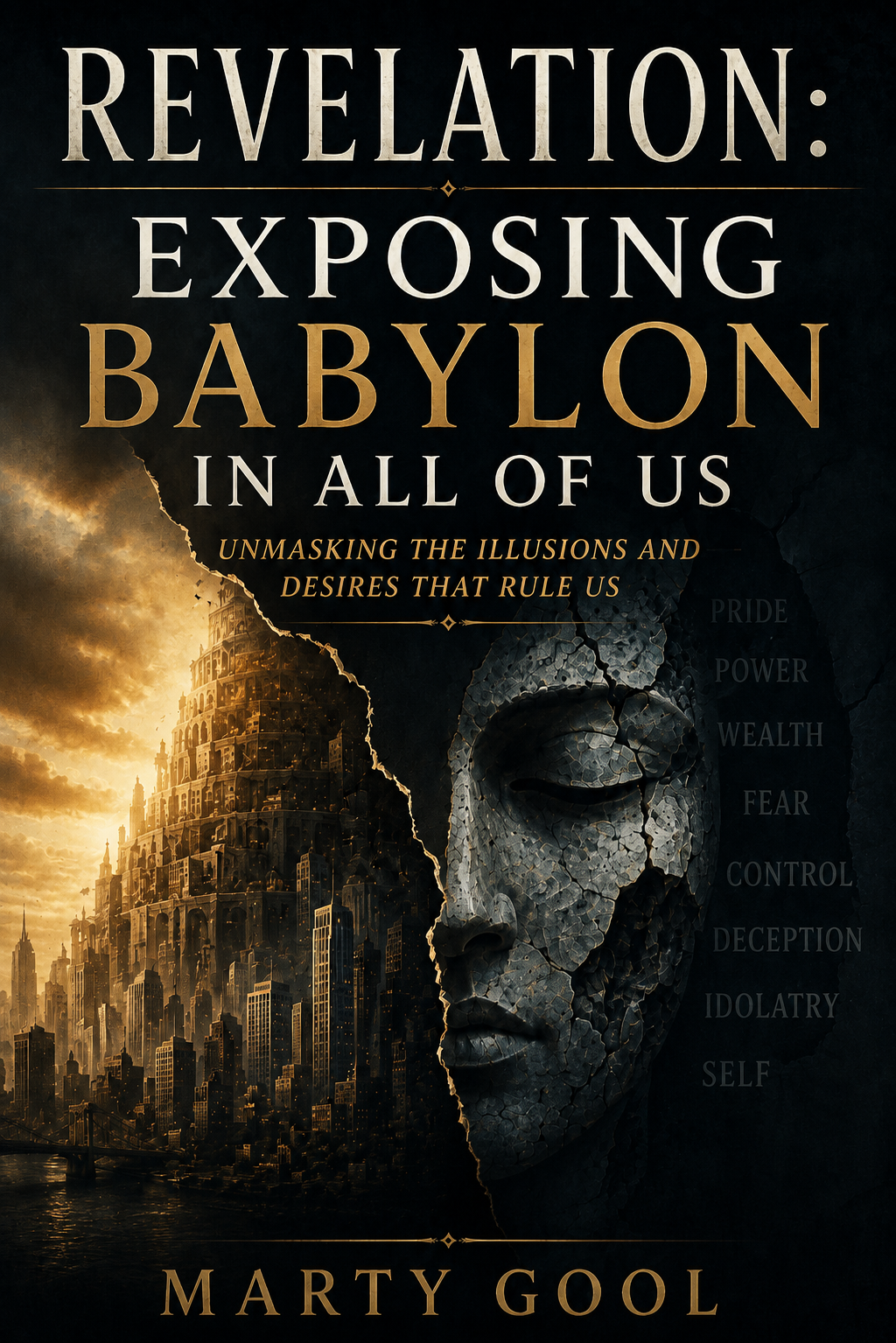
Revelation: Exposing the Babylon in All of Us
Revelation: Exposing Babylon in All of Us
Unmasking the Illusions and Desires That Rule Us
What if Revelation is not first about predicting the end of the world?
What if it is about exposing the world that already exists beneath the surface?
Revelation: Exposing Babylon in All of Us turns the reader away from fear-driven speculation and toward the deeper work of unveiling. Revelation means disclosure. Uncovering. The pulling back of what hides what is already there. This book begins from that premise and asks the reader to look again at the beasts, the seals, the trumpets, the bowls, Babylon, judgment, and the Lamb.
But this is not only a book about empires.
It is a book about us.
Because the same fear that builds a false self inside a person can eventually build a system outside that person.
Fear becomes control.
Control becomes compliance.
Compliance becomes institution.
Institution becomes law, market, theology, and enforcement.
That is how Babylon grows.
Babylon is not merely an ancient city waiting somewhere in the past or a prophetic empire waiting somewhere in the future. Babylon is what fear becomes when it acquires enough power to organize the lives of others.
And Babylon can live in us.
It can appear as pride.
Power.
Wealth.
Control.
Deception.
Idolatry.
The endless construction of a self that must be protected, defended, elevated, and obeyed.
This book follows Revelation as an unveiling of that architecture.
The mountain exposes the false self.
The fire reveals what was already hidden.
The sea strips away the structures we trusted to keep us above the water.
The seals uncover.
The trumpets call.
The bowls dismantle.
Babylon falls.
And through it all, the character of God does not change.
That is one of the book’s central claims.
The God revealed at the end of Revelation is not a different God from the One revealed in Christ. The Lamb does not stop being the Lamb when judgment comes. The wounded One remains the One on the throne. Judgment does not require God to abandon love. It reveals what love does when it encounters what is false, destructive, exploitative, and built on fear.
This book refuses the image of a God whose grace eventually expires and whose mercy gives way to another divine personality.
Instead, it asks a harder question:
What if judgment is not God becoming someone else?
What if judgment is the unveiling of everything that cannot survive the undivided holiness of who God has always been?
In this reading, Babylon does not fall because God finally loses patience.
Babylon falls because everything built on fear carries collapse inside itself.
The system eventually reveals what it has always been.
A wall becomes a market.
A market becomes an empire.
An empire eventually prices human beings as cargo.
And Revelation pulls the cover off.
But the unveiling is not only political.
The same question comes home.
Where has fear built something in you?
Where has survival become identity?
Where has protection become control?
Where has desire become domination?
Where have you built a small Babylon and called it wisdom, success, spirituality, security, or strength?
Revelation: Exposing Babylon in All of Us does not invite the reader to stand outside Babylon and point.
It asks the reader to recognize the architecture.
In the world.
In systems.
In theology.
In the self.
And after Babylon falls, something else appears.
The New Jerusalem comes down.
It is not another empire.
It is not another tower built upward by frightened people trying to make a name for themselves.
It is gift.
Open gates.
Shared light.
A city where no human being appears on a cargo list.
And at the center is the Lamb.
Still wounded.
Still bearing the scars.
Still revealing the character of God.
The wounds are not erased.
They become light.
This is Revelation as unveiling.
Not a countdown designed to make you afraid.
Not an escape manual for getting out before everything burns.
Not a puzzle whose purpose is to identify the beast before your neighbor does.
It is a confrontation.
With fear.
With power.
With empire.
With illusion.
With the false self.
With the Babylon we condemn outside ourselves while quietly building versions of it within.
And finally, with the Lamb who refuses to become Babylon in order to defeat Babylon.
The question is no longer only, “What will happen?”
The deeper question is:
What has already been uncovered?
And once you see it, will you keep looking?