
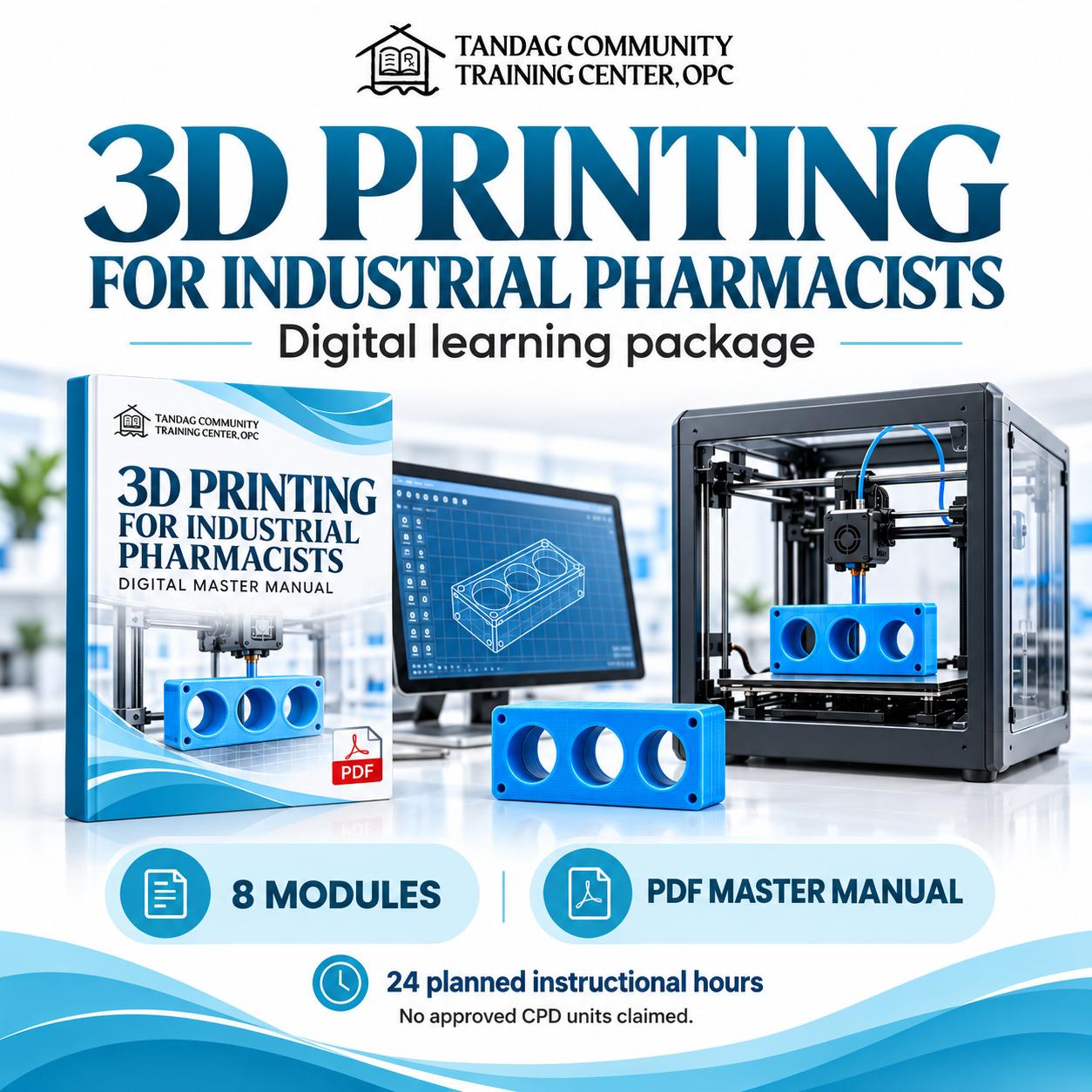
3d Printing Pharmacists 24-hr Master Nanual
Explore how 3D printing connects digital design, materials, process documentation, and pharmaceutical development through this structured learning package from Tandag Community Training Center, OPC.
Designed for pharmacists working in—or preparing to enter—manufacturing, research and development, quality assurance, quality control, and related industrial roles in the Philippines.
The eight modules cover:
- Applications in Industrial Pharmacy — Identify potential uses and define project boundaries.
- Printing Technologies and Materials — Compare processes and assess material suitability.
- CAD and Design Control — Understand dimensional requirements, revisions, and design verification.
- Printing and Process Documentation — Connect controlled files, printing records, and specimen traceability.
- Pharmaceutical Dosage-Form Development — Analyze hypothetical formulation, geometry, content, and release data.
- GMP and Implementation Controls — Examine quality-system considerations and implementation readiness.
- Inspection and Investigation — Review evidence, investigate discrepancies, and develop corrective actions.
- Integration and Assessment — Complete a capstone recommendation and evaluate your understanding.
What’s included
- Illustrated PDF master manual containing all eight modules
- Practical worksheets and documentation templates
- Fictional case studies and calculation exercises
- Knowledge assessments, answer guides, and scoring rubrics
- A learning framework covering 24 planned instructional hours
Build your understanding of how to evaluate a 3D-printing proposal, document decisions, and identify the evidence needed before workplace implementation.
Format: Digital PDF learning material. No physical book, printer, materials, live instruction, or certification service is included.
CPD status: This package is CPD accreditation-oriented. No PRC approval or approved CPD units are claimed. The 24 planned instructional hours must not be interpreted as 24 approved CPD units.
Educational examples include inert training prototypes and hypothetical pharmaceutical development cases; they do not authorize medicine manufacture, patient use, or product release.