
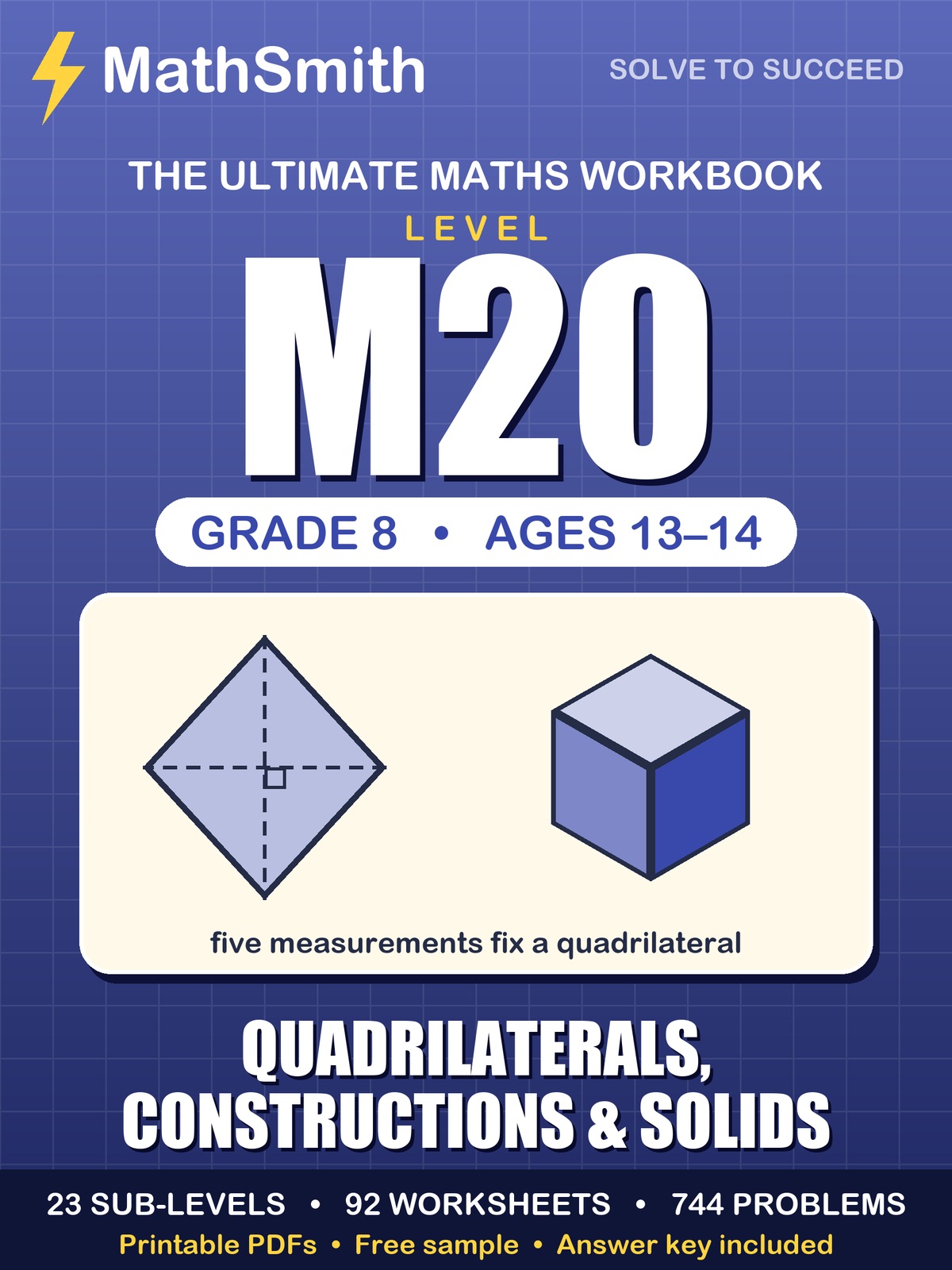
Gr 8 Maths Worksheets (Ages 13-14) | Level M20: Quadrilaterals, Constructions & Solids
🎓 Launch offer: 80% OFF every MathSmith workbook with code LAUNCH80 (first 1000 orders). Click Add to Cart, then enter LAUNCH80 in the discount box before you pay.
Not sure which level your child needs? Take the free 40-question placement test: https://ebooks.thecodecrafters.net/placement
See free sample pages first: https://ebooks.thecodecrafters.net/
Help your child build absolute confidence and mastery in mathematics. This comprehensive workbook from MathSmith takes a highly structured, "one-rung-at-a-time" approach to Quadrilaterals, Constructions and Solids, ensuring students fully understand concepts before moving forward.
Instead of overwhelming learners with random equations, this workbook uses a carefully scaffolded, predictable learning ladder. It is perfect for homework, structured independent study, or mastery practice.
📊 What Is Included?
1 Complete Level (Level M20)
23 Structured Sub-levels for gradual progression
92 Printable Worksheets
744 Total Problems for thorough practice
Full Answer Key online, unlocked by the order ID on your Payhip receipt, for quick, stress-free marking
🗺️ Curriculum Breakdown
This collection focuses deeply on mastering Quadrilaterals, Constructions and Solids through a carefully curated system:
Polygons, and the two ways of counting their angles (4 Sub-levels): Four rungs that put the vocabulary in place and then count with it. Convex and concave first, because every shape in the rest of the level is convex and it is worth knowing what the other kind looks like. Then the diagonals, where a quadrilateral turns out to have only two of them - the other four joins are its sides. The angles inside come from cutting the shape into triangles with the diagonals from one corner, so it is M17's half turn counted rather than a second rule; and the angles outside come to a full turn however many there are, which is the only angle fact on the level that does not depend on the number of sides.
The quadrilaterals, and the marks that name them (6 Sub-levels): Six rungs whose questions are written on the shape rather than beside it. A tick says two sides are equal, an arrowhead says two are parallel, a small square says a right angle - and none of that can be put into the words without answering the question, because "the parallelogram PQRS" has already told the child what the arrowheads were for. The family is a hierarchy and it runs one way only: every square is a rectangle and no rectangle need be a square. Each shape is taught by what it ADDS to the one above it - a rhombus adds equal sides to a parallelogram and gains diagonals that cross square; a rectangle adds right angles and gains diagonals that are equal - so five shapes are five facts rather than five lists.
Five measurements, and four ways of spending them (6 Sub-levels): The level's own idea, and the strand it exists for. Three sides fix a triangle and four sides fix nothing, so a quadrilateral takes five measurements - and the four constructions are four ways of handing over the same amount of information. Four sides and a diagonal is the one to understand, because the diagonal cuts the shape into two triangles and each is then M13's construction; three sides and both diagonals is the one that looks impossible, since the fourth side is never measured at all; and the two with angles in them bring the protractor. The special quadrilaterals close the strand by needing fewer, which is not an exception: a square's four equal sides are four measurements made at once by the word "square".
A solid on flat paper, and what gets lost (7 Sub-levels): Seven rungs, and the same idea one dimension up. A view throws a direction away, so the front view of a solid says nothing whatever about how deep it is - which is why three are drawn, and why even three do not always say how many cubes there are. The isometric grid is the other way round: it keeps all three directions and lies about the angles between them instead, so every edge is drawn its true length and the solid can be counted off the sketch. A map turns out to be a view too, which is why it has no perspective and why it needs a scale. The strand ends on counting a solid that cannot be drawn at all - a prism with twenty-sided ends - first by the counting argument and then with Euler's formula, which finds the count nobody has given.
🎯 Who Is This For?
Parents looking to provide structured math support at home.
Homeschoolers searching for a sequential curriculum to guarantee zero gaps in math skills.
Teachers & Tutors looking for bite-sized, scaffolded printables for classroom morning work or targeted intervention.
📖 How To Use This Workbook
Print the workbook, read each rung's method page, and let your child work inside the printed frame. Then check the answers your way: in the printable answer-key PDF included in this download, or online, one page at a time, with the order ID on your Payhip receipt (valid for six months). Please keep the answer key for the adult marking the work and do not share it with your child: the workbook only works if they have worked each answer out for themselves.
Step-by-step manual and video guide: https://ebooks.thecodecrafters.net/manual/
Check the answers: https://ebooks.thecodecrafters.net/answers
⚙️ Digital Delivery Details
Format: four instant-download PDFs (free sample, sample answers, workbook, full answer key). The answer key is also available online.
Print Ready: Easily printable on home or school printers.
Usage: Licensed for individual family or single-classroom use.