
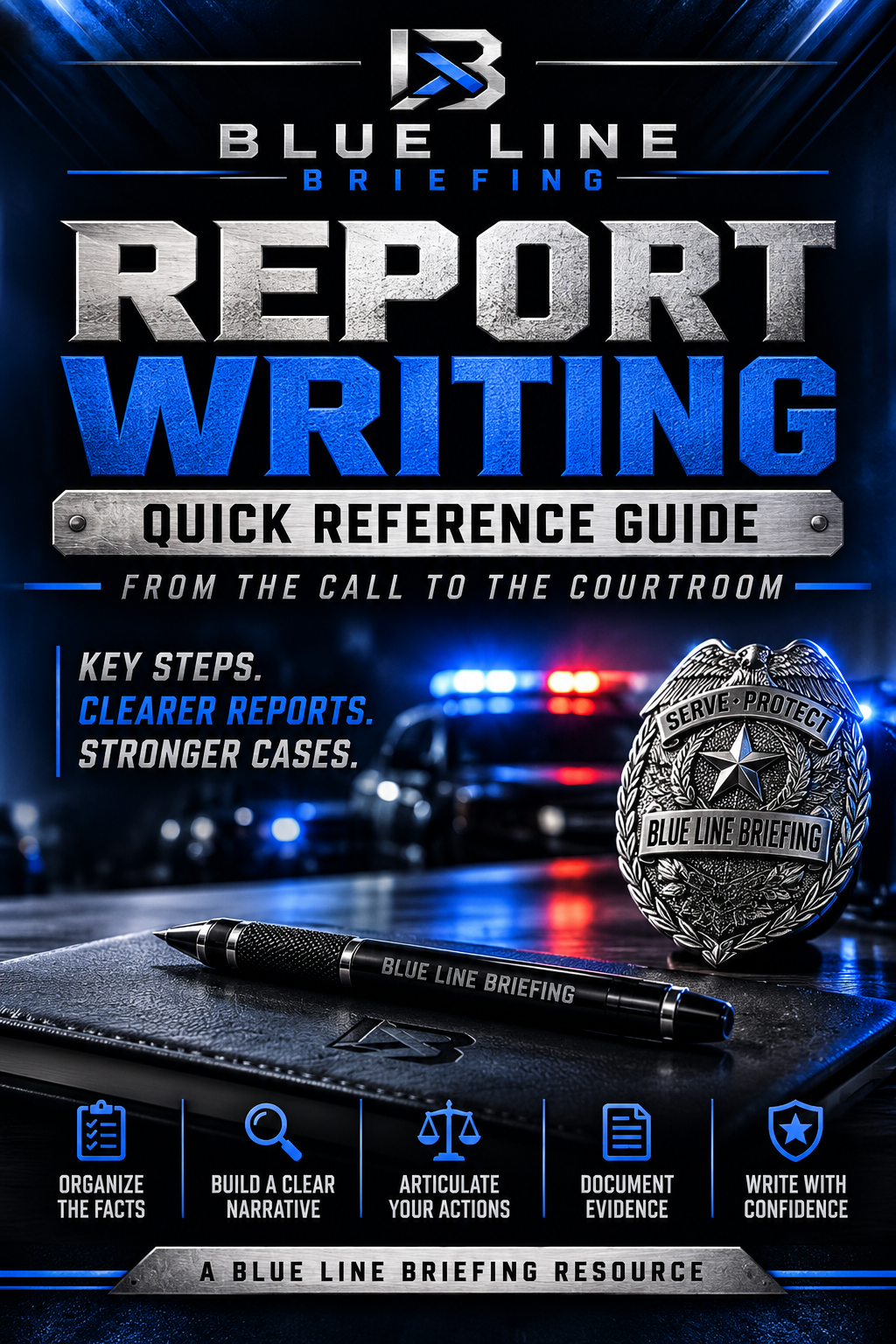
Report Writing Quick Reference Guide | Blue Line Briefing
Report Writing Quick Reference Guide
From the Call to the Courtroom | Blue Line Briefing
FREE DOWNLOAD
A strong police report does more than document an incident. It clearly communicates what happened, what the officer observed, what actions were taken, and the facts supporting those decisions.
The Blue Line Briefing Report Writing Quick Reference Guide is a practical, easy-to-use training resource designed to help law enforcement officers improve the clarity, organization, and articulation of their reports.
Whether you’re a new officer developing your report-writing skills, an experienced patrol officer looking to sharpen your documentation, or an FTO coaching a trainee, this guide provides essential reminders you can apply on your next shift.
What’s Inside?
- Report Organization: Build clear, chronological narratives that are easy to follow.
- Articulation: Connect observations, facts, and circumstances to investigative decisions.
- Facts vs. Conclusions: Learn to support statements with specific, observable details.
- Statements & Evidence: Properly attribute information and document relevant evidence.
- Report Review: Use practical checkpoints to identify omissions, inconsistencies, and unclear language before submission.
Who Is This For?
- Police recruits and academy students
- Patrol officers
- Field Training Officers (FTOs)
- Supervisors and law enforcement trainers
Want to Take Your Report Writing Further?
This free quick reference guide is a companion to the Blue Line Briefing Report Writing Field Guide — From the Call to the Courtroom.
The complete 29-page field guide provides expanded instruction, practical examples, report-writing scenarios, FTO coaching techniques, and additional tools to help officers strengthen their documentation skills.
Full Report Writing Field Guide available separately for $20.
High Standards. Solid Training. Better Officers.
Disclaimer: This material is intended for educational and training purposes only. It does not replace agency policy, applicable law, legal guidance, or department-specific reporting requirements.