
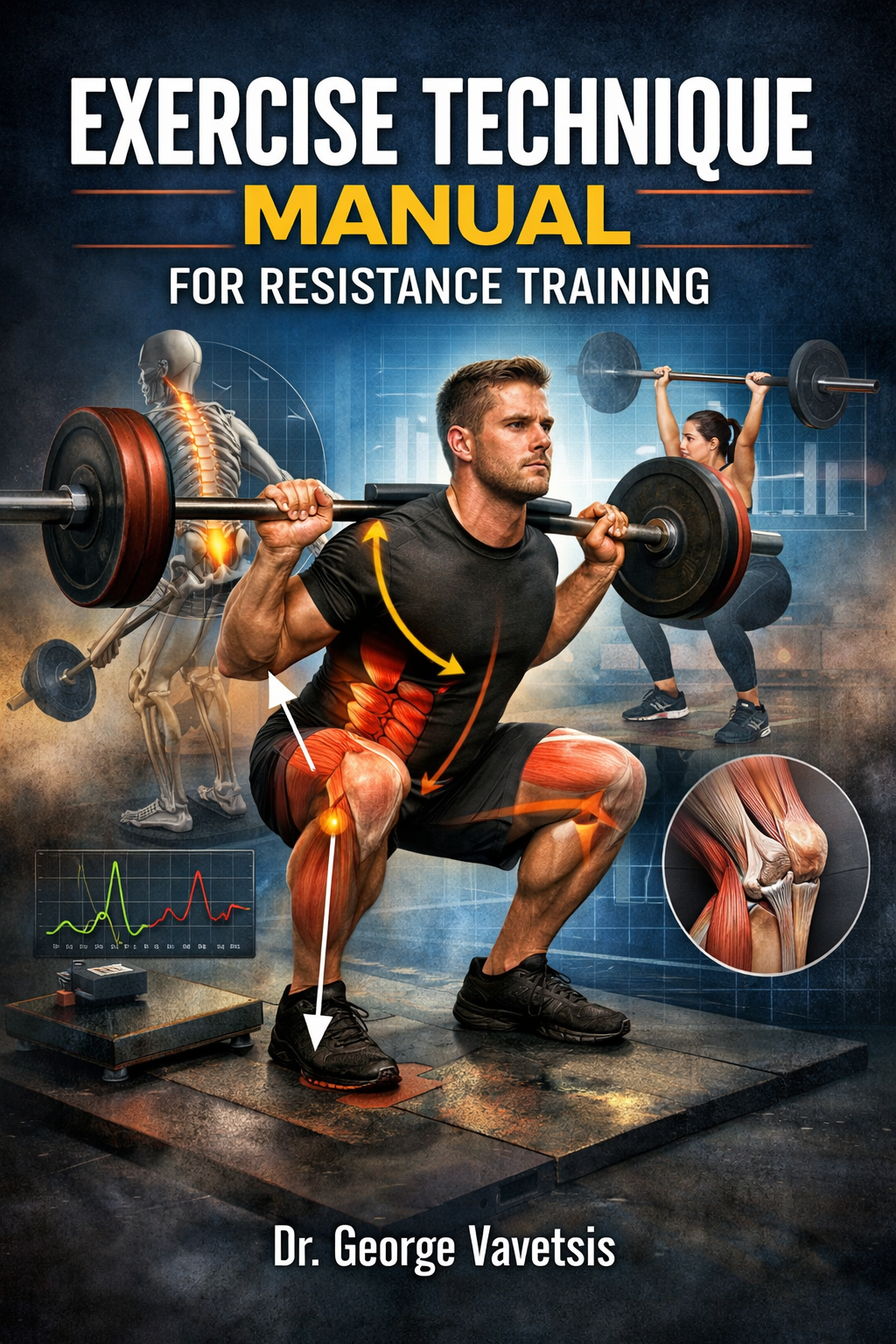
Exercise Technique Manual for Resistance Training
Pages: 1771
Resistance training is one of the most powerful tools available for developing human performance, improving musculoskeletal health, and enhancing resilience against injury. Yet despite the widespread adoption of strength training across sport, rehabilitation, and general fitness settings, the technical mastery of exercise execution often remains the most overlooked component of the training process.
Modern athletes and coaches operate in an environment increasingly driven by data: load prescriptions, velocity-based training, force–velocity profiling, and advanced monitoring systems now shape the way performance programs are designed. However, no monitoring system can compensate for flawed movement mechanics. The foundation of effective resistance training remains the ability to execute movements with biomechanical precision, structural integrity, and neuromuscular coordination.
The purpose of the Exercise Technique Manual for Resistance Training is to provide a comprehensive and systematic reference for understanding the technical, biomechanical, and neuromuscular principles that govern resistance exercise execution. Rather than focusing solely on individual exercises, this work emphasizes the underlying movement principles that determine whether resistance training becomes a tool for performance enhancement or a pathway toward overload-related injury.
In resistance training, load is often perceived as the primary driver of adaptation. Yet the reality is more nuanced. External load only produces a meaningful training stimulus when it is applied within biomechanically sound movement patterns. When technique deteriorates, the load ceases to be productive and instead becomes a mechanical stressor acting on vulnerable structures.
For this reason, technical proficiency must always precede load progression. The correct execution of movement patterns ensures that the forces generated during resistance training are distributed efficiently across joints, muscles, and connective tissues. As described in the biomechanical foundations of this manual, maintaining correct alignment, joint stacking, and coordinated kinetic chain activation is critical for both performance and injury prevention.
A well-executed resistance exercise is not simply the act of moving weight from point A to point B. Instead, it is a complex neuromuscular event that involves:
- Coordinated recruitment of multiple muscle groups
- Precise joint alignment and stabilization
- Efficient transmission of ground reaction forces
- Control of the body’s center of mass
- Integration of breathing and intra-abdominal pressure mechanisms
- Synchronization of the kinetic chain
When these elements operate together, resistance training becomes a powerful method for developing strength, power, and movement efficiency.
When they do not, training quickly devolves into compensation patterns.
This manual therefore emphasizes the mechanics behind the movement, not merely the appearance of the movement itself. Understanding why a technique works biomechanically allows coaches and athletes to adapt the principles across different exercises, equipment variations, and training environments.
Another key goal of this book is to bridge the gap between biomechanical theory and applied coaching practice. Many strength training resources describe exercises superficially, focusing on muscle groups or simple cues without addressing the deeper mechanical principles involved.
In contrast, this manual explores the structural foundations of movement such as:
- Neutral spine mechanics and lumbopelvic stability
- Joint stacking and skeletal alignment
- Force vector orientation relative to external resistance
- Intra-abdominal pressure and bracing strategies
- Center-of-mass control and balance
- Kinetic chain synchronization in compound lifts
- Ground reaction force utilization
- Torque production and lever manipulation
- Scapulohumeral rhythm in upper-body movements
These principles form the biomechanical language of resistance training, and mastery of this language enables coaches and athletes to diagnose movement inefficiencies with precision.
Importantly, the manual is written not only for elite strength and conditioning coaches but also for any practitioner responsible for supervising resistance training. This includes personal trainers, sport coaches, physiotherapists, rehabilitation specialists, and students of exercise science.
While the performance goals of these professionals may differ, they share a common responsibility: ensuring that resistance training is performed safely, effectively, and with technical integrity.
In the modern era of strength training, athletes often encounter thousands of repetitions of foundational movement patterns such as squats, presses, hinges, pulls, and lunges throughout their careers. Even small technical errors repeated over time can accumulate into significant mechanical stress.
Conversely, when these patterns are executed correctly, they reinforce optimal motor control and produce long-term structural adaptations that enhance performance capacity.
This is why technique should never be treated as a beginner’s concern. Technical mastery is a lifelong pursuit in strength training.
Elite athletes often spend years refining details such as bar path efficiency, joint alignment, and force transfer patterns in order to maximize performance outcomes. The same dedication to technique should also guide the training of recreational lifters and developing athletes.
The structure of this manual reflects that philosophy. Each section breaks down movement patterns into their biomechanical components and highlights the key technical cues, common errors, and practical coaching strategies necessary for achieving optimal execution.
Rather than presenting exercises as isolated movements, the book encourages readers to view resistance training through a systems perspective. In this framework, the body operates as an integrated kinetic chain in which each segment influences the others.
When one link in the chain fails—whether through instability, poor alignment, or incorrect force application—the efficiency of the entire movement is compromised.
By learning to identify and correct these breakdowns, practitioners can ensure that resistance training fulfills its intended role as a tool for performance development, physical resilience, and long-term athletic longevity.
Ultimately, the goal of this manual is simple: to elevate the standard of resistance training technique.
When athletes learn to move with precision and control under load, strength training becomes more than an exercise modality. It becomes a platform for building stronger, more efficient, and more durable human movement.