
9. PM-MPC-009 — Model Predictive Control, Predictive Optimization, Intelligent Decision-Making, Reinforcement Learning and Autonomous Systems
Description
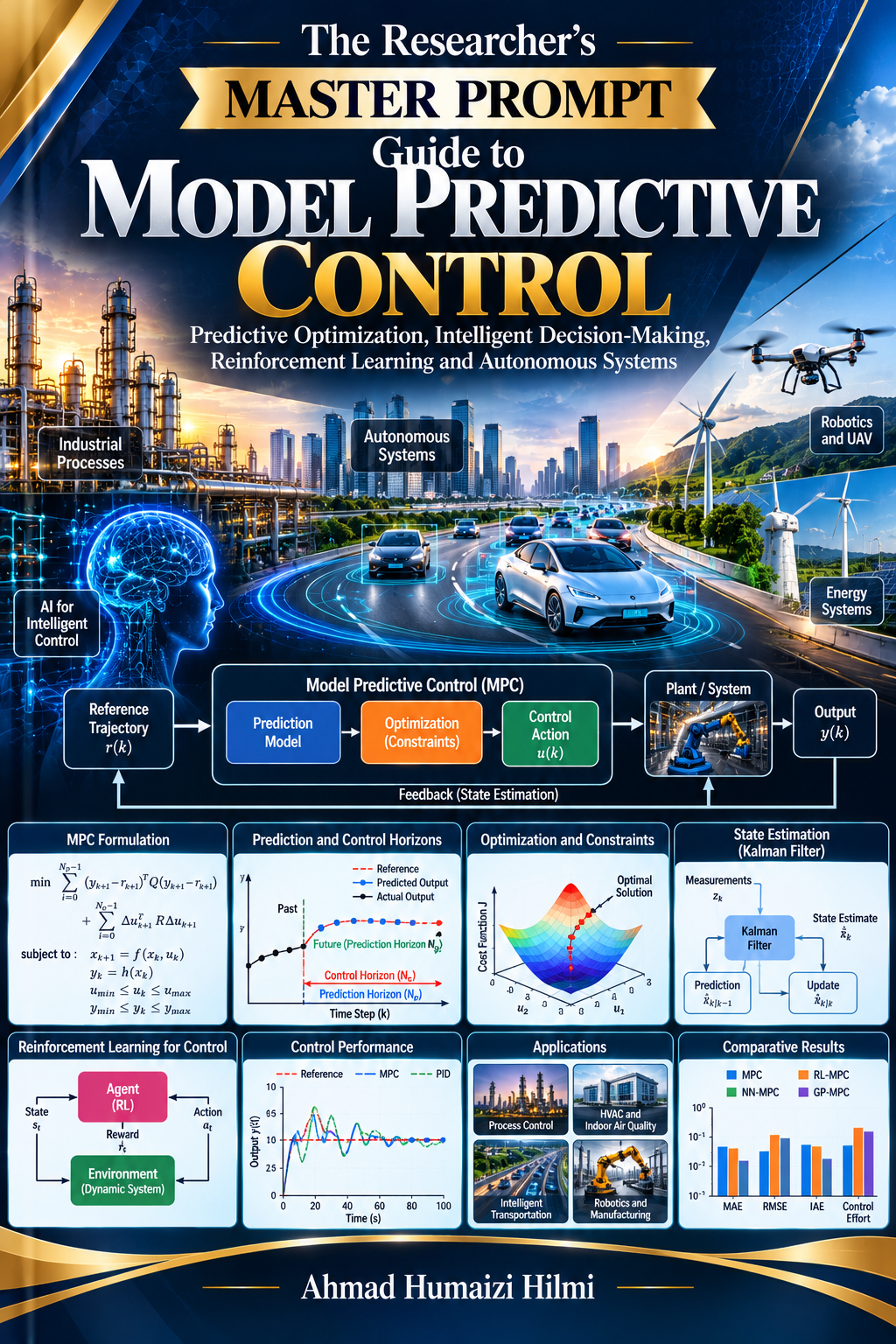
This Master Prompt addresses the integration of predictive models with optimization, feedback control, decision-making and autonomous system operation through model predictive control and related intelligent control methodologies. It guides researchers through the theoretical and mathematical foundations of model predictive control, including system dynamics, prediction horizons, control horizons, objective functions, state estimation, control constraints, optimization formulations, receding-horizon implementation and feedback correction. The theme encompasses linear and nonlinear model predictive control, robust MPC, stochastic MPC, adaptive MPC, economic MPC, learning-based MPC, data-driven MPC, neural network MPC, Gaussian process MPC, physics-informed MPC and reinforcement-learning-enhanced predictive control. Particular attention is given to prediction–optimization integration, constraint satisfaction, model mismatch, disturbance rejection, uncertainty-aware control, stability, feasibility, computational efficiency and real-time implementation. Researchers are guided in applying predictive control to chemical processes, HVAC systems, indoor air quality, energy dispatch, renewable energy systems, power converters, autonomous vehicles, quadrotors, robotic systems, industrial actuators and manufacturing equipment. The theme also examines multi-agent AI systems, large language model-assisted control design, digital twins, online model adaptation and intelligent supervisory decision-making. It emphasizes that model predictive control differs from conventional predictive modelling because its primary objective is to use model predictions to determine optimal future control actions rather than merely estimate an outcome. The framework supports rigorous simulation, benchmarking, experimental validation and assessment of operational performance.