
Gr 10 Maths Worksheets (Ages 15-16) | Level M28: Similarity, Coordinates, Data & Chance
🎓 Launch offer: 80% OFF every MathSmith workbook with code LAUNCH80 (first 1000 orders). Click Add to Cart, then enter LAUNCH80 in the discount box before you pay.
Not sure which level your child needs? Take the free 40-question placement test: https://ebooks.thecodecrafters.net/placement
See free sample pages first: https://ebooks.thecodecrafters.net/
Help your child build absolute confidence and mastery in mathematics. This comprehensive workbook from MathSmith takes a highly structured, "one-rung-at-a-time" approach to Similarity, Coordinates, Data and Chance, ensuring students fully understand concepts before moving forward.
Instead of overwhelming learners with random equations, this workbook uses a carefully scaffolded, predictable learning ladder. It is perfect for homework, structured independent study, or mastery practice.
📊 What Is Included?
1 Complete Level (Level M28)
26 Structured Sub-levels for gradual progression
148 Printable Worksheets
1,264 Total Problems for thorough practice
Full Answer Key online, unlocked by the order ID on your Payhip receipt, for quick, stress-free marking
🗺️ Curriculum Breakdown
This collection focuses deeply on mastering Similarity, Coordinates, Data and Chance through a carefully curated system:
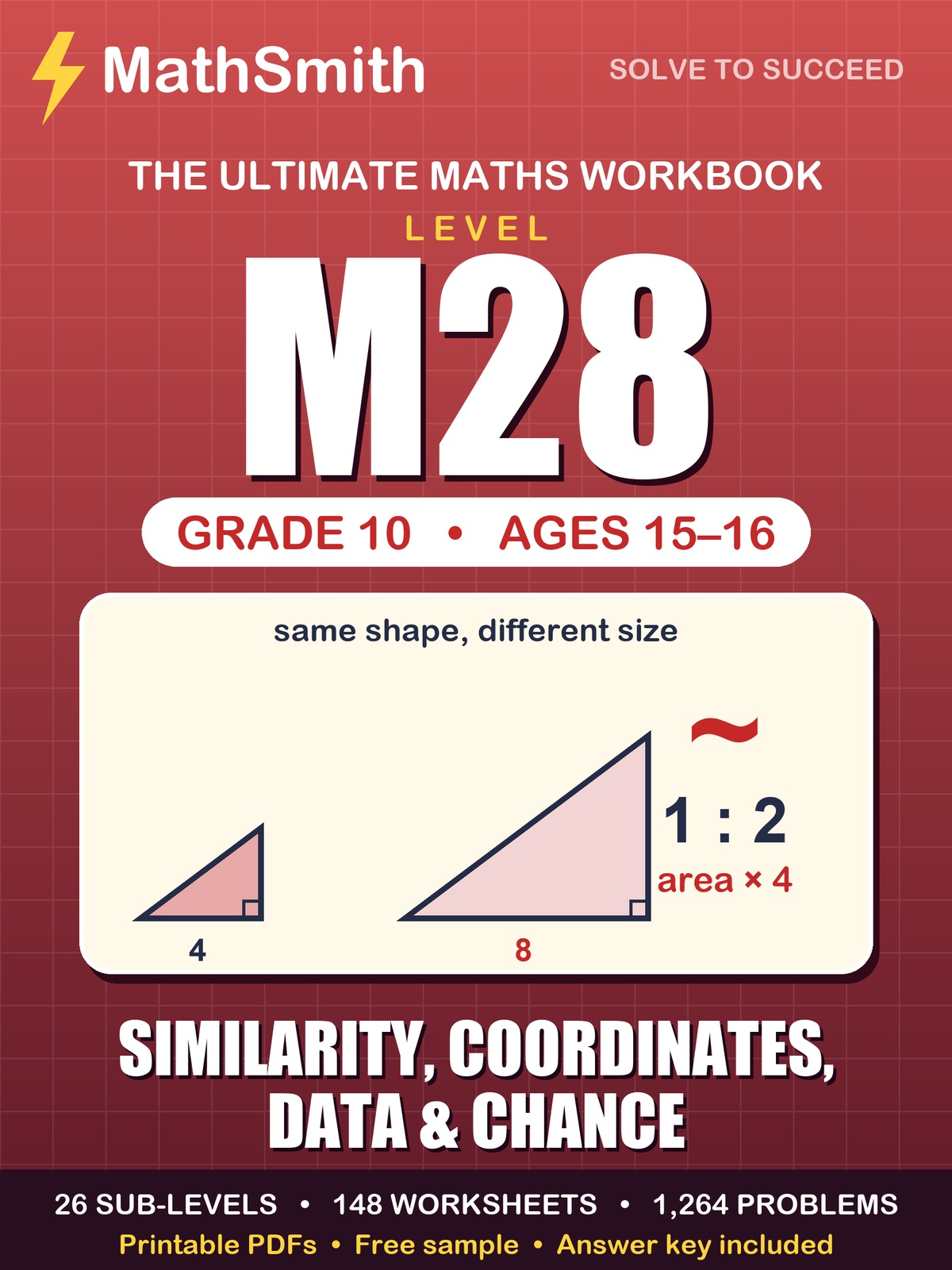
What similar means, and how the claim is written down (2 Sub-levels): Two rungs, and the second of them is the level's notation. Similar figures have equal angles and sides all in one ratio - so the pair is drawn at ONE shared scale, because a triangle twice the size has to come out twice the size or the page denies the only thing being claimed. M17's congruent pair fits each shape to its own box, which is right there and would be a lie here. Then the statement itself: `ABC ~ PQR` says A goes with P, and the same two triangles written `ABC ~ QRP` is a different claim and a false one. Nothing about the drawing changes when the order is wrong, which is exactly why it is a rung.
A line across two sides, and the ratio it cuts them in (2 Sub-levels): The basic proportionality theorem and its converse. A line parallel to one side of a triangle cuts the other two in the same ratio - the first line in this book that bounds nothing, hangs off nothing and misses every corner, so the four pieces are labelled separately and the arrowheads go on both lines because parallel is a relation and takes two. The cut is drawn at the fraction its own labels name. Read backwards it is the test for parallel, and half of those are not.
How little it takes to be sure (2 Sub-levels): AA, SSS and SAS. Two pairs of equal angles are enough and the third pair is not another fact - it is the first two added up and taken off 180 - so two arcs go on and never three. SAS needs the angle BETWEEN the two sides, which is the whole of that rule. Which rule a marking amounts to is read off the marks rather than taken on trust, and every rule gets a spec of its own rather than being sampled.
What happens to the area, which is not what happens to the sides (1 Sub-level): One rung, and it is the level's. Multiply every side by three and the area is nine times bigger, not three - and the model shows why by tiling nine copies of the small triangle inside the big one, so it is a COUNT and not a rule to remember. It is the only idea on the level that nobody guesses right, and the perimeter going up by three while the area goes up by nine is what makes it worth a page.
The right angle, and similarity at work (3 Sub-levels): Three rungs. Pythagoras is PROVED here rather than asserted - the perpendicular from the right angle cuts the triangle into two that are similar to the whole, which is the only proof of it this book gives and the reason it sits on this level. Then the converse, asked in words with no figure, because a triangle drawn to three lengths has the right angle visibly in it and the eye would settle the question before anything was squared. Then the shadow, the mirror and the plan: a height nobody can reach off a length anybody can.
Measuring between two points on the grid (5 Sub-levels): Five rungs on M21's grid, and the first thing on it that is FINITE: a line has no ends and a distance is about the bit in the middle. The distance formula is Pythagoras and the figure says so - the right triangle drawn under the join, both legs dashed because neither is a side of anything the question is about, with the square on the corner. Then three points in a row, four that make a square rather than a rhombus, the point that cuts a join in a ratio, the middle as that formula at one to one, and the area off three pairs - which comes to nought exactly when the three are in a line.
The mean of a table, three ways to the same number (3 Sub-levels): M25 said what grouping COSTS: once thirty readings have become five counts the readings cannot be got back, so a grouped mean is an estimate and the level says so. These three rungs are three routes to it - every reading taken at its class mark, then counted from a mark in the middle, then with the class width divided out as well. All three give the SAME number every time, which is the point: nothing has been approximated, the arithmetic has been made smaller.
The two averages that are read off the table, and the curve (4 Sub-levels): Mode and median are not added up - they are found inside the class that holds them, which is why each has a class to find first. The modal class is a clear winner on every sheet here, because a table with two tied for the top is a question with two right answers. Then the running total, and the OGIVE - plotted at the class BOUNDARIES where M25's frequency polygon plots at the marks. Same table, same ink, dots half a class apart, and a curve plotted at the marks rises through plausible numbers and reads a median half a class width out.
A count over a count, and what has to be true first (4 Sub-levels): Four rungs to close the level. A probability is the number of ways an event can happen over the number of outcomes - but only when those outcomes are EQUALLY LIKELY, which is the condition nobody states and the whole of the difficulty. Two coins have three possible numbers of heads and four equally likely outcomes, and a child who writes a third for one head has made no arithmetic mistake anywhere. Coins, dice and cards are the three whose outcomes can actually be listed; two dice are the real work, because the answer counts thirty-six ORDERED pairs and not eleven totals.
🎯 Who Is This For?
Parents looking to provide structured math support at home.
Homeschoolers searching for a sequential curriculum to guarantee zero gaps in math skills.
Teachers & Tutors looking for bite-sized, scaffolded printables for classroom morning work or targeted intervention.
📖 How To Use This Workbook
Print the workbook, read each rung's method page, and let your child work inside the printed frame. Then check the answers your way: in the printable answer-key PDF included in this download, or online, one page at a time, with the order ID on your Payhip receipt (valid for six months). Please keep the answer key for the adult marking the work and do not share it with your child: the workbook only works if they have worked each answer out for themselves.
Step-by-step manual and video guide: https://ebooks.thecodecrafters.net/manual/
Check the answers: https://ebooks.thecodecrafters.net/answers
⚙️ Digital Delivery Details
Format: four instant-download PDFs (free sample, sample answers, workbook, full answer key). The answer key is also available online.
Print Ready: Easily printable on home or school printers.
Usage: Licensed for individual family or single-classroom use.