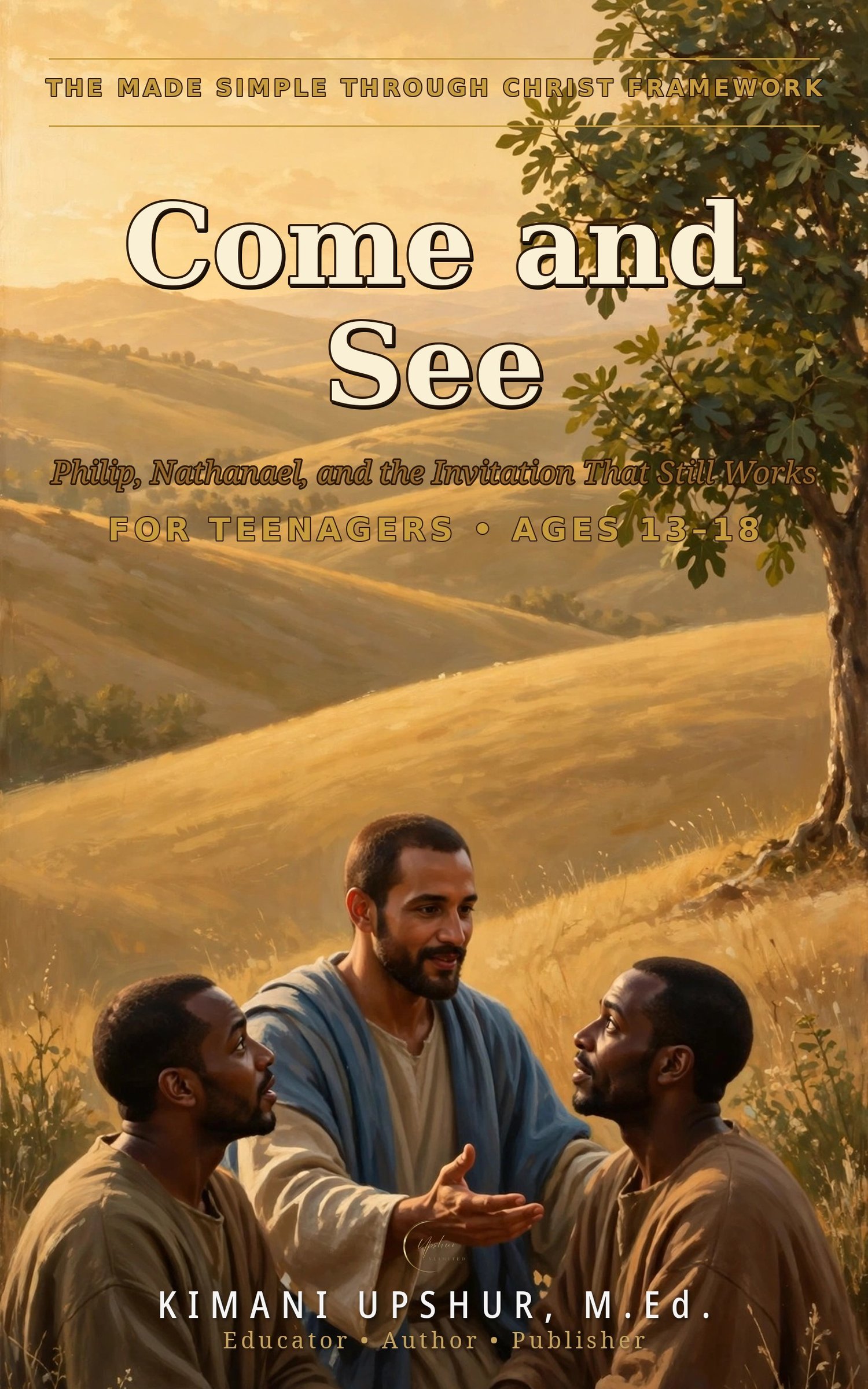
Come and See
Nobody in this story argues anybody into believing. Jesus never holds a debate, and none of His first followers wins a convert with a clever argument. What they do is simpler, and it is harder to resist: 'Come and see.'
Come and See: Philip, Nathanael, and the Invitation That Still Works walks John 1:43–51 in order across twelve chapters, beginning before the invitation — with Andrew, who was himself brought before he ever brought (John 1:40–42). The call itself is two words: 'Follow me' (1:43). Philip carries the claim to Nathanael — 'him, of whom Moses in the law, and the prophets, did write' (1:45) — and Nathanael answers with honest skepticism, not contempt: 'Can there any good thing come out of Nazareth?' The book takes that skepticism seriously; it is not contempt (John 7:52; 6:42). Philip does not argue — he invites (1:46). Jesus receives the skeptic and names what He sees: 'an Israelite indeed, in whom is no guile' (1:47), and Nathanael's question 'Whence knowest thou me?' opens onto the fig tree (1:48) — a scene John deliberately never explains, the hidden place God already saw. Nathanael's confession, 'Rabbi, thou art the Son of God,' and the Lord's closing promise — 'greater things than these,' Jacob's ladder with its traffic open between heaven and earth (1:51; Genesis 28:12) — complete the arc: how a teenager invites a skeptical friend the same way today — witness, not debate, with the promise held at its true size (2 Corinthians 5:20).
Every Scripture quotation is word-for-word from the King James Version (KJV). The book closes with a personal invitation to give your life to Jesus. For teenagers ages 13-18.
Written from a Christian worldview — Scripture first.
More from Kimani Upshur: https://upshurunlimitedllc.com