
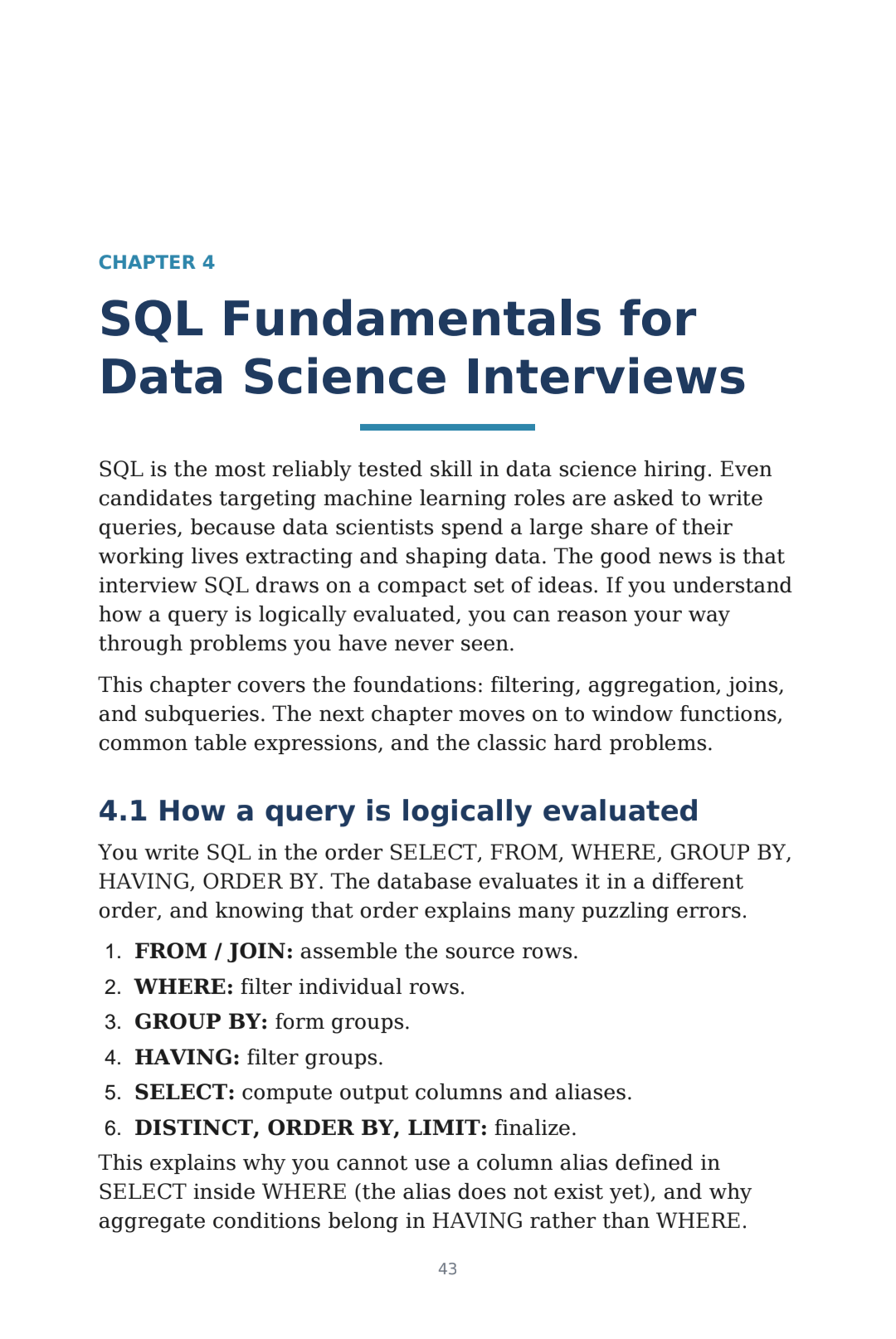
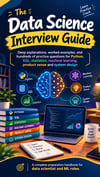
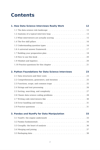
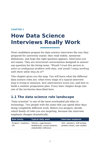
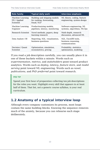
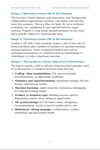
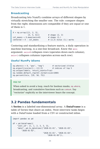

📘🧠 The Ultimate Data Science Interview Guide 🚀 | Deep Explanations, Worked Examples & Hundreds of Practice Questions for Python 🐍, SQL 💾, Statistics 📊, Machine Learning 🤖, Product Sense 💡 & System Design 🏗️ | Complete Preparation Handbook for Data Scienti
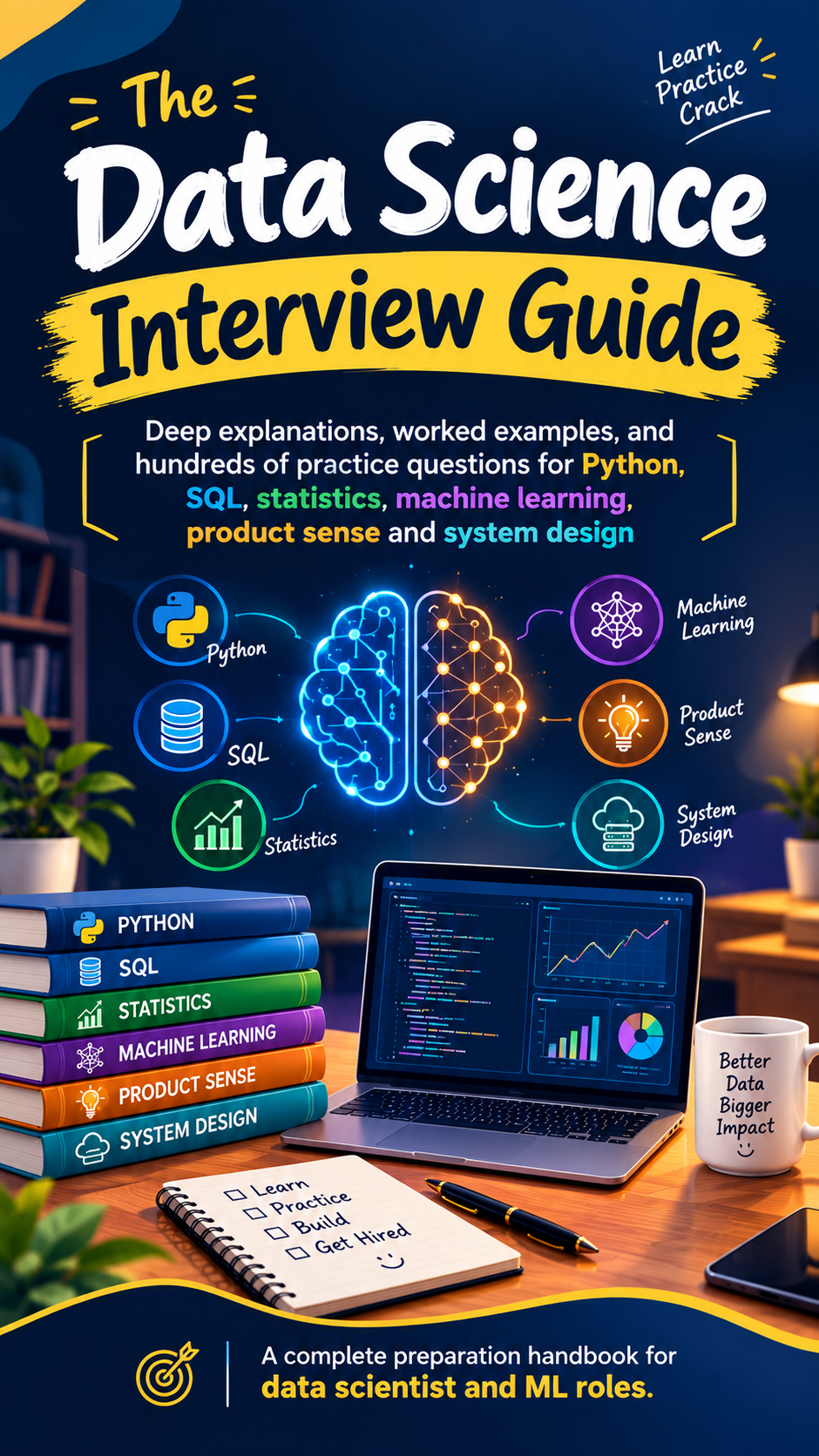
📘 The Data Science Interview Guide 🚀
Your complete preparation handbook for Data Scientist and Machine Learning interviews. 🧠📊💻
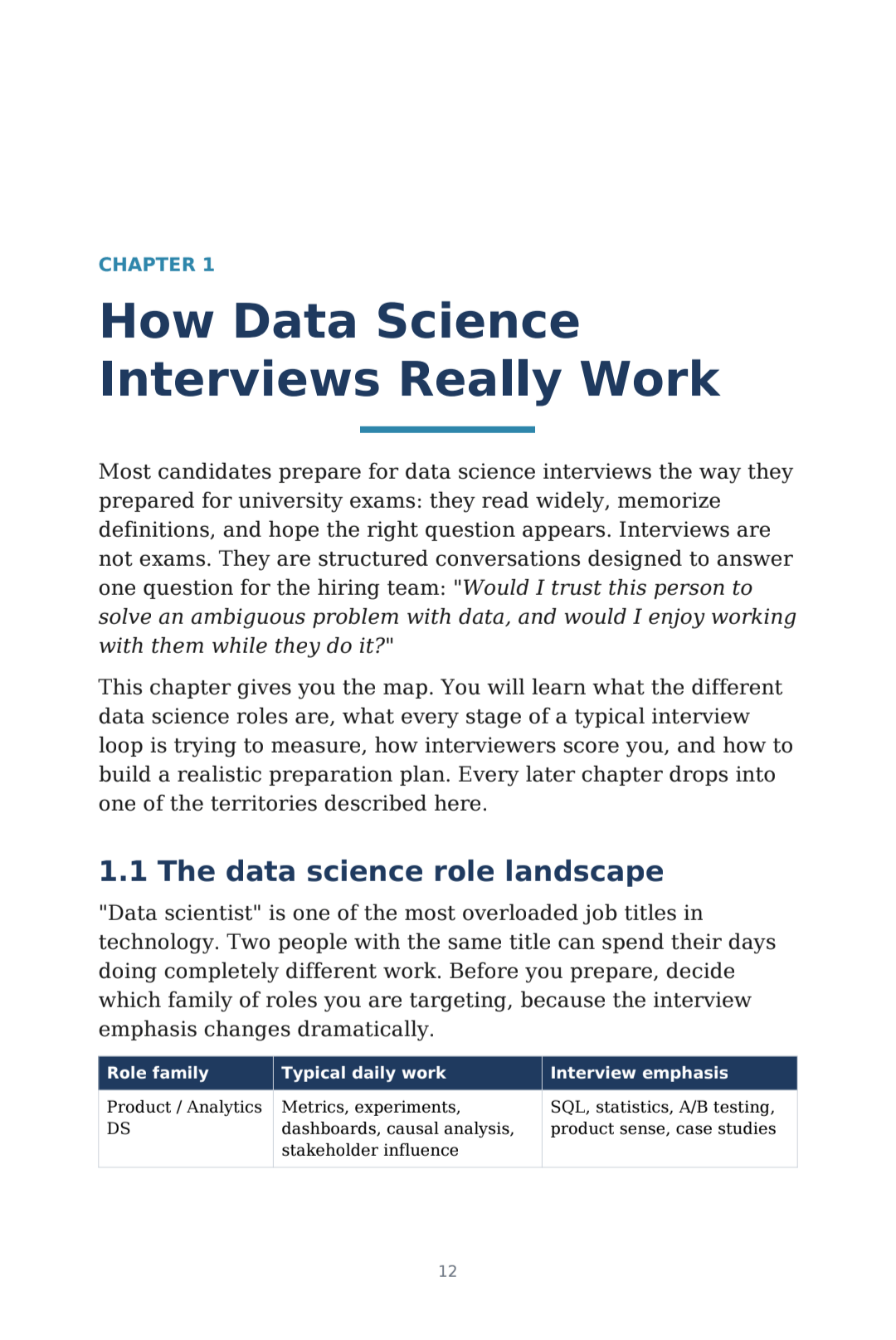
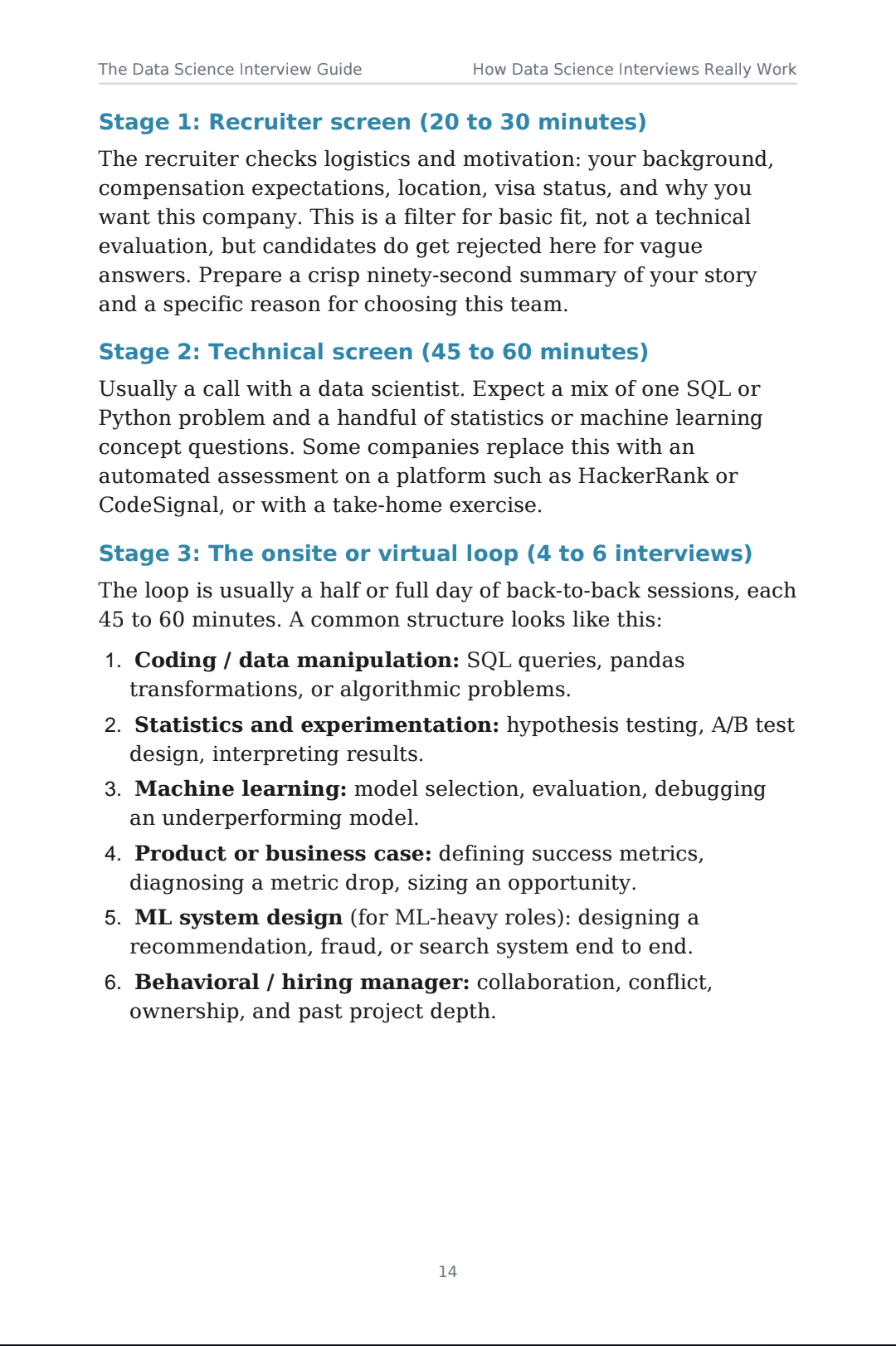
Breaking into data science and machine learning can feel overwhelming. Interviews often test much more than just coding—they require strong foundations in Python, SQL, statistics, machine learning, product sense, experimentation, problem-solving, and system design. 🎯
The Data Science Interview Guide is designed to bring all of these essential skills together in one practical, structured, and interview-focused handbook. Whether you are preparing for your first data science interview, switching into a data-focused career, strengthening your technical foundations, or aiming for challenging Data Scientist, ML Engineer, or Machine Learning roles, this guide provides a comprehensive path for preparation. 🚀
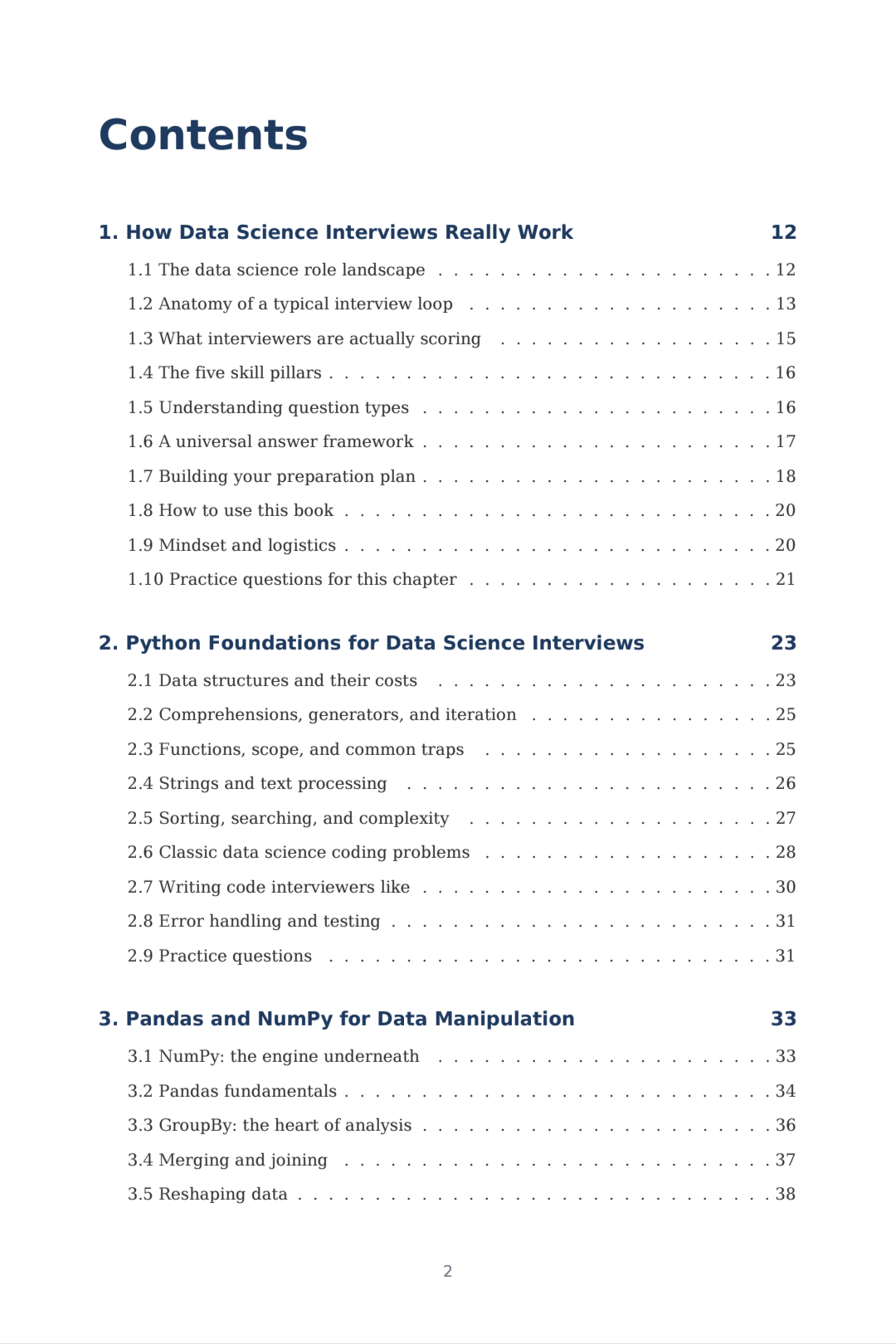
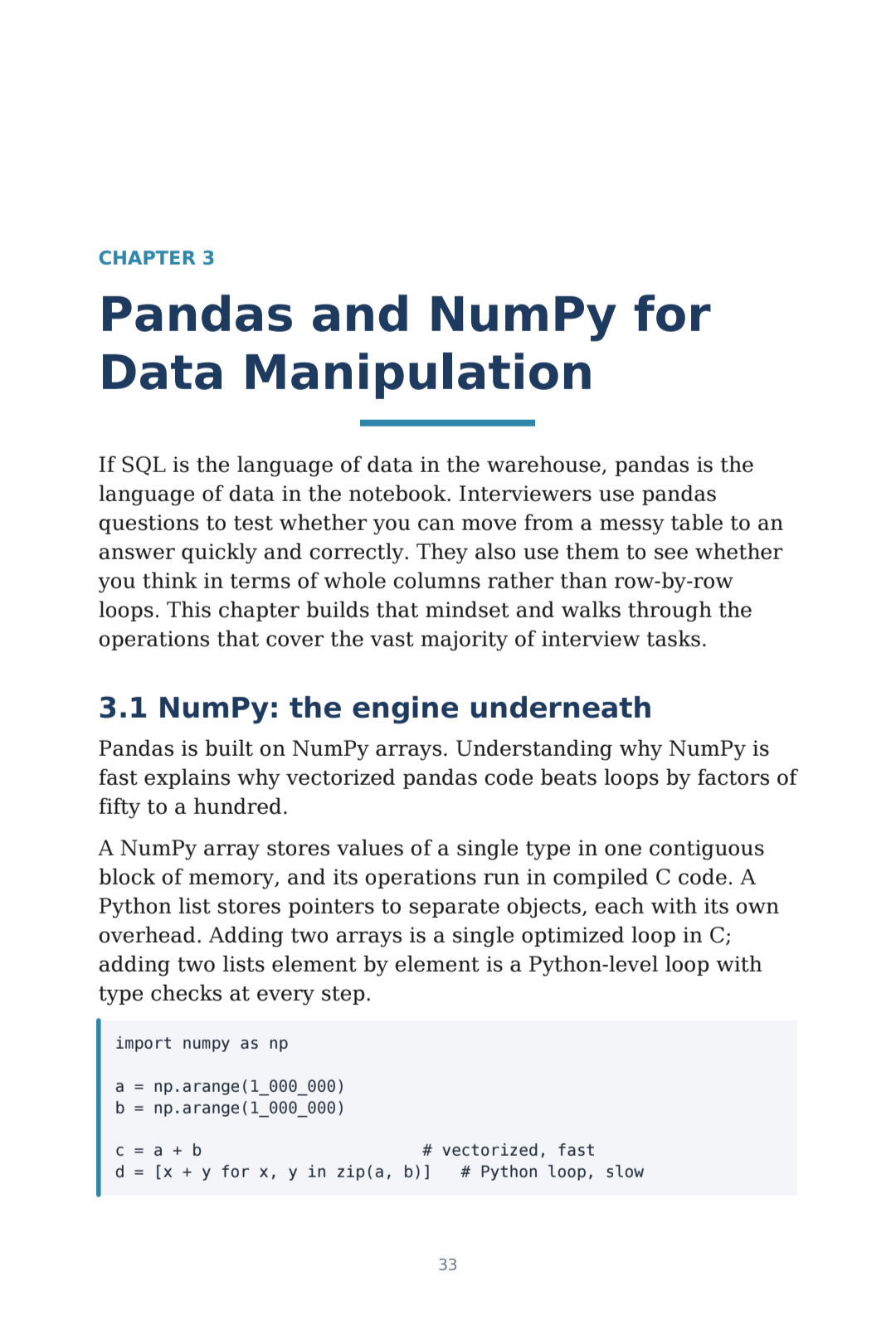
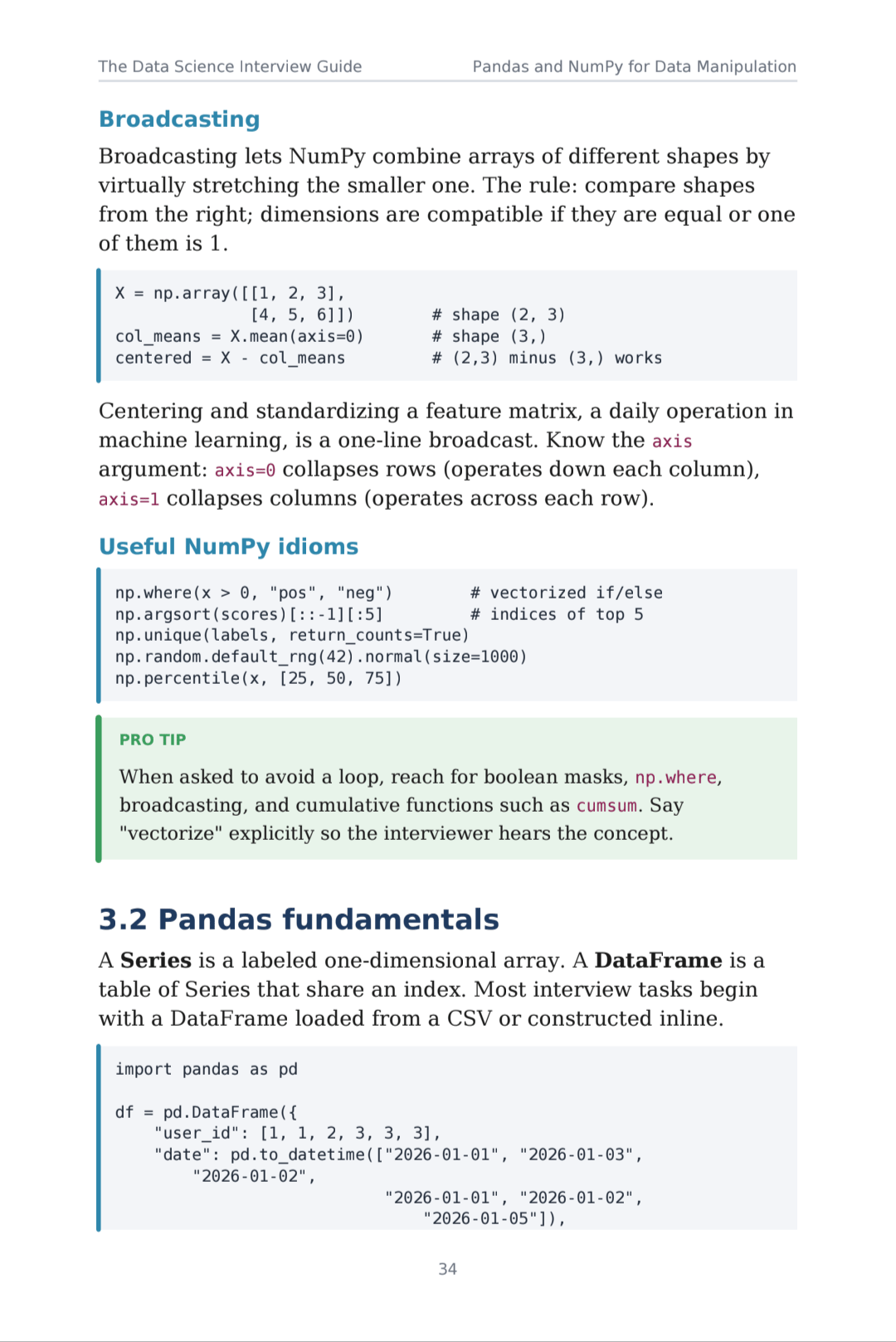
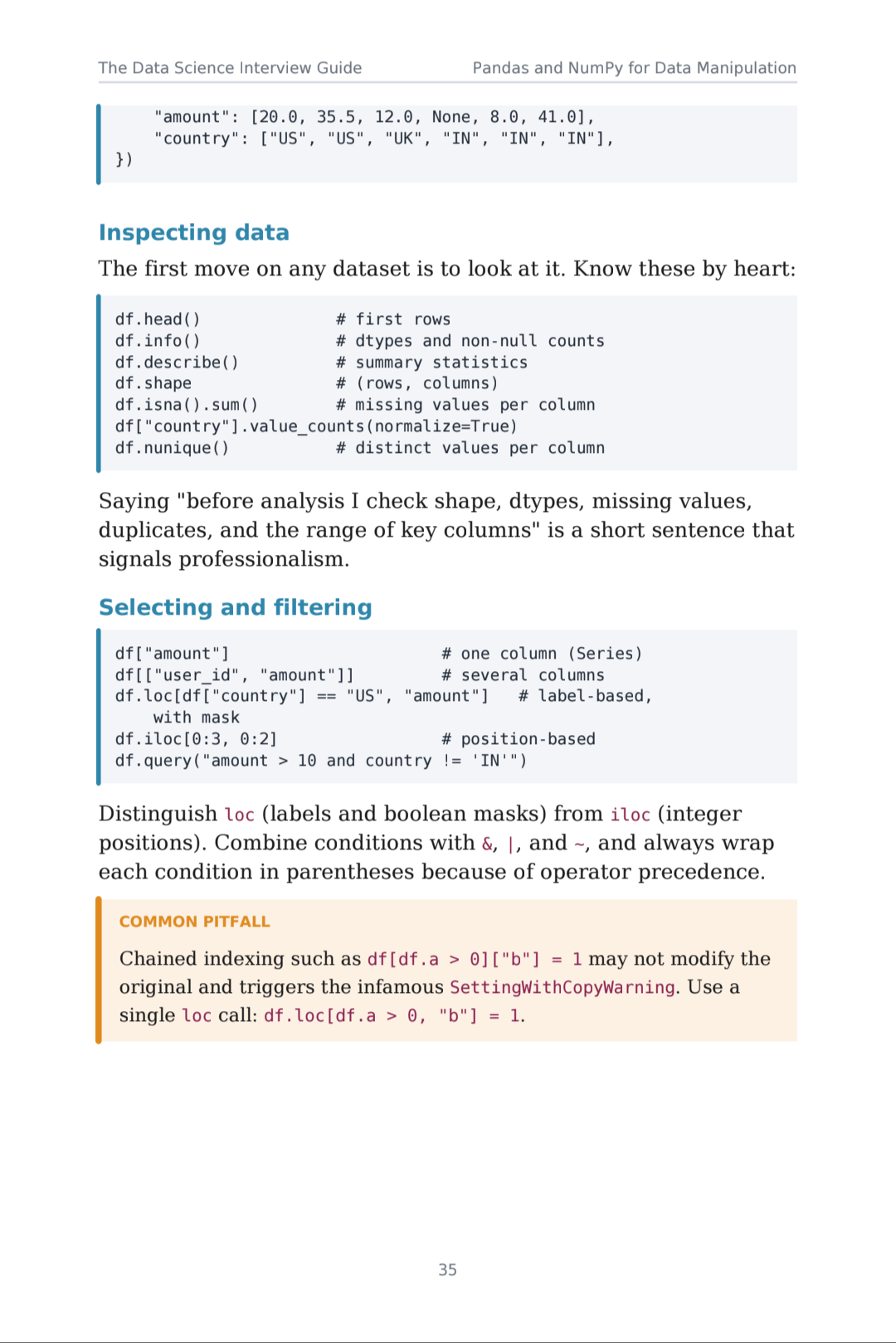
🐍 Master Python for Data Science
Build a strong Python foundation with clear explanations and practical examples covering the concepts frequently tested in technical interviews.
You’ll explore:
🔹 Python fundamentals and syntax
🔹 Data types and data structures
🔹 Lists, tuples, sets, and dictionaries
🔹 Strings and string manipulation
🔹 Functions and lambda expressions
🔹 Object-oriented programming
🔹 Iterators and generators
🔹 Exception handling
🔹 File handling
🔹 List and dictionary comprehensions
🔹 Python interview problems
🔹 Coding patterns and problem-solving techniques
The goal is not simply to memorize Python syntax, but to understand how and why Python concepts work and how to apply them when solving real interview problems. 💡
🗄️ Build Strong SQL Skills
SQL is one of the most important skills for data-focused roles. This guide takes you from fundamental queries to advanced analytical techniques.
Learn and practice:
🔹 SELECT, WHERE, ORDER BY and GROUP BY
🔹 Aggregate functions
🔹 JOINs and subqueries
🔹 CASE statements
🔹 Common Table Expressions (CTEs)
🔹 Window functions
🔹 Ranking and analytical queries
🔹 Date and time operations
🔹 Data filtering and transformation
🔹 Duplicate and missing-data problems
🔹 Business-oriented SQL questions
🔹 Real-world analytical scenarios
You’ll learn how to approach SQL questions logically rather than relying on memorized query patterns. 🧩📈
📊 Understand Statistics
A strong understanding of statistics is essential for making reliable conclusions from data.
This guide covers important statistical concepts such as:
📌 Descriptive statistics
📌 Mean, median, mode and variance
📌 Probability fundamentals
📌 Probability distributions
📌 Sampling
📌 Confidence intervals
📌 Hypothesis testing
📌 p-values
📌 Statistical significance
📌 Correlation and covariance
📌 Regression fundamentals
📌 A/B testing
📌 Experimental design
Each topic is presented with practical explanations and worked examples so you can connect statistical theory with the kinds of problems you may encounter during interviews. 🔬📐
🤖 Master Machine Learning Concepts
Machine learning interviews can range from fundamental concepts to deep discussions about model selection, evaluation, and real-world implementation.
Explore:
🧠 Supervised and unsupervised learning
📈 Linear and logistic regression
🌳 Decision trees and ensemble methods
🔍 Classification and regression
🎯 Clustering techniques
⚙️ Feature engineering
📏 Model evaluation metrics
🔄 Cross-validation
⚠️ Overfitting and underfitting
🧹 Data preprocessing
🎛️ Hyperparameter tuning
📉 Bias-variance tradeoff
🚀 Model improvement strategies
You’ll also learn how to reason about why a model may perform poorly, how to diagnose problems, and what steps you can take to improve it.
💡 Develop Product Sense
Data scientists are often expected to think beyond models and metrics.
Strong product sense means understanding:
🎯 What problem are we solving?
👥 Who are the users?
📊 Which metrics matter?
🔎 How should success be measured?
🧪 How should an experiment be designed?
⚖️ What trade-offs should be considered?
💰 How could a data-driven decision affect the business?
This guide introduces practical frameworks for answering product and business-focused interview questions while connecting analytical thinking with real-world decision-making. 🚀📱
🏗️ Learn Data & ML System Design
For experienced Data Scientist and ML candidates, interviews may involve designing scalable data or machine learning systems.
Learn how to think about:
🏗️ System architecture
📥 Data collection and ingestion
🔄 Data pipelines
🗃️ Data storage
⚡ Batch and real-time processing
🤖 Machine learning pipelines
📡 Model serving
📊 Monitoring and evaluation
🔁 Retraining strategies
📈 Scalability and reliability
⚖️ System trade-offs
Instead of memorizing architectures, the focus is on developing a structured way to break down complex system-design problems into manageable components.
📝 Worked Examples & Practice Questions
Understanding a concept is only the beginning. Interview success also requires practice. 💪
Throughout the guide, you’ll find worked examples, practical scenarios, interview-style problems, and hundreds of practice questions designed to help you test your understanding.
Use the questions to:
✅ Identify knowledge gaps
✅ Improve problem-solving speed
✅ Practice explaining your reasoning
✅ Strengthen technical fundamentals
✅ Become comfortable with unfamiliar problems
✅ Prepare for different interview formats
🎯 Designed for Interview Preparation
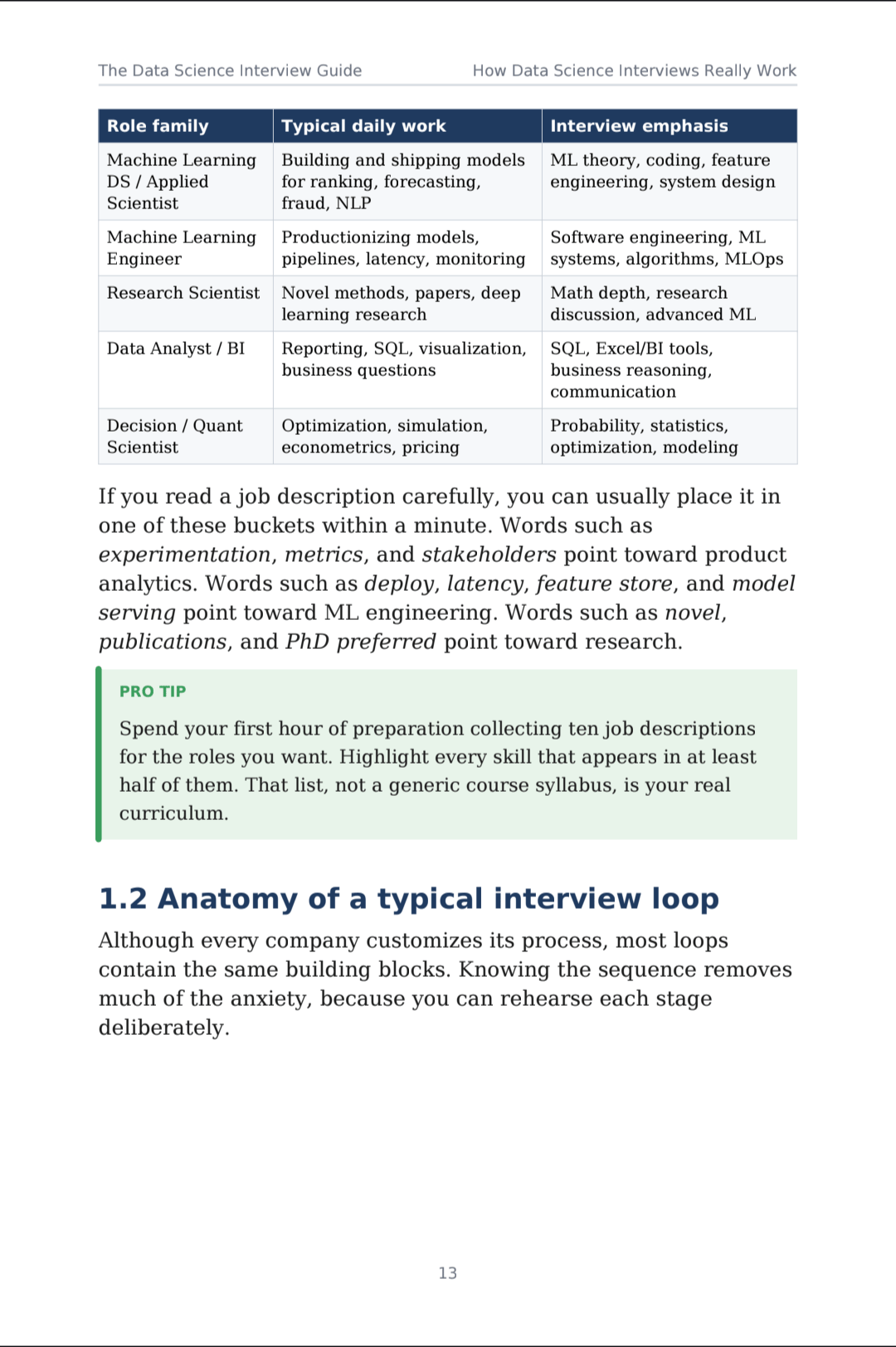
This book is especially useful for:
👨💻 Aspiring Data Scientists
🤖 Machine Learning Engineers
📊 Data Analysts transitioning into Data Science
🎓 Students and recent graduates
🔄 Professionals transitioning into data careers
💼 Experienced candidates preparing for technical interviews
🚀 Anyone looking to strengthen their data science interview skills
🧠 Learn the Concepts. Practice the Problems. Crack the Interview.
Data science interviews are rarely about knowing one perfect answer. They are about demonstrating structured thinking, technical knowledge, analytical reasoning, communication, and the ability to solve unfamiliar problems.
This guide is built to help you develop those skills step by step.
From writing your first Python solution 🐍 to solving complex SQL problems 🗄️, reasoning about statistical experiments 📊, choosing and evaluating machine learning models 🤖, thinking through product decisions 💡, and designing scalable ML systems 🏗️—this handbook brings the major areas of data science interview preparation together in one place.
🚀 Your Data Science Interview Journey Starts Here.
Learn deeply. Practice consistently. Think analytically. Solve confidently.
📘 The Data Science Interview Guide
Deep explanations • Worked examples • Hundreds of practice questions
🐍 Python | 🗄️ SQL | 📊 Statistics | 🤖 Machine Learning | 💡 Product Sense | 🏗️ System Design
A complete preparation handbook for Data Scientist and ML roles. 🎯