

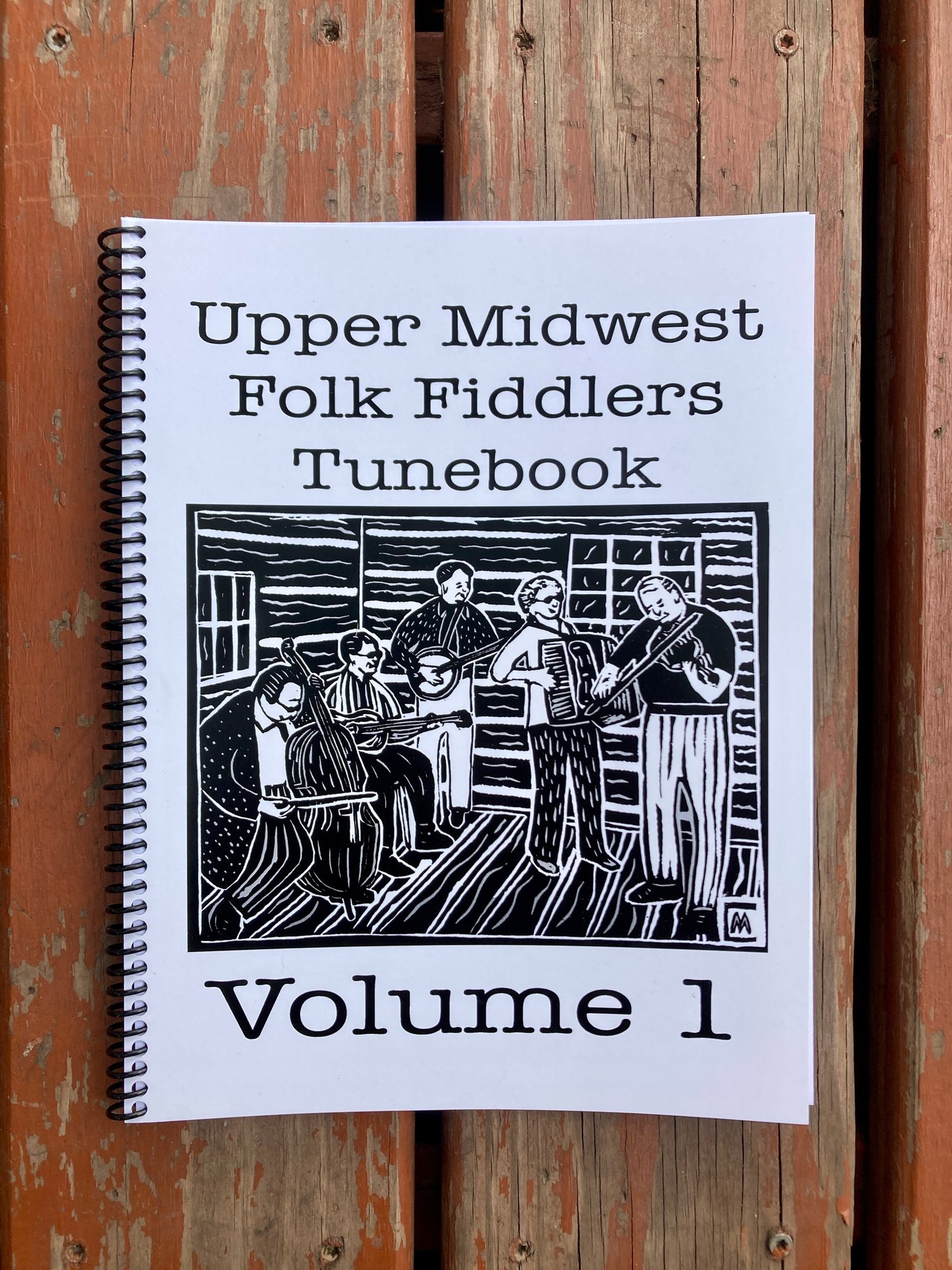
Upper Midwest Folk Fiddlers Tunebook- Volume 1
This book is the culmination of Clawhammer Mike’s years of research into the historical fiddle tunes of the Upper Midwest. The Upper Midwest Fiddlers Tunebook includes 137 tunes that were mostly played by Scandinavian immigrants who came to the Upper Midwest. Most of these tunes were passed down generationally over the past 150 years.
Free shipping in USA.
For those of you who use Strum Machine to play along with, here is a link to the back-up chords for all the songs-
Intro from Clawhammer Mike:
This tunebook is an incomplete look at the what the traditional fiddle music of the early pioneers in the Upper Midwest were playing. This volume is heavy skewed to the music that Nordic immigrants played, with the knowledge that a plethora of different cultures and ethnicities played traditional music in the Upper Midwest. I have concentrated mostly on Scandinavian-American fiddle music for a variety of different reasons, but make no mistake, this is just the start of our story. My aim is for the rich history of ethnic traditional music in the Upper Midwest to be reclaimed and relearned by current Upper Midwest musicians with a pride you see in other areas of the country like Appalachia.
As in other parts of the country, I would dare to say that Upper Midwest began to have it’s own dialect of traditional music in the early to mid 1900’s. Jams would have Norwegian schottisches, Irish jigs, Me’tis style Canadian two-steps, German polkas... all played with a similar Upper Midwestern sound. I had my epiphany on this subject when I was listening to an Irish-Minnesotan fiddler recording from the 1950’s compared to a Norwegian-Minnesotan fiddler in the 1950’s. The Norwegian fiddler played Irish tunes and the Irish fiddler played Norwegian tunes and they all had this distinctive Upper Midwest sound. I am only an unschooled, amateur, musicologist, so I can’t give you an educated answer on what defines this sound, but I will give it a try: The tunes are flatter and simpler than traced back to the home countries, with more American drive. A lot of simple tunes with less ornamentation, while still keeping a little lilt. Of course, this is an over-simplification, but it gets at my main point- Your grandmas old tunes are not something you should be ashamed of, but celebrated and taught to the children again for their historical value.
Lets teach this music again in schools. Music that actually was played under our feet 150 years ago. Long before the television and the radio, fiddlers and accordions entertained the entire Upper Midwest. Small towns in Wisconsin would sometimes have more than 20 good dance fiddlers within walking distance. You could find a dance in some central Minnesotan towns most Saturday nights when it wasn’t to cold.
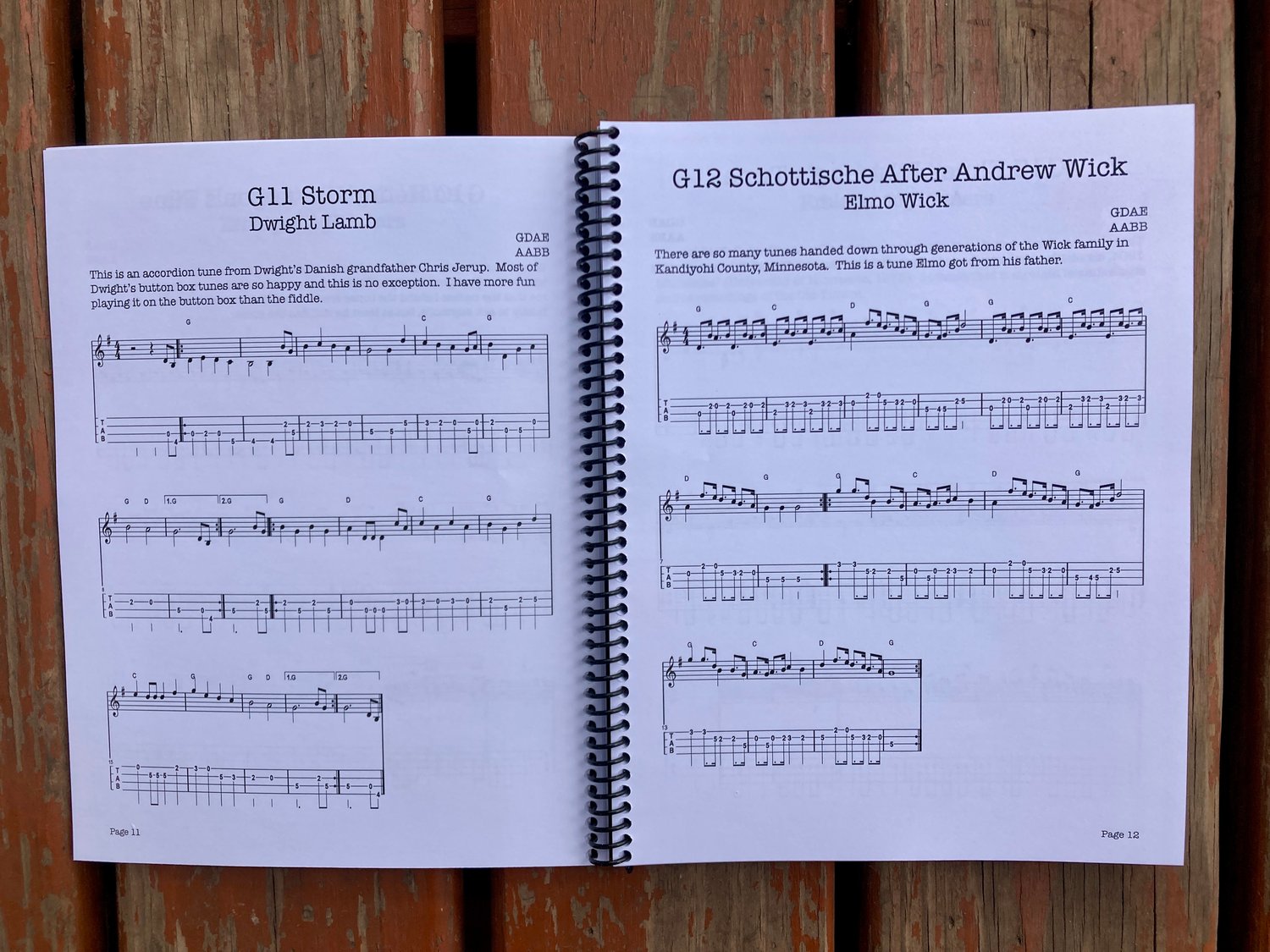
This first volume contains a lot of the tunes that my learners group, Upper Midwest Folk Fiddlers play at our week jams, (during non-Covid times). A lot of them are my own transcriptions from home recordings of the old fiddlers. I like to concentrate on tunes from fiddlers who learned their tunes from older fiddlers in the area, putting many of these tunes back into the 1800’s.
Also included are many tune transcriptions from Elmo Wick’s self-published tunebook of tunes from his family and friends in central Minnesota- Norwegian Emmigrants Old-Time Dance Music for Fiddle. Elmo Wick started the Minnesota State Fiddle Association. In recent years the MSFA has started to share and promote the catalogue of transcriptions Elmo had left them. The MSFA has graciously let me use some of that material here.
This tunebook is meant for folks coming together to jam and play together. I have erred on the side of simplicity in the transcriptions and have kept the music in three easier keys
(A, D and G) for maximum playability. The spirit of this tunebook is the same that we have fostered at Upper Midwest Folk Fiddler gatherings- We welcome folks to the circle. We want this music to grow and people to learn the mostly lost traditional music of our region.