
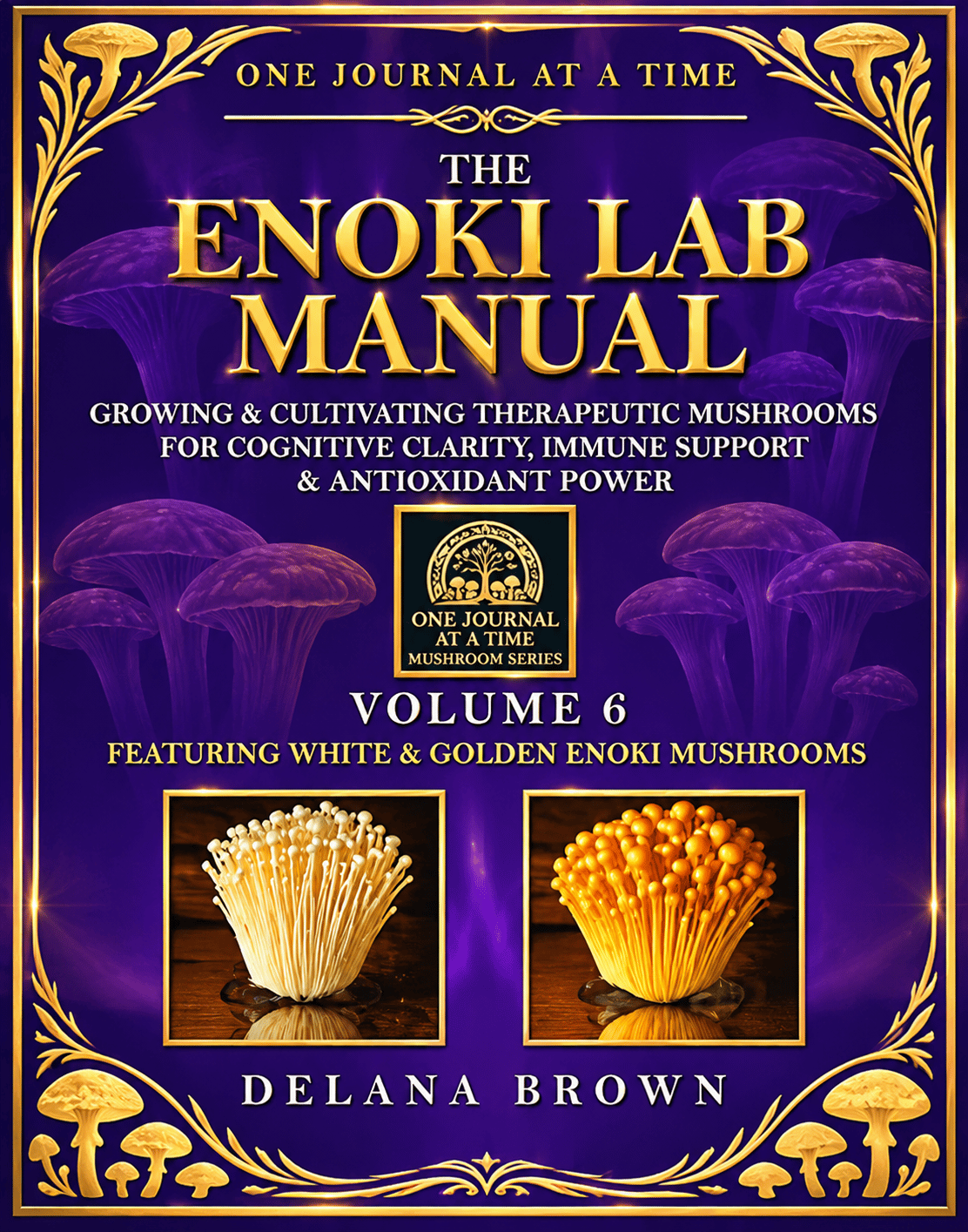

The Enoki Lab Manual: Growing & Cultivating Therapeutic Mushrooms for Cognitive Clarity, Immune Support & Antioxidant Power Featuring White & Golden Enoki Mushrooms
THE ENOKI LAB MANUAL — VOLUME 6
Growing & Cultivating Therapeutic Mushrooms for Cognitive Clarity, Immune Support & Antioxidant Power
Featuring White & Golden Enoki Mushrooms
One Journal at a Time — Mushroom Cultivation, Functional Fungi & Human Biology Series
By DeLana K. Brown | Wholesome Harvest Mushrooms LLC
MORE THAN A CULTIVATION MANUAL — DISCOVER THE SCIENCE BEHIND ENOKI MUSHROOMS
What if growing mushrooms could become a gateway to understanding genetics, cellular biology, nutrition, and the fascinating chemical relationship between fungi and the human body?
The Enoki Lab Manual — Volume 6 is a comprehensive, 260-page scientific cultivation guide and interactive laboratory journal dedicated to White and Golden Enoki mushrooms (Flammulina velutipes).
Part laboratory manual, part mushroom science reference, and part wellness journal, this volume takes readers beyond ordinary mushroom cultivation.
It explores not only how to cultivate Enoki mushrooms, but also how their genetics, growing environments, and naturally occurring compounds connect with modern research into human physiology.
From the laboratory to the kitchen, readers are invited to explore the science behind Enoki's distinctive biology and its potential applications in nutrition and functional food development.
This is not simply about growing mushrooms. It's about understanding the extraordinary biology behind what you grow.
1. MASTER WHITE, GOLDEN & WILD ENOKI CULTIVATION
Enoki mushrooms are among the most fascinating cultivated fungi because their appearance and development can change dramatically depending on genetics and growing conditions.
The Enoki Lab Manual introduces readers to the scientific principles behind cultivating these remarkable mushrooms.
DISCOVER:
• The Enoki life cycle, fungal anatomy, and mycelial development.
• Laboratory preparation and sterile cultivation techniques.
• Culture propagation, strain selection, and genetic variation.
• Substrate formulation and nutritional requirements.
• Grain spawn preparation and colonization.
• Temperature, humidity, lighting, and environmental management.
• Carbon dioxide control and its relationship to Enoki morphology.
• Fruiting conditions and developmental differences between cultivated and wild forms.
• Contamination prevention and troubleshooting.
• Harvesting, preservation, and post-harvest handling.
• Cultivation schedules, environmental charts, and experimental tracking.
Learn how environmental conditions influence mushroom structure, appearance, and development while building practical laboratory and cultivation skills.
2. FUNGAL GENETICS, STRAIN SELECTION & PHENOTYPIC EXPRESSION
Why do some Enoki mushrooms develop long, slender white stems while others display shorter stems and golden-brown caps?
The answer involves genetics, environmental conditions, and the biological processes controlling fungal development.
This volume introduces readers to:
• Genetic differences between Enoki strains.
• Strain selection and cultivation characteristics.
• Phenotypic expression and environmental influences.
• Mushroom morphology and developmental biology.
• How lighting, temperature, and carbon dioxide influence fruiting-body characteristics.
• The importance of consistent growing conditions.
• The relationship between cultivation variables and mushroom quality.
These concepts help readers understand why successful cultivation requires more than following a recipe—it requires understanding the organism.
3. THE BIOACTIVE COMPOUNDS OF ENOKI MUSHROOMS
Enoki mushrooms contain a fascinating diversity of nutritional and biologically active substances.
The Enoki Lab Manual explores compounds associated with Enoki and their relevance to ongoing scientific research.
COMPOUNDS DISCUSSED INCLUDE:
Flammutoxin: A protein associated with Flammulina velutipes that has been studied for its biological activity, including effects on cell membranes. Its presence is also relevant to understanding why Enoki must be properly cooked.
Proflamin: A protein-associated fraction investigated in experimental research for its biological activity.
Ergothioneine: A naturally occurring antioxidant studied for its role in cellular protection and oxidative stress.
Beta-Glucans: Complex fungal polysaccharides investigated for their interactions with immune recognition and signaling pathways.
Other Fungal Metabolites: Naturally occurring substances contributing to Enoki's chemical diversity and nutritional characteristics.
The goal is to help readers understand not only the names of these compounds, but also why their chemical structures, biological activities, and preparation methods matter.
4. HUMAN BIOLOGY — HOW ENOKI COMPOUNDS INTERACT WITH YOUR BODY
This is one of the most important distinctions of the One Journal at a Time series.
Many mushroom books discuss compounds without explaining the human biological systems involved.
The Enoki Lab Manual connects fungal chemistry with the science of human physiology.
EXPLORE THE BIOLOGY OF:
THE IMMUNE SYSTEM
Learn how researchers investigate fungal polysaccharides and their interactions with immune recognition, cellular signaling, and inflammatory pathways.
THE NERVOUS SYSTEM
Explore the biological foundations of cognitive function, including neurons, cellular communication, oxidative stress, and the scientific questions surrounding mushroom-derived compounds.
THE GUT MICROBIOME
Discover why scientists study the relationship between dietary fungal carbohydrates, intestinal microorganisms, and the digestive environment.
CELLULAR PROTECTION
Understand the role of antioxidant defenses and why compounds such as ergothioneine are investigated in relation to oxidative stress.
DIGESTION & METABOLISM
Explore how food-derived substances are processed by the body and why digestion, absorption, and metabolism matter when interpreting research.
INFLAMMATORY SIGNALING
Examine the biological pathways involved in immune responses and the difference between normal inflammation and chronic inflammatory processes.
Readers are encouraged to distinguish between laboratory experiments, animal research, and effects established in human clinical studies.
Understanding what a mushroom contains is only the beginning. Understanding how the body responds is where scientific discovery becomes meaningful.
5. FROM SUBSTRATE TO SUPPLEMENT — EXTRACTIONS & PREPARATIONS
The Enoki Lab Manual also introduces the relationship between mushroom cultivation, preparation methods, and fungal chemistry.
LEARN ABOUT:
• Mushroom drying and preservation.
• The principles of hot-water extraction.
• Alcohol extraction and tincture preparation.
• Dual-extraction concepts.
• Mushroom teas and culinary infusions.
• How different preparation methods affect the chemical constituents present.
• The importance of product consistency, safe handling, and appropriate storage.
• Why whole mushrooms, powders, and extracts are not necessarily chemically equivalent.
The book encourages readers to consider both the scientific principles and safety considerations involved in mushroom preparations.
6. DEAR DOCTOR — CONNECTING MUSHROOM SCIENCE WITH HEALTHCARE
The One Journal at a Time series emphasizes informed wellness education and thoughtful communication with healthcare professionals.
The Dear Doctor approach encourages readers to develop meaningful questions about functional mushrooms, nutrition, and emerging research.
TOPICS INCLUDE:
• Discussing mushroom-derived compounds and scientific evidence.
• Understanding potential supplement and medication interactions.
• Asking about contraindications and individual health considerations.
• Distinguishing dietary mushrooms from concentrated extracts.
• Understanding the difference between experimental research and established clinical treatments.
• Organizing personal wellness observations and questions.
The purpose is to support informed healthcare conversations—not to replace medical evaluation or prescribed treatment.
7. YOUR INTERACTIVE ENOKI LABORATORY & WELLNESS JOURNAL
Unlike conventional cultivation manuals, The Enoki Lab Manual incorporates structured journaling and practical tracking tools.
INSIDE YOU'LL FIND:
• Strain identification and cultivation notes.
• Substrate formulation records.
• Spawn-run and colonization logs.
• Fruiting-condition trackers.
• Environmental monitoring charts.
• Yield measurements and harvest records.
• Extraction and preparation notes.
• Personal wellness tracking.
• Guided reflections on energy, mood, immune wellness, and cognitive clarity.
These tools encourage scientific observation, consistent documentation, and continued learning.
Wellness observations are intended for personal reflection and do not establish that a mushroom preparation produces a specific medical effect.
8. CULINARY SCIENCE, PRESERVATION & SAFE FORAGING
Enoki mushrooms are prized for their delicate texture, distinctive appearance, and culinary versatility.
Explore the connection between mushroom cultivation and food preparation through:
• Culinary applications and recipe integration.
• Preservation and storage methods.
• Nutritional considerations.
• Mushroom preparation and food safety.
• The differences between cultivated and wild Enoki.
• Wild mushroom identification and the importance of avoiding dangerous look-alikes.
Important: Wild Enoki can resemble deadly poisonous mushrooms, including Galerina marginata. Never consume a wild mushroom based solely on a photograph or an unverified identification. Enoki should be thoroughly cooked before eating.
9. WHO IS THIS BOOK FOR?
The Enoki Lab Manual is designed for:
• Beginning and experienced mushroom cultivators.
• Mycology students and laboratory enthusiasts.
• Functional mushroom researchers and educators.
• Chefs and culinary explorers.
• Functional food developers.
• Readers interested in nutrition, microbiology, and human physiology.
• Anyone fascinated by the science of fungal cultivation.
Whether you're growing your first Enoki culture or refining an established laboratory process, this volume provides an educational foundation for exploring the extraordinary world of fungi.
WHAT MAKES THE ENOKI LAB MANUAL DIFFERENT?
Most mushroom books focus on growing techniques alone.
The Enoki Lab Manual connects six important disciplines:
CULTIVATION + FUNGAL GENETICS + BIOACTIVE COMPOUNDS + HUMAN BIOLOGY + CULINARY SCIENCE + INTERACTIVE JOURNALING
Together, these subjects create a deeper educational experience that extends beyond the harvest.
This is more than a mushroom-growing guide.
It's a laboratory companion, scientific learning resource, and interactive journal designed to help readers cultivate with precision, document their discoveries, and understand the remarkable biology of fungi.
BOOK DETAILS
Title: The Enoki Lab Manual: Growing & Cultivating Therapeutic Mushrooms for Cognitive Clarity, Immune Support & Antioxidant Power
Series: One Journal at a Time
Volume: 6
Featured Mushrooms: White & Golden Enoki
Author: DeLana K. Brown
Publisher: Wholesome Harvest Mushrooms LLC
Print Length: 260 pages
Publication Date: June 1, 2025
ISBN-13: 979-8992899757
Paperback Weight: 1.66 pounds
GROW. DISCOVER. UNDERSTAND. TRANSFORM.
Two extraordinary cultivated Enoki varieties. One comprehensive journey through mycology, fungal chemistry, and human biology.
Learn to cultivate White and Golden Enoki mushrooms, explore their fascinating biological compounds, investigate the scientific research, and develop a deeper appreciation for the relationship between fungi and the human body.
THE ENOKI LAB MANUAL — VOLUME 6
Where precision cultivation meets scientific discovery.
Grow. Heal. Track. Transform. One Journal at a Time.
EDUCATIONAL DISCLAIMER
This publication is intended for mycological, scientific, nutritional, and educational purposes. Laboratory findings concerning mushroom-derived compounds do not establish that consuming Enoki mushrooms prevents, treats, or cures disease. Mushroom products should not replace prescribed medical treatments or professional healthcare advice.