
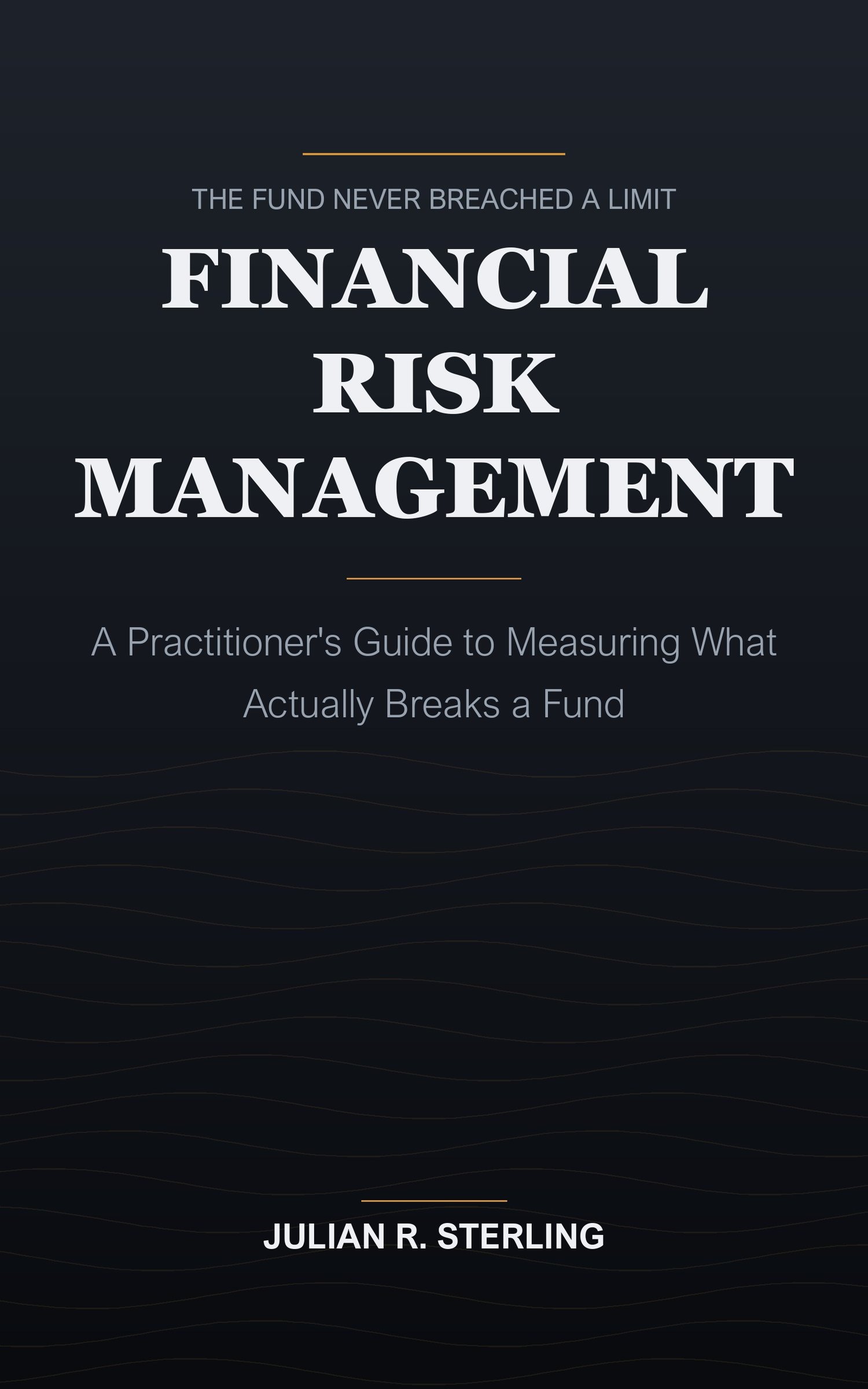
Financial Risk Management (PDF edition)
Halverton Credit Opportunities Fund is inside every limit on the morning this book begins. Six weeks later it cannot meet a redemption at the price it struck. Nothing was hidden, nothing was mismarked, and the measurements were correct.
Four people look at the same book of risk and produce four numbers:
- The risk officer: a one-day value at risk of 7,242,456, 0.862 per cent of net assets
- The stress tester: 93,277,800, which is 12.9 times that, and 2.9 times the twenty-day version
- The dealing desk: 5,101,785 or 2,016,532 to raise the cash, depending on a decision nobody logs as a risk decision
- The fund accountant: 0.8098 per remaining unit, because the investors who stay fund the exit of those who leave
Then a fifth question arrives that none of them owns: how much of this can we turn into cash by Friday? Before the redemption, 31.2 per cent. After the desk takes the cheaper of its two options, 8.3 per cent.
What the book works through
- Value at risk three ways, and precisely where the three constructions disagree
- Expected shortfall, and why, on a normal distribution, it is almost the same number
- Backtesting, the zones, and the clustering a count test cannot see
- Scaling, root-of-time understates the event that matters by a factor of nearly three
- Stress and reverse stress, how to design a scenario that changes a decision
- The liquidation cost, built from half-spread, impact and delay, and computed sleeve by sleeve
- The selling policy, worth 0.4897 a unit against 0.0804 for the first-mover advantage the industry writes rules about
- The collateral call, 14,860,681, due the same morning, from the same liquid sleeve
Four Excel workbooks accompany the book, with no sign-up and no email address. Every printed figure is reproduced by a live formula, and each workbook checks itself against the printed page.
This edition: PDF, 6 x 9 in, 121 pages, DRM-free. The free companion Excel workbooks for this book are at julianrsterling.com/risk.