

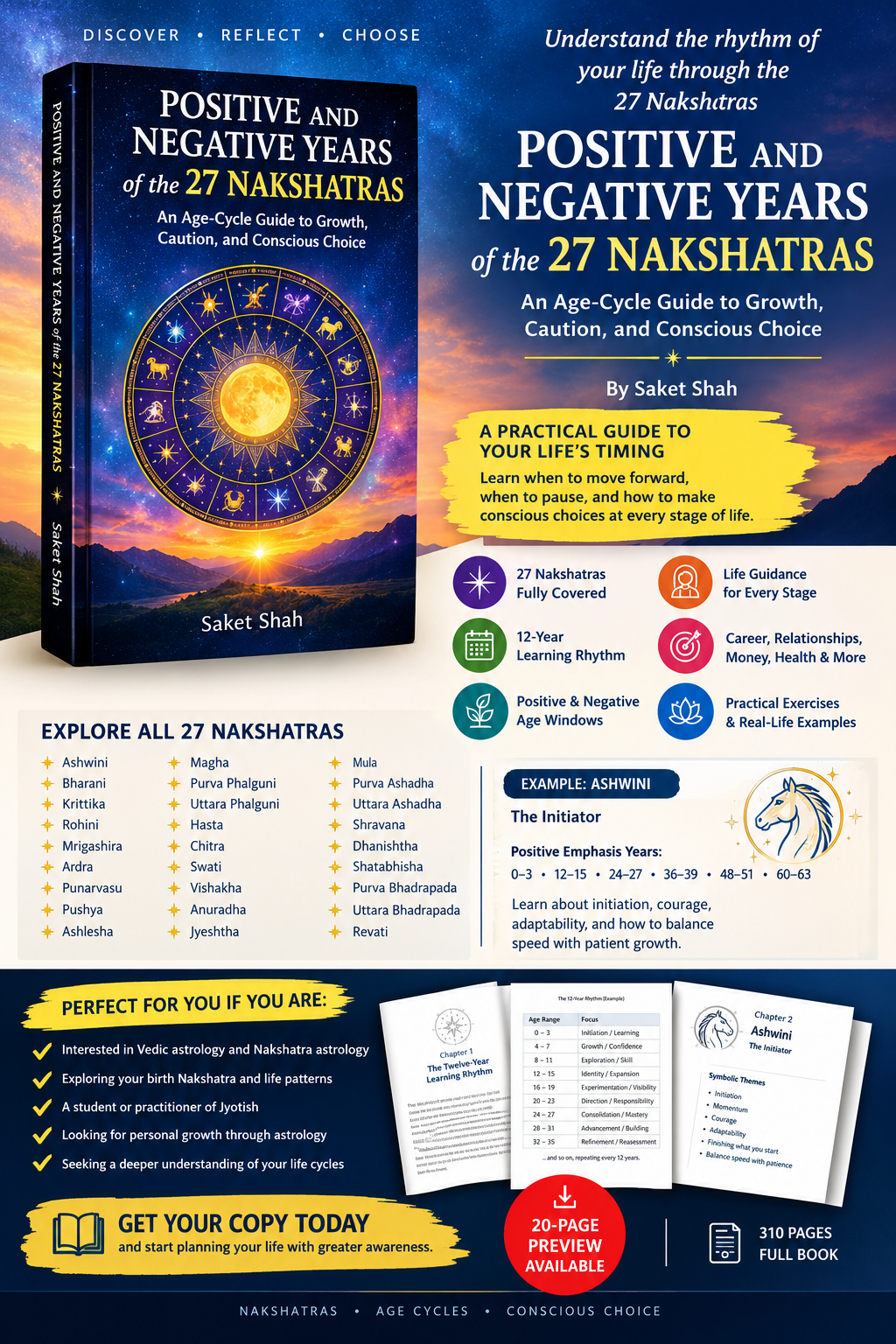
POSITIVE AND NEGATIVE YEARS OF THE 27 NAKSHATRAS
Positive and Negative Years of the 27 Nakshatras
An Age-Cycle Guide to Growth, Caution, and Conscious Choice
By Saket Shah
Discover a practical way to explore the 27 Nakshatras through age cycles, identifying periods of constructive emphasis and periods better suited to reflection, preparation, repair, and conscious decision-making.
This book presents an original interpretive framework built around a repeating 12-year rhythm, with three-year emphasis windows for each Nakshatra. The approach is designed as a reflective planning tool rather than deterministic fortune-telling.
✨ What You'll Discover
- The positive emphasis years associated with all 27 Nakshatras
- How the 12-year learning rhythm works
- How three-year age windows repeat throughout life
- How to distinguish constructive periods from caution years
- Age-specific guidance from childhood through later life
- Practical approaches for career, relationships, money, wellbeing and ethics
- Nakshatra archetypes and their core life lessons
- Practical exercises designed around each Nakshatra
- Illustrative celebrity case lenses
- A quick-reference framework for applying the system to your own life
🌙 Explore the 27 Nakshatras
The book covers:
Ashwini • Bharani • Krittika • Rohini • Mrigashira • Ardra • Punarvasu • Pushya • Ashlesha • Magha • Purva Phalguni • Uttara Phalguni • Hasta • Chitra • Swati • Vishakha • Anuradha • Jyeshtha • Mula • Purva Ashadha • Uttara Ashadha • Shravana • Dhanishtha • Shatabhisha • Purva Bhadrapada • Uttara Bhadrapada • Revati
🔥 Example: Ashwini
Ashwini is presented as “The Initiator,” with positive emphasis windows at:
0–3 • 12–15 • 24–27 • 36–39 • 48–51 • 60–63
The chapter explores initiation, momentum, courage, adaptability, finishing what you start, and balancing speed with patient cultivation.
🌱 Example: Bharani
Bharani, presented as “The Bearer,” has positive emphasis windows at:
4–7 • 16–19 • 28–31 • 40–43 • 52–55 • 64–67
Its themes include responsibility, stewardship, endurance, boundaries, ethical discernment, and learning when to hold on and when to release.
🔥 Example: Krittika
Krittika, “The Refiner,” has positive emphasis windows at:
8–11 • 20–23 • 32–35 • 44–47 • 56–59 • 68–71
This section focuses on refinement, discipline, clarity, craftsmanship, simplifying life, and making deliberate changes with empathy rather than impulsiveness.
🌿 Example: Rohini
Rohini, “The Cultivator,” has positive emphasis windows at:
1–4 • 13–16 • 25–28 • 37–40 • 49–52 • 61–64
The chapter explores patience, gradual growth, sustainable foundations, mastery, relationships, financial discipline, and long-term cultivation.
📖 Who Is This Book For?
Ideal for readers interested in:
- Vedic astrology
- Nakshatra astrology
- 27 Nakshatras
- Birth Nakshatra interpretation
- Astrology age cycles
- Nakshatra life patterns
- Jyotish study
- Indian astrology
- Personal reflection through astrology
- Astrology timing frameworks
- Spiritual and symbolic self-development
- Students and practitioners of Nakshatra astrology
⚠️ A Responsible Approach to Astrology
This book explicitly presents astrology as a cultural and symbolic practice, not a scientifically validated forecasting method. “Positive” and “negative” years are used as shorthand for constructive emphasis and caution emphasis—not guarantees that a particular year will be good or bad.
The central philosophy is simple:
Recognize the opportunity.
Recognize the risk.
Choose a measurable action.
Review the result.
Use the age-cycle framework as a tool for conscious choice—not destiny.
Keywords
27 Nakshatras, Nakshatra astrology, Vedic astrology, Jyotish, birth Nakshatra, Nakshatra age cycle, positive years Nakshatra, negative years Nakshatra, Nakshatra predictions, Nakshatra timing, astrology age cycles, Indian astrology, lunar mansions, Vedic astrology book, Nakshatra guide, 27 Nakshatras book, astrology life cycles, Nakshatra life patterns, Jyotish book, astrology timing, birth star astrology, Nakshatra analysis, spiritual astrology, astrology self development.
Get the complete book and explore the age-cycle framework for all 27 Nakshatras.