
Gr 8 Maths Worksheets (Ages 13-14) | Level M19: Expressions, Identities & Equations
🎓 Launch offer: 80% OFF every MathSmith workbook with code LAUNCH80 (first 1000 orders). Click Add to Cart, then enter LAUNCH80 in the discount box before you pay.
Not sure which level your child needs? Take the free 40-question placement test: https://ebooks.thecodecrafters.net/placement
See free sample pages first: https://ebooks.thecodecrafters.net/
Help your child build absolute confidence and mastery in mathematics. This comprehensive workbook from MathSmith takes a highly structured, "one-rung-at-a-time" approach to Expressions, Identities and Equations, ensuring students fully understand concepts before moving forward.
Instead of overwhelming learners with random equations, this workbook uses a carefully scaffolded, predictable learning ladder. It is perfect for homework, structured independent study, or mastery practice.
📊 What Is Included?
1 Complete Level (Level M19)
22 Structured Sub-levels for gradual progression
88 Printable Worksheets
880 Total Problems for thorough practice
Full Answer Key online, unlocked by the order ID on your Payhip receipt, for quick, stress-free marking
🗺️ Curriculum Breakdown
This collection focuses deeply on mastering Expressions, Identities and Equations through a carefully curated system:
What an expression is made of (2 Sub-levels): Two rungs of vocabulary, and one of them is not vocabulary. Terms and coefficients are M16's, asked again because everything after them is said in those words. DEGREE is new, and it is the first number in the book that describes an expression rather than counting anything in it. Then adding and subtracting, where the only change from M16 is the one that matters: a squared term and a plain term of the same letter are UNLIKE, however inviting they look, and the minus in front of a bracket reaches every term inside it.
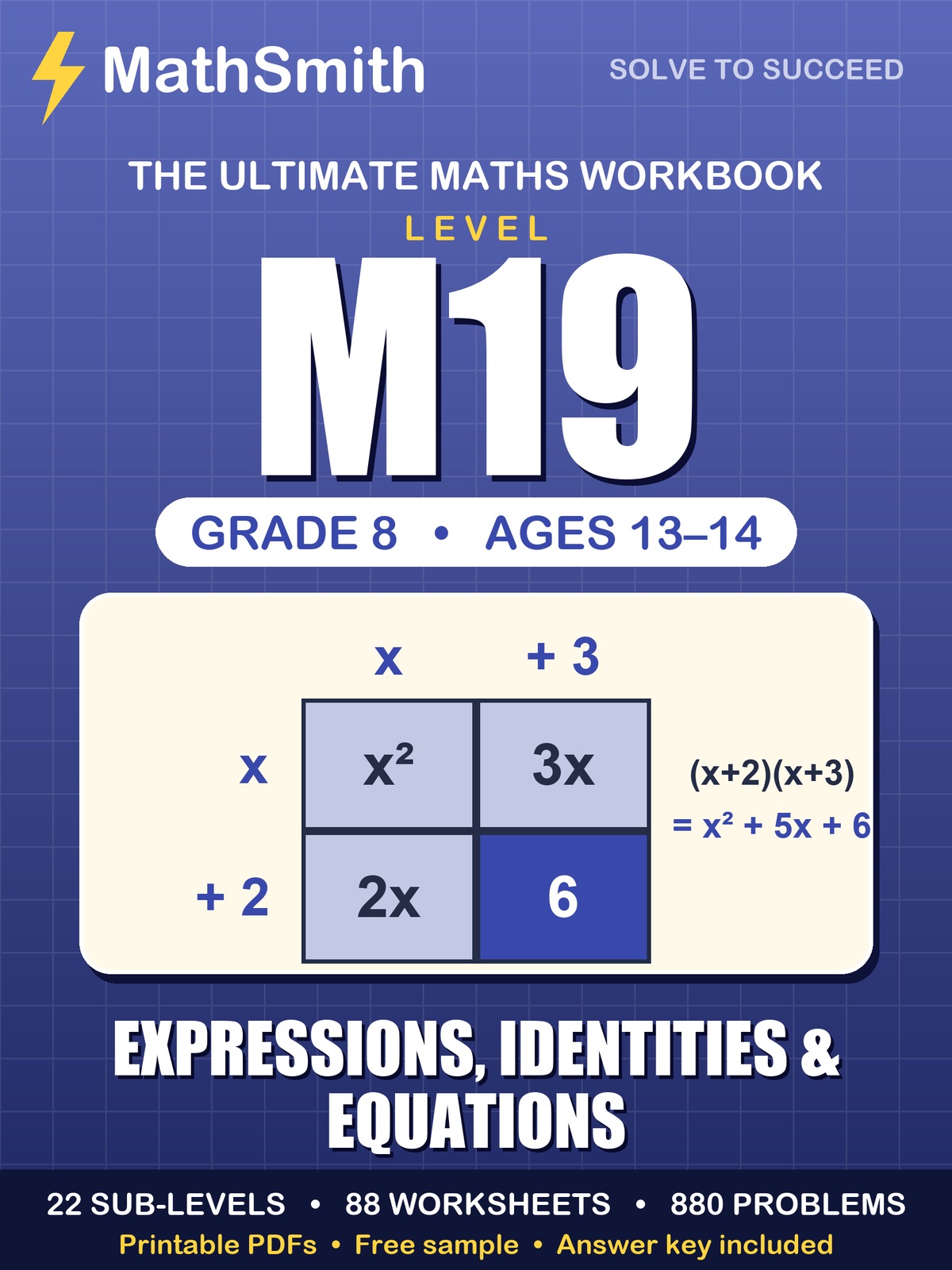
Every term against every term (4 Sub-levels): The level's own strand. A term times a term, a term across a bracket, two brackets, and then two terms against three - and the method never changes, which is the point of asking the last one. Four products is not a rule to learn; it is two times two. The grid is drilled here because a child who fills four cells has multiplied every term by every term whether or not they could say so, and the famous wrong answer - (x + 2)(x + 3) giving x squared plus 6 - is two of those cells left empty rather than any arithmetic gone wrong.
Three products worth recognising (5 Sub-levels): A sum squared, a difference squared, and a sum times the matching difference. None of them is a new fact: each is the previous strand with the two brackets made the same, or made opposite. The 2 in the middle term is a COUNT of the two matching pieces rather than a doubling of anything, which is what the square cut in four says; the last term of a squared difference is positive because it is a square, which is a check needing no working; and the middle terms of a sum times its difference cancel, which is what makes 98 times 102 a subtraction anybody can do in their head.
The same strand, backwards (4 Sub-levels): Factorising is multiplying read the other way, and it is taught after it for that reason. Four methods and one question in front of all of them: is there a factor common to every term? Then grouping, where the noticing is the whole of the work; the two identities backwards, which start by asking whether the outer terms are squares; and finally two numbers that multiply to the last term and add to the middle one. Every answer on the strand is checked the same way, and the way needs nothing new: multiply it back out.
Dividing, which is cancelling (3 Sub-levels): A term by a term, an expression by a term, and an expression by a bracket - and the third is why the factorising strand came first, because Class 8 divides by a binomial by factorising the top and cancelling rather than by long division. The rule that matters is what may be cancelled: a factor of the WHOLE top goes, and a term of it does not, which is the mistake that runs for the next four years.
Equations that have two sides (4 Sub-levels): Everything M16 solved had a number on one side and could be undone a step at a time. Here the letter is on both sides, so the first move is to gather it - and which side is a choice rather than a rule. Then the equations that cannot be started until they have been tidied, a bracket multiplied out or a denominator cleared, which is the first time in the book that is true. The strand closes on a story, where three quarters of the work is deciding what the letter stands for.
🎯 Who Is This For?
Parents looking to provide structured math support at home.
Homeschoolers searching for a sequential curriculum to guarantee zero gaps in math skills.
Teachers & Tutors looking for bite-sized, scaffolded printables for classroom morning work or targeted intervention.
📖 How To Use This Workbook
Print the workbook, read each rung's method page, and let your child work inside the printed frame. Then check the answers your way: in the printable answer-key PDF included in this download, or online, one page at a time, with the order ID on your Payhip receipt (valid for six months). Please keep the answer key for the adult marking the work and do not share it with your child: the workbook only works if they have worked each answer out for themselves.
Step-by-step manual and video guide: https://ebooks.thecodecrafters.net/manual/
Check the answers: https://ebooks.thecodecrafters.net/answers
⚙️ Digital Delivery Details
Format: four instant-download PDFs (free sample, sample answers, workbook, full answer key). The answer key is also available online.
Print Ready: Easily printable on home or school printers.
Usage: Licensed for individual family or single-classroom use.