

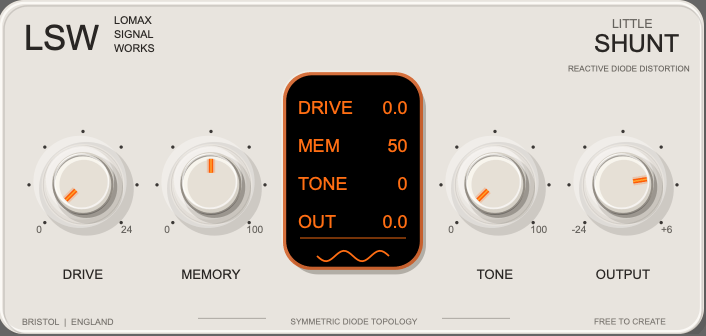
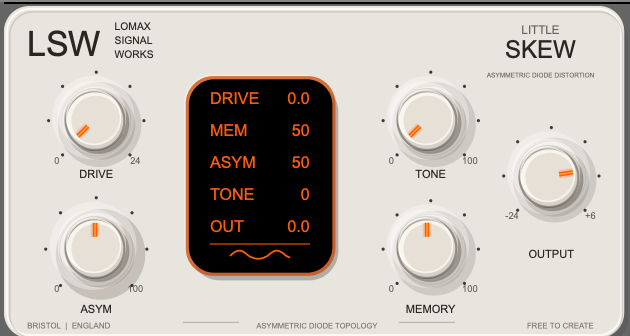
Little Shunt/Skew
LSW SHUNT + SKEW
Two free reactive diode distortion devices from Lomax Signal Works.
SHUNT and SKEW started as experiments in the LSW Nonlinear Lab: building distortion from simple circuit behaviour rather than reaching for a generic saturation curve.
SHUNT uses a symmetric antiparallel diode network. As the signal pushes harder, the diodes progressively conduct and shunt current away from the signal path. A reactive element inside the circuit carries state from one moment to the next, changing the way the diode distortion responds to transients and frequency.
The result can move from subtle density to tough, compressed diode breakup without feeling like a conventional static waveshaper.
SKEW takes the same idea and deliberately makes the two polarities behave differently. One side of the waveform can reach nonlinear conduction differently from the other, introducing asymmetry, even harmonics and a more lopsided, aggressive character.
Both devices include controls for drive, reactive behaviour and tone compensation so the nonlinear interaction can be pushed hard without automatically sacrificing all of the top end.
They are not models of any particular piece of hardware.
They are two small nonlinear mechanisms built to be played with.
SHUNT
Symmetric. Dense. Tough.
SKEW
Asymmetric. Uneven. Nasty.
Free Max for Live devices from Lomax Signal Works · Bristol, England.