
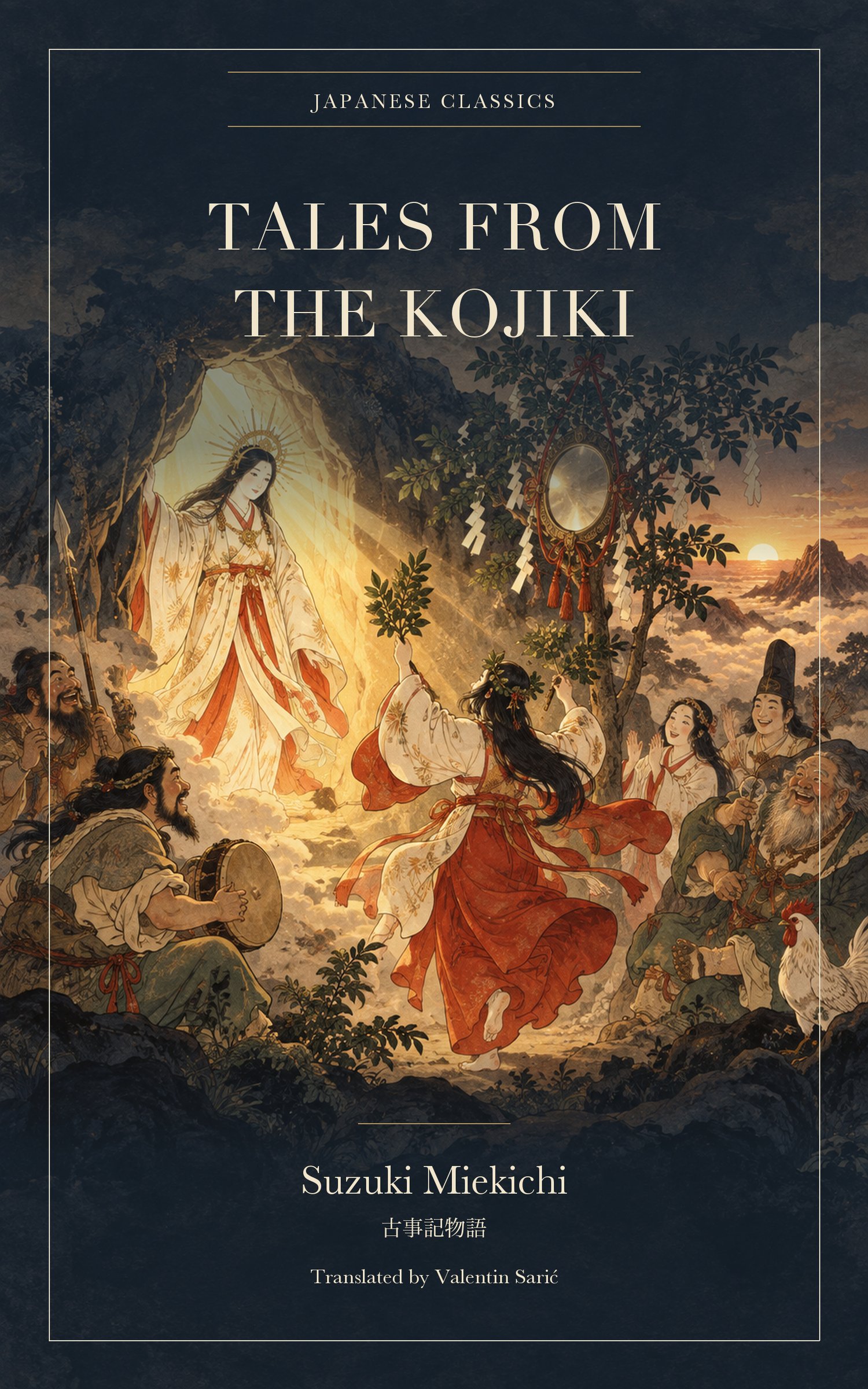
Tales from the Kojiki
Suzuki Miekichi founded Akai Tori, the magazine that made modern Japanese children's literature, and in 1920 he did for the Kojiki what no one had done: he told it plainly. Japan's oldest book, compiled in 712 from court genealogy and ritual, became nineteen tales a reader could follow — and for most Japanese of the twentieth century, this retelling, not the eighth-century chronicle, is where they first met their own mythology.
The gods make the islands from a spear dipped in the sea. Izanagi follows his dead wife into the dark and looks at what he was told not to look at. Amaterasu shuts herself in a cave and the world goes black until a dance and a mirror bring her out. Susanoo kills the eight-forked serpent and finds a sword in its tail. A skinned hare on a beach, a chamber of centipedes, a jewel that raises the tide and a jewel that lowers it, a crow of eight spans that walks an army through the mountains. Yamato Takeru burns his way out of a moor, wins by wearing a woman's clothes, and dies inland singing of the mountains of home. An emperor climbs a hill, sees no smoke rising from the kitchens of his people, and forgives their taxes for three years.
Nineteen chapters, complete: creation to the seventh century, in Suzuki's own order and his own plain, courteous voice — the genealogies and ritual formulae of the original left out, as he left them out, and the strangeness left in.
English-language digital edition. Translated by Valentin Sarić.
You receive: a 169-page PDF and an EPUB edition.
Digital download only. No physical book is shipped.