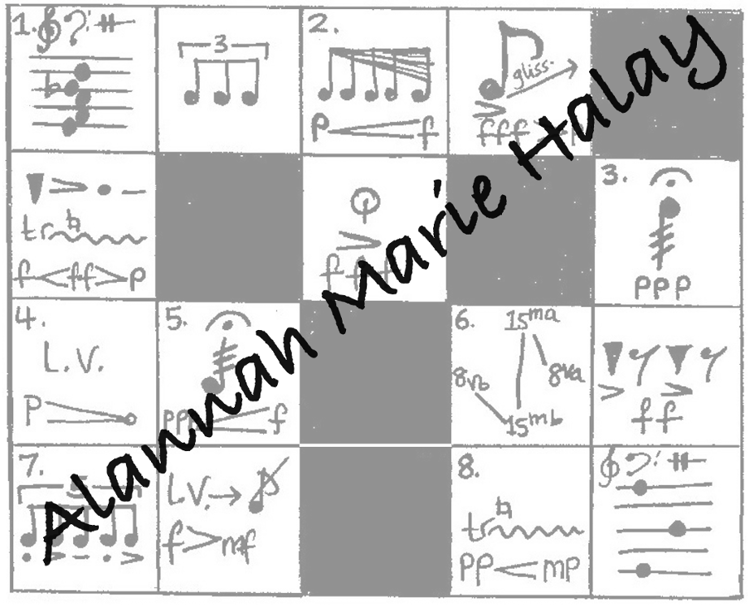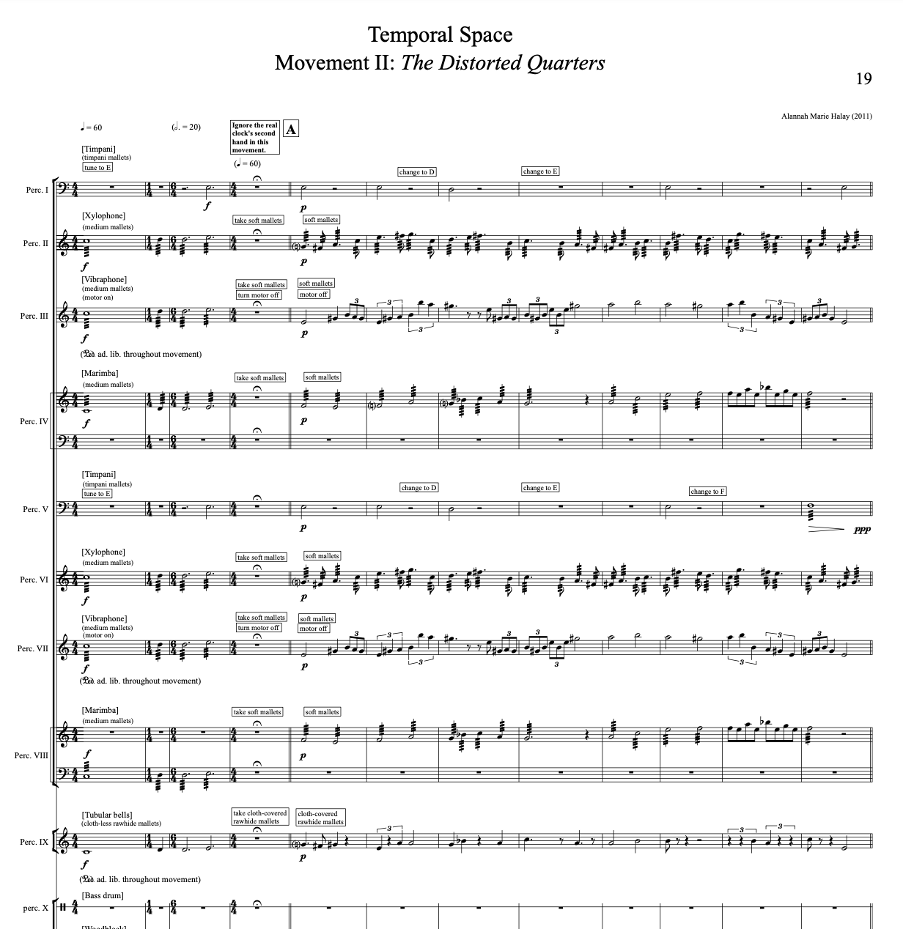
Temporal Space [21 percussionists] (2011, AMH) FULL SCORE
1 hour of music
For 21 percussionists
I. Aristotle’s ‘Time-Paradox’ Game and the Shattered Talking Clock
II. The Distorted Quarters
III. Absolute Clockwork Relativity
IV. Parallel Paradox
V. Aristotle’s ‘Time-Paradox’ Game and the Shattered Talking Clock
Instrumentation
Percussionists I - XXI
Instrumentation has been ordered in the score in accordance with the performance layout to emphasise
clarity and ease for the conductor. The list of percussion, here, will require 21 percussionists, some
playing additional instruments as indicated.
Percussionist I: playing timpani, suspended cymbal (situated so that percussionist I can play both
timpani and suspended cymbal at the same time) and tambourine. Percussionist I will require 1x 25"
timpani; 2x timpani mallets; 2x wooden sticks; 1 x double bass bow.
Percussionist II: playing xylophone (notated an octave lower than sounding pitch), F#4 tubular bell
(stand permitted if required) and metronome (preferably mechanical, although an electronic metronome
with a ticking sound of mechanical timbre will be permitted if more convenient). Percussionist II will
require 2x soft mallets; 2x medium mallets; 2x hard mallets; 1x cloth-less rawhide mallet.
Percussionist III: playing vibraphone (with a motor of medium speed), Newton’s cradle (of any size as
long as it is the same size as percussionist VI’s), and crotales (containing pitches sounding two octaves
higher than the written C4 to C5 and mounted, arranged chromatically, on a board). Percussionist III
will require 2x soft mallets; 2x medium mallets; 2x hard mallets; 2x metal mallets; 1x double bass bow.
Percussionist IV: playing marimba and G#4 tubular bell (stand permitted if required). Percussionist IV
will require 2x soft mallets; 2x medium mallets; 2x hard mallets; 1x cloth-less rawhide mallet; 1x
double bass bow.
Percussionist V: playing timpani, suspended cymbal (situated so that percussionist V can play both
timpani and suspended cymbal at the same time) and tambourine. Percussionist V will require 1x 25"
timpani; 2x timpani mallets; 2x wooden sticks; 1 x double bass bow.
Percussionist VI: playing xylophone (notated an octave lower than sounding pitch), B3 tubular bell
(stand permitted if required) and Newton’s cradle (of any size as long as it is the same size as
percussionist III’s). Percussionist VI will require 2x soft mallets; 2x medium mallets; 2x hard mallets;
1x cloth-less rawhide mallet.
Percussionist VII: playing vibraphone (with a motor of medium speed), metronome (preferably
mechanical, although an electronic metronome with a ticking sound of mechanical timbre will be
permitted if more convenient), and crotales (containing pitches sounding two octaves higher than the
written C4 to C5 and mounted, arranged chromatically, on a board). Percussionist VII will require 2x
soft mallets; 2x medium mallets; 2x hard mallets; 2x metal mallets; 1x double bass bow.
Percussionist VIII: playing marimba, E4 tubular bell (stand permitted if required). Percussionist VIII
will require 2x soft mallets; 2x medium mallets; 2x hard mallets; 1x cloth-less rawhide mallet; 1x
double bass bow.
Percussionist IX: playing tubular bells. Percussionist IX will require 2x cloth-covered rawhide
mallets; 2x cloth-less rawhide mallets.
Percussionist X: playing large orchestral bass drum (positioned vertically in a circular frame, and of
equal size to percussionist XVI’s bass drum). Percussionist X will require 2x heavy felt-covered
beaters.
Percussionist XI: playing medium-sized woodblock of equal size to percussionist XVII’s woodblock
and requiring a surface or stand so that woodblock tremolos can be executed practically. Percussionist
XI will also require 2x hard beaters.
Percussionist XII: playing snare drum (of any size from 6" to 7" as long as it is the same as
Alannah Marie Halay (2011)3
percussionist XVIII’s snare-drum size). Percussionist XII will require 2x wooden sticks; 2x wire
brushes.
Percussionist XIII: playing timbales. Percussionist XIII will require 1x 13" timbale (notated as a note
above the percussive staff) and 1x 14" timbale (notated as a note below the percussive staff) on stands;
2x timbale sticks.
Percussionist XIV: playing tenor drum. Percussionist XIV will require 2x wooden sticks.
Percussionist XV: playing field drum (of lower pitch than the tenor drum and of equal size to
percussionist XXI’s field drum). Percussionist XV will require 2x wooden sticks.
Percussionist XVI: playing large orchestral bass drum (positioned vertically in a circular frame, and of
equal size to percussionist X’s bass drum). Percussionist XVI will require 2x heavy felt-covered
beaters.
Percussionist XVII: playing medium-sized woodblock of equal size to percussionist XI’s woodblock
and requiring a surface or stand so that woodblock tremolos can be executed practically. Percussionist
XVII will also require 2x hard beaters.
Percussionist XVIII: playing snare drum (of any size from 6" to 7" as long as it is the same as
percussionist XII’s snare-drum size). Percussionist XVIII will require 2x wooden sticks; 2x wire
brushes.
Percussionist XIX: playing timbales. Percussionist XIX will require 1x 13" timbale (notated as a note
above the percussive staff) and 1x 14" timbale (notated as a note below the percussive staff) on stands;
2x timbale sticks.
Percussionist XX: playing tenor drum. Percussionist XX will require 2x wooden sticks.
Percussionist XXI: playing field drum (of lower pitch than the tenor drum and of equal size to
percussionist XV’s field drum). Percussionist XXI will require 2x wooden sticks.
It is a requirement that all performers (percussionists and conductor) wear a watch (of any type) with a
second hand. All the performers’ watches’ second hands do not have to be in sync with one another.
An engineer, with a copy of the score, will be required to control the volume of the amplified ticking of
the real clock and start and control the volume of the recording of the manipulated clock ticking via a
sampler. Further information is provided on page 5.
Percussionists with additional instruments - such as metronome or Newton’s cradle - are permitted
additional surfaces/small tables/stands for convenience.