
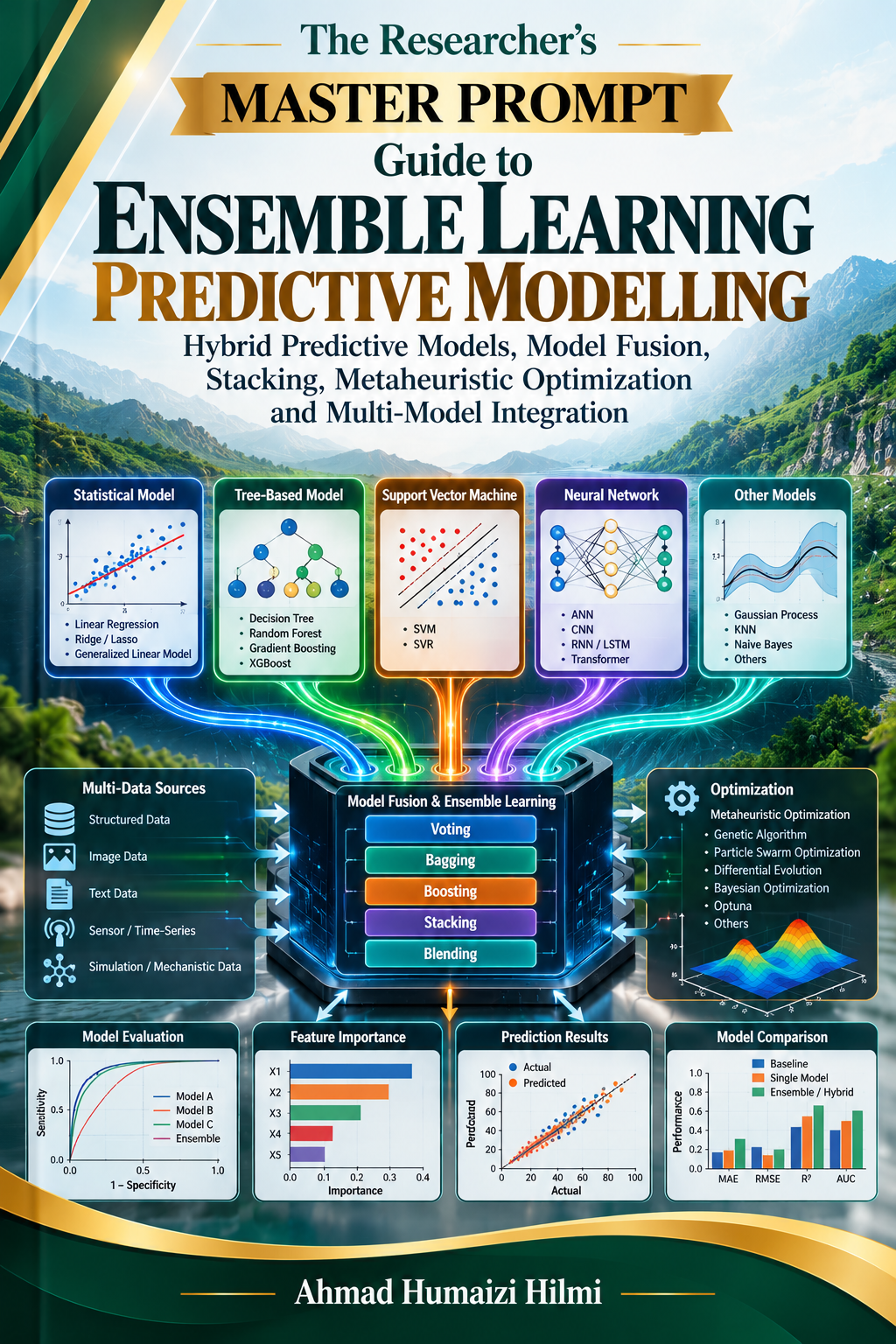
5. PM-ENS-005 — Ensemble Learning, Hybrid Predictive Models, Model Fusion, Stacking, Metaheuristic Optimization and Multi-Model Integration
Description
This Master Prompt focuses on the design, development and validation of advanced predictive systems that integrate multiple algorithms, modelling paradigms, data sources and optimization strategies to improve predictive accuracy, robustness and generalization. It guides researchers through ensemble learning methods such as bagging, boosting, random forests, gradient boosting, stacking, blending, voting, weighted averaging and heterogeneous model combinations. The theme addresses hybrid predictive architectures combining statistical models, machine learning algorithms, neural networks, mathematical equations, mechanistic relationships and optimization techniques. Particular attention is given to model fusion, multi-feature fusion, meta-learning, ensemble diversity, base-learner selection, meta-learner construction, model weighting, residual correction and the prevention of information leakage during ensemble training. Researchers are guided in applying metaheuristic optimization, Bayesian optimization and other search strategies for hyperparameter tuning, feature selection and predictive performance improvement. Applications reflected in the uploaded literature include optimized stacking models for food-quality prediction, hybrid ensemble models for ecological relationships, metaheuristic-optimized solubility prediction, multimodal therapeutic response prediction and hybrid surrogate models for engineering analysis. The theme also addresses computational complexity, sensitivity analysis, uncertainty, comparative benchmarking, interpretability, reproducibility and statistical assessment of whether ensemble or hybrid approaches provide meaningful improvements over simpler baseline models.