


Conversations That Build Change: Motivational Interviewing in Homeless Services
On Sale
$999.99
Rich Los Angeles context. Skills that work wherever you practice.
Built for homeless-services staff in any US city or county, with Los Angeles as the worked example. A self-paced field guide and practice toolkit for shelter and interim housing staff, outreach workers, case managers, housing navigators, drop-in and coordinated entry staff, prevention workers, peers and supervisors: have conversations about housing, documents, health, substance use and program rules that draw out the person's own reasons, without pushing, arguing or pretending a fixed rule is optional. Published by Homeless Services Learning Lab Foundation (California). Edition 1.0, October 2026.
What you'll be able to do
- Agree what a conversation is about, and choose whether to guide, inform or act, including when MI is the wrong tool (an emergency, a safety issue, a rule that isn't negotiable).
- Use open questions, affirmations, reflections and summaries (OARS) so the person does more of the thinking out loud.
- Hear change talk and sustain talk, and respond to "no" and friction without arguing.
- Share information and hard facts honestly with Ask–Offer–Ask, and agree on a next step in the person's own words.
- Use MI on health, substance use and program rules without coercion, and know what your program can and can't require.
Included in the download
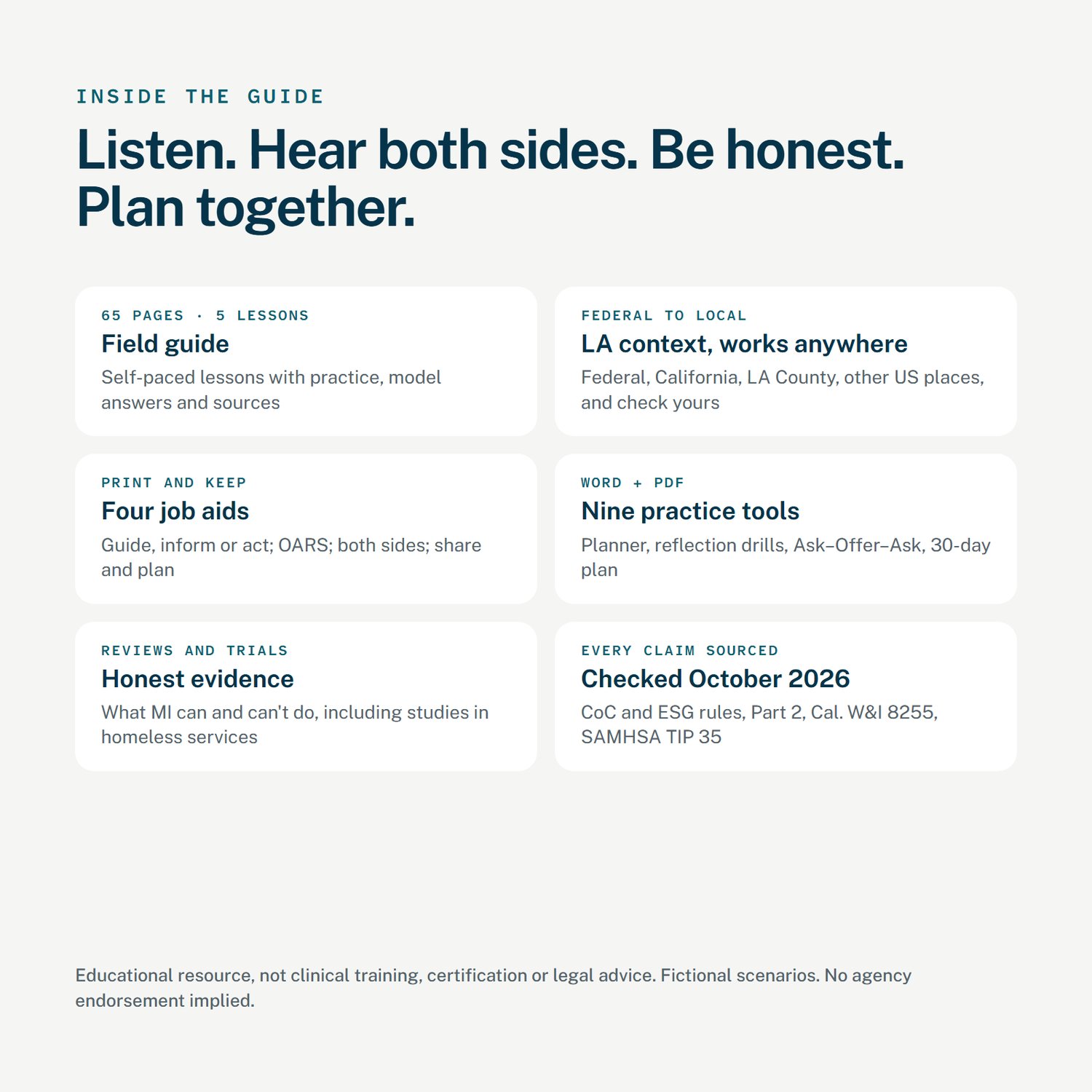
- 65-page field guide with five lessons. Each lesson has a layer-by-layer lens (federal, California, the LA County example, other US places, and "check yours"), a worked decision, practice scenarios with model answers, a self-check with feedback, and numbered sources.
- Four printable one-page job aids and a Check Yours worksheet (PDF and Word).
- Nine practice tools in Word with a printable PDF: conversation planner, response starters, reflection drills with model answers, change-talk practice with model answers, Ask–Offer–Ask builder, My next step (for participants), conversation reflection, feedback with permission, and a 30-day practice plan.
- Start Here and the license for the tier you choose.
License tiers
- Individual (1 user): $49
- Program / Site Team (15 named users): $199
- Agency / Multi-site (50 named users): $499
Before you buy
- Sources: built on 78 research, legal and policy claims, each traced to a numbered source (laws and regulations read in full; research checked against the published record, at abstract level where that was all we read): Miller and Rollnick's 4th edition (described in our own words), Cochrane and other reviews of MI, studies with people experiencing homelessness in Los Angeles, Seattle, Columbus (Ohio) and Minneapolis–St. Paul, training research, SAMHSA's TIP 35, HUD's CoC and ESG rules (24 CFR 578.75(h), 576.401(e)), 42 CFR Part 2, California's Housing First law (W&I Code §8255, which names motivational interviewing), and reporting laws in California and Texas. Checked October 2026.
- Honest about the evidence: MI usually helps by a small amount, is often about as good as other active approaches, and has mixed results with people experiencing homelessness. The guide says so.
- What it isn't: clinical training, MI certification, a fidelity measure, or legal or HR advice. Real proficiency comes from practice with coaching and feedback; the guide points to the Motivational Interviewing Network of Trainers without endorsing any trainer. No agency endorsement is implied. The scenarios are fictional.
- No workbook: this toolkit has no Excel file; the practice tools and 30-day plan cover practice tracking without storing participant details.
- Related HSLL guides: Participant Support & Difficult Situations (de-escalation, emergencies, disclosures) and Rules, Rights and Fair Exits (program rules, grievances, exits).
- Accessibility: the PDFs aren't certified PDF/UA accessible. The worksheet and tools are also supplied in Word.
Downloadable digital resource.