

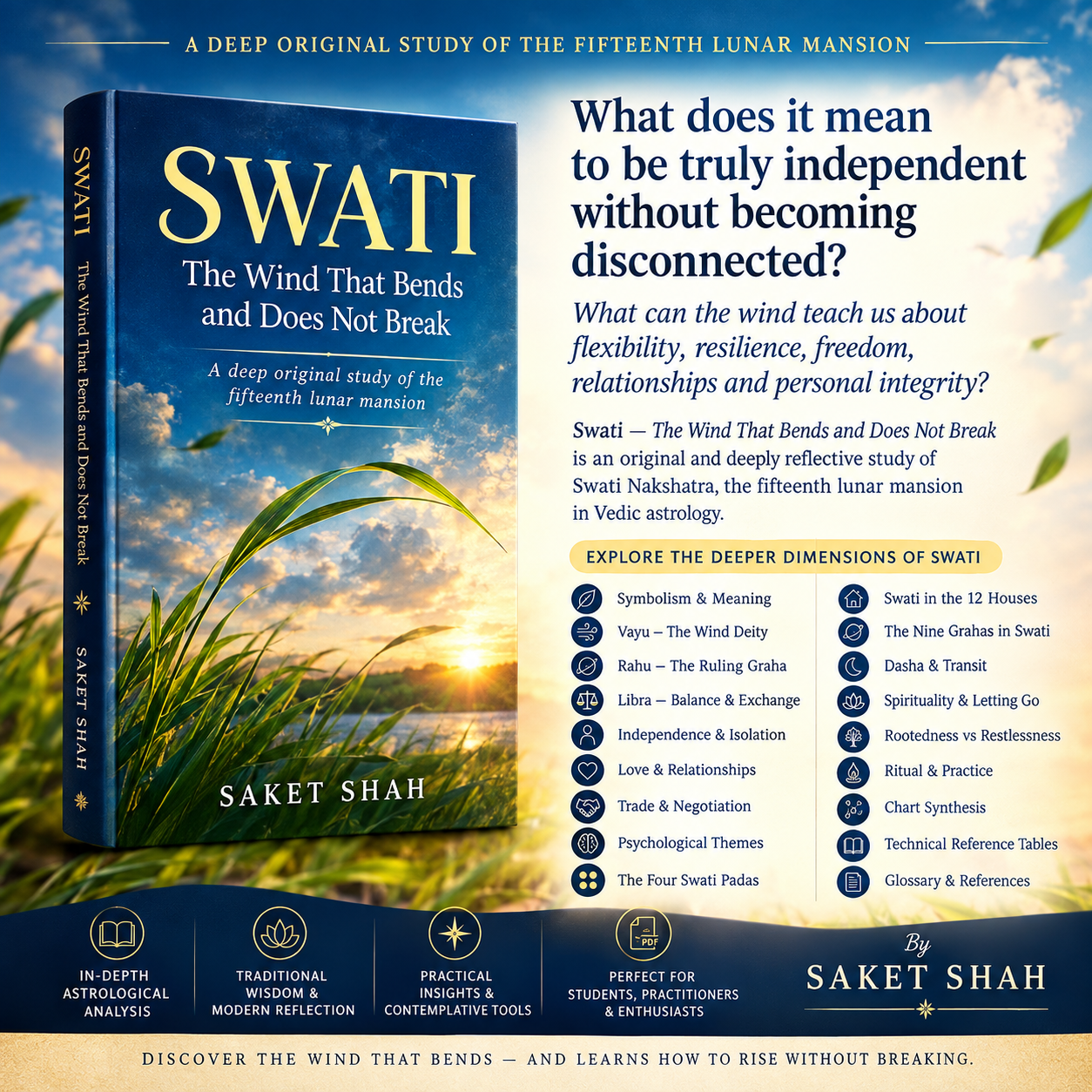
SWATI Nakshatra The Wind That Bends and Does Not Break
Swati: The Wind That Bends and Does Not Break
A Deep Original Study of the Fifteenth Lunar Mansion
By Saket Shah
What does it mean to be truly independent without becoming disconnected?
What can the wind teach us about flexibility, resilience, freedom, relationships, and personal integrity?
Swati — The Wind That Bends and Does Not Break is an original and deeply reflective study of Swati Nakshatra, the fifteenth lunar mansion in Vedic astrology.
Rather than treating a nakshatra as a fixed label or prediction, this book explores Swati as a living symbolic framework for understanding independence, adaptability, movement, negotiation, self-reliance, relationships, and ethical choice.
Inside This Book
Explore the deeper dimensions of Swati through:
- Swati Nakshatra meaning and symbolism
- The young shoot bending in the wind
- Vayu, the deity of wind, breath, and life-force
- Rahu, the ruling graha of Swati
- Libra and the dynamic search for balance
- The sword and coral symbolism
- Independence versus isolation
- Adaptability and self-reliance
- Relationships, intimacy, boundaries, and freedom
- Trade, negotiation, diplomacy, and fair exchange
- Swati's psychological themes
- The four Swati padas
- Swati in the twelve houses
- The nine grahas in Swati
- Dasha and transit considerations
- Spirituality and letting go
- Rootedness versus restlessness
- Practical reflection, ritual, and contemplative practices
- Chart synthesis and technical reference material
The book's contents progress from foundational symbolism into psychological, relational, technical, and practical applications.
The Central Wisdom of Swati
Swati is symbolized through the image of a young plant bending in the wind.
It does not survive by becoming rigid.
It bends.
And when the wind passes, it rises again.
This becomes the central metaphor of the book: flexibility without losing one's roots.
The opening chapters explore the distinction between conscious adaptability and simply being carried by circumstances. The book describes Swati's ideal as movement that remains connected to an inner sense of direction.
Independence Without Rootlessness
Swati is traditionally associated with movement, trade, diplomacy, travel, communication, and unconventional paths.
But independence has another side.
Freedom can become avoidance. Movement can become restlessness. Detachment can become isolation.
This book therefore examines both the constructive and challenging expressions of Swati, asking how a person can remain flexible while still honoring commitments, relationships, responsibility, and personal values.
Vayu — The Breath That Moves Without Being Seen
One of the book's major themes is Vayu, the presiding deity associated with wind, breath, and life-force.
Vayu is experienced through effects rather than through a fixed visible form: the movement of leaves, breath, storms, and the invisible forces that move through life.
The book connects this symbolism with Swati's themes of communication, mediation, adaptability, movement, and invisible influence.
Rahu, Libra and the Swati Paradox
Swati occupies a portion of Libra and is ruled by Rahu.
The book explores the tension between Libra's themes of balance, relationship, harmony, and exchange and Rahu's themes of unconventionality, expansion, appetite, and movement beyond established boundaries.
This creates one of Swati's defining paradoxes:
How can you remain free without becoming rootless?
A Book for Serious Students of Jyotisha
This is not presented as a simplistic "Swati personality" guide.
The author emphasizes that nakshatra symbolism describes tendencies rather than fixed laws, and that a birth chart must be considered in the context of a person's actual life, choices, history, and circumstances.
The book is suitable for:
- Vedic astrology students
- Jyotisha practitioners
- Nakshatra researchers
- Astrology teachers
- Readers studying Rahu
- Readers studying Libra
- Students exploring the four padas of Swati
- Astrology enthusiasts interested in deeper symbolic interpretation
- Readers interested in the philosophical dimensions of Jyotisha
What Makes This Study Different?
Instead of reducing Swati to a list of personality traits, this book explores the nakshatra through several interconnected dimensions:
Symbol → Deity → Graha → Psychology → Relationships → Ethics → Technical Astrology → Practice
It asks not only what Swati represents, but also how its symbolism can be examined responsibly in an actual human life.
Keywords
Swati Nakshatra, Swati Nakshatra meaning, Swati Nakshatra Vedic astrology, Swati Nakshatra characteristics, Swati Nakshatra astrology, Swati Nakshatra padas, Swati Nakshatra Rahu, Swati Nakshatra Vayu, Swati Nakshatra Libra, fifteenth Nakshatra, Vedic astrology Nakshatras, Jyotisha Nakshatra study, Vedic astrology ebook, Nakshatra astrology book, Swati Pada 1, Swati Pada 2, Swati Pada 3, Swati Pada 4, Rahu in Swati, Moon in Swati, planets in Swati, Swati in houses, Swati relationships, Swati independence, Swati career, Swati spirituality, Nakshatra research, Vedic astrology PDF, Jyotisha ebook, Saket Shah astrology
About the Author
Saket Shah presents this work as part of a planned series exploring the nakshatras individually through traditional Jyotisha vocabulary, symbolism, technical interpretation, and contemporary reflection.
Start Your Exploration of Swati
If Swati Nakshatra appears prominently in your birth chart, or if you are studying the nakshatras in greater depth, this book offers a sustained exploration of the themes of wind, independence, adaptability, balance, movement, communication, and rooted freedom.
Discover the wind that bends — and learns how to rise without breaking.
Swati: The Wind That Bends and Does Not Break
Saket Shah