
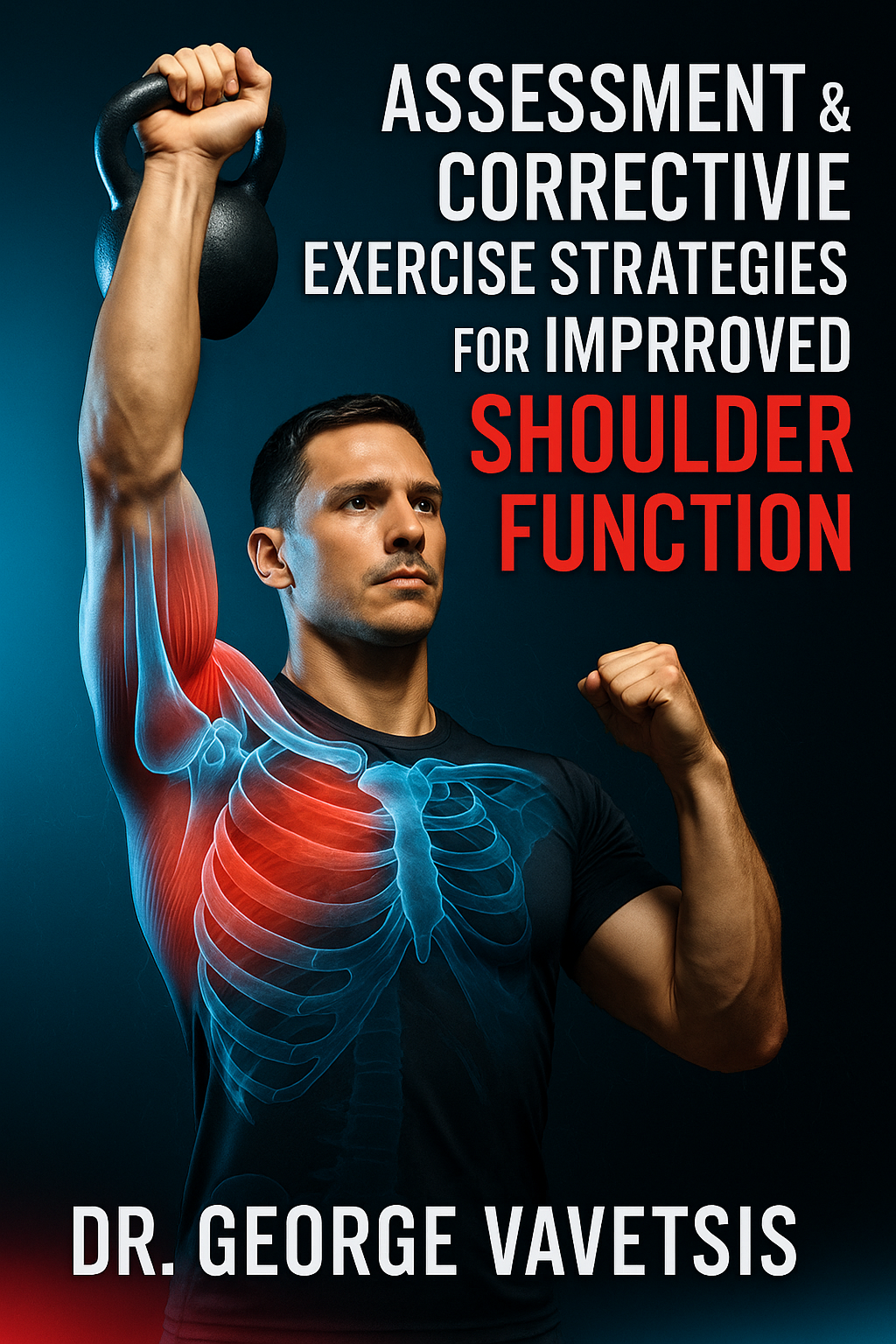
Assessment & Corrective Exercise Strategies for Improved Shoulder Function
Pages: 664
The shoulder complex is a marvel of human biomechanics. It grants us the freedom to reach, lift, throw, strike, and interact with the world in countless ways—yet this very complexity also makes it uniquely vulnerable. In high-performance sport, in physically demanding occupations, and even in daily life, shoulder dysfunction is among the most common orthopedic challenges faced by clinicians, strength and conditioning coaches, and performance specialists. Pain, instability, rotator cuff dysfunction, scapular dyskinesis, and limited overhead capacity are issues that can silently erode athletic potential and reduce quality of life. The ability to accurately assess, correct, and optimize shoulder function is therefore essential in modern sports science and rehabilitative practice.
This book was written with a singular mission: to bridge the gap between clinical knowledge and performance application. Too often, assessment insights remain trapped in medical terminology, while corrective exercise remains disconnected from mechanical and neurological root causes. Athletes may be instructed to “strengthen the rotator cuff” or “improve scapular stability,” yet without precise understanding of movement faults, neuromuscular imbalances, and load-transfer disruptions, even well-intended programs fail to produce long-term resilience. The shoulder thrives when all subsystems—glenohumeral, scapulothoracic, acromioclavicular, sternoclavicular, and cervical-thoracic regions—operate in harmony. It breaks down when any link in this chain fails to communicate or tolerate load.
Within these pages, the reader will discover a systematic and evidence-based approach to shoulder functional assessment and corrective exercise design. We explore mobility, stability, neuromechanics, and coordinated movement patterns using terminology and frameworks accessible to both strength professionals and rehabilitation specialists. The structure of the book reinforces applied integration: every theoretical explanation is followed by actionable, field-tested applications that can be immediately implemented in the gym, on the court, or within rehabilitative settings.
This work emphasizes three foundational principles:
1. Movement is information.
The body constantly expresses its neuromuscular state through observable performance signatures: scapular winging, altered rhythm, anterior humeral translation, compensatory trunk mechanics, or poor overhead motion quality. Rather than chasing symptoms, we decode these signatures to locate the primary source of dysfunction and guide targeted intervention.
2. Stability precedes strength.
Elite performance requires efficient load transfer through the shoulder complex. True shoulder health is achieved not only with large muscles but through deep, coordinated motor control—particularly from the rotator cuff, serratus anterior, lower trapezius, and thoracic stabilizers. Before progressing to power, the athlete must regain centered joint mechanics, proprioceptive awareness, and symmetrical control.
3. Correction must be specific to context.
Sport-specific demands reveal weaknesses that may not appear in standard assessments. A volleyball spiker requires rapid deceleration into external rotation; a baseball pitcher needs posterior shoulder shear control at extreme range; a swimmer must maintain scapular control under continuous repetitive volume. The corrective strategy must mirror the task’s mechanical reality.
Throughout this book, advanced terminology—including load-sharing mechanisms, scapulohumeral rhythm, posterior capsular restraint, fascial connectivity, and kinetic chain influence—is translated into practical coaching language. You will find detailed progressions ranging from early-stage isometrics and controlled articular rotations to closed-chain neuromechanical sequencing and high-velocity return-to-sport drills. Programming variables (intensity, tempo, volume, rest, and progression systems) are included so that interventions evolve with the athlete’s needs rather than stagnating as generic “prehab exercises.”
This text also serves as a call to collaboration. Performance and rehabilitation professionals each hold pieces of the solution. While therapists excel in anatomical precision and individualized correction, coaches understand load, adaptation, and the demands of performance environments. Only through integrated communication can we guide the athlete seamlessly from injury risk to optimal capacity. Every chapter encourages this interdisciplinary connection, uniting the rigor of clinical biomechanics with the practical realities of coaching and athlete preparation.
The shoulder is not simply a joint—it's a dynamic, load-bearing architecture that reflects the health of the entire kinetic system. When it moves well, the athlete expresses power freely and confidently. When it falters, performance suffers long before pain is felt. Corrective strategies are therefore not remedial tasks but performance enhancers. They build robustness, expand overhead strength profiles, and unlock movement potential that athletes may never have experienced.
Whether you are a strength and conditioning coach working to improve performance, a clinician guiding athletes safely back to competition, or a student seeking to deepen your biomechanical understanding, this book provides a complete framework to evaluate, interpret, and correct dysfunctional shoulder patterns.
The athlete’s shoulder deserves both respect and mastery. By applying the science-driven principles detailed here, you will be better equipped to preserve its longevity, restore its precision, and elevate its performance expression under load. The goal is not merely to treat pain, but to prevent it—by developing shoulders that move with intelligence, stability, and resilient force.
Welcome to a more intentional and empowered approach to shoulder function. Let this book be your guide toward building stronger athletes, safer overhead movers, and confident, powerful upper limbs that withstand the demands of sport and life.