

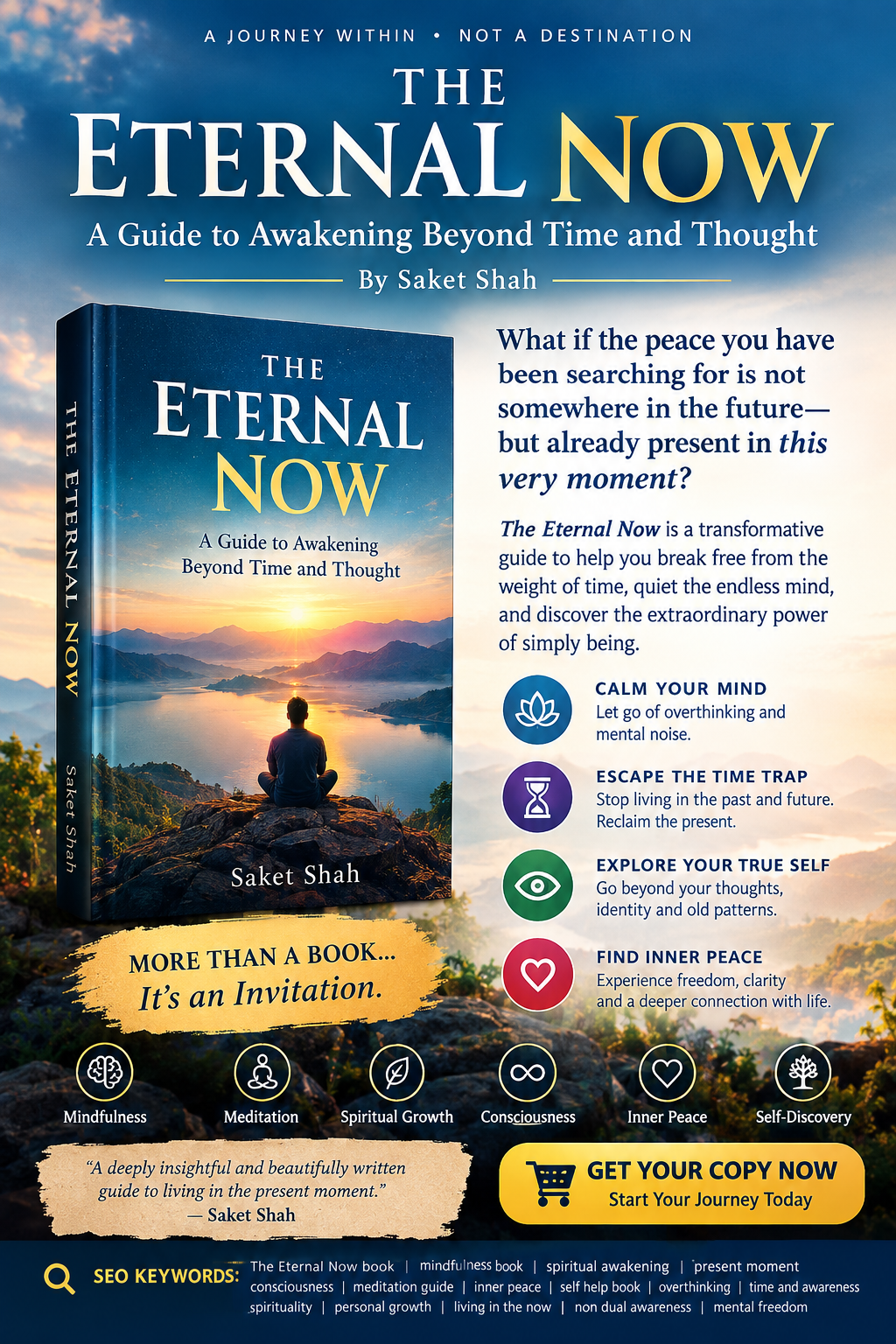
The Eternal Now A Guide to Awakening Beyond Time and Thought
THE ETERNAL NOW
A Guide to Awakening Beyond Time and Thought
By Saket Shah
What if the peace you have been searching for is not somewhere in the future—but already present in this very moment?
There is a moment when you stop chasing.
You stop replaying yesterday.
You stop rehearsing tomorrow.
You stop trying to become someone else.
And for just a few seconds, you simply are.
That moment is not insignificant.
It may be the doorway to something much deeper.
The Eternal Now is an invitation to explore that doorway.
This is not a book asking you to collect more spiritual information.
It is not a book demanding that you adopt a new belief system.
It is not a complicated philosophical manual filled with concepts you must memorize.
Instead, this book points toward something much closer, much simpler, and much more immediate:
the awareness that is already here.
As the author explains in the Preface, the purpose of this book is not to give you new information, but to point toward something that may already be known beneath the constant noise of thought.
HAVE YOU EVER FELT THAT YOUR MIND IS ALWAYS SOMEWHERE ELSE?
You may be sitting in one room while your mind is living in another decade.
You remember something that happened years ago.
You replay a conversation.
You imagine what you should have said.
You worry about what might happen tomorrow.
You plan.
You anticipate.
You analyze.
You compare.
You remember.
You worry.
And somewhere in the middle of all this mental activity, the actual moment of your life is passing quietly.
This is one of the central questions explored in The Eternal Now.
The book examines what happens when we become so identified with psychological time that we begin living primarily through memories of the past and projections of the future.
The past can arrive as memory, regret, and story.
The future can arrive as anxiety, planning, and hope.
And between them is the present moment—the one place where life is actually being experienced.
THE WEIGHT OF PSYCHOLOGICAL TIME
We all need clocks.
We need calendars.
We need history.
We need planning.
The book does not ask you to abandon these practical tools.
Instead, it explores something more subtle:
What happens when psychological time stops being a useful tool and becomes the place in which we unconsciously live?
Think about how much of your inner dialogue today has concerned something that already happened—or something that has not happened yet.
A conversation replayed in your head.
A mistake you wish you could undo.
A future problem rehearsed before it arrives.
A possibility imagined so vividly that it begins to feel more real than the room around you.
This is what the book calls the weight of time.
Not simply the clock on the wall.
The mental clock inside the mind.
The book suggests that the past we experience psychologically is being remembered now, while the future we imagine is also being imagined now.
That simple observation can become surprisingly profound.
Because if every memory is happening now...
And every anticipation is happening now...
Then perhaps the present moment is not something you need to reach.
Perhaps you have never actually left it.
YOU HAVE NEVER EXPERIENCED ANY MOMENT OTHER THAN NOW
This is one of the most striking ideas explored in the early chapters.
Think about your entire life.
Every celebration.
Every disappointment.
Every relationship.
Every achievement.
Every loss.
Every ordinary morning.
Every difficult night.
Every moment of laughter.
Every moment of silence.
Every single experience occurred as a present moment.
The past was once present.
The future, when it arrives, will also arrive as present.
There has never been an exception.
Yet we often behave as though the present is somewhere we need to reach.
We say:
"I need to become more present."
"I need to learn how to live in the moment."
"One day I will finally feel peaceful."
But The Eternal Now asks you to look more closely.
What if presence is not a destination?
What if you are not far away from it?
What if the problem is not that you cannot find the present moment—but that you overlook the one you are already experiencing?
The book describes this as a strange kind of forgetting: searching for something while already immersed in it.
PRESENCE DOES NOT REQUIRE A PERFECT MOOD
One of the most important distinctions in the book is that presence is not the same thing as feeling peaceful.
You do not have to wait until your mind becomes completely calm.
You do not have to manufacture bliss.
You do not have to eliminate every uncomfortable emotion.
You do not have to escape difficult circumstances.
A moment filled with anxiety is still a present moment.
A moment filled with grief is still a present moment.
A moment filled with uncertainty is still a present moment.
The question becomes:
Can you change your relationship with what is happening right now?
Instead of constantly trying to escape the present, the book invites you to explore what happens when you stop resisting the fact that this is the moment that is actually here.
That is a very different approach to spiritual practice.
WHAT IF YOU ARE NOT YOUR THOUGHTS?
Now the exploration moves even deeper.
Sit quietly for a moment and listen to your mind.
You may notice an endless stream of commentary:
"What should I do?"
"Am I doing this correctly?"
"What will happen?"
"Why did they say that?"
"What if something goes wrong?"
"I should have..."
"I need to..."
The voice seems so intimate that we naturally assume:
That voice is me.
But The Eternal Now asks you to investigate that assumption.
If you can observe a thought...
Who is observing it?
If you can notice worry...
Who is aware of the worry?
If you can hear the internal commentary...
Are you identical to the commentary?
The book uses the image of the sky and clouds to explore this distinction: thoughts can move through awareness without awareness itself being identical to the thoughts.
This creates an entirely different relationship with the mind.
FROM "I AM WORRIED" TO "WORRY IS HAPPENING"
Here is a simple experiment from the book.
When worry appears, instead of immediately becoming absorbed in its story, notice:
"There is worry happening."
Rather than:
"I am worried."
The distinction may sound small.
But experientially, it can create space.
The worry may still be there.
The situation may still need attention.
But the thought is no longer automatically treated as an absolute definition of who you are.
The book calls this witnessing.
Not suppression.
Not denial.
Not fighting the mind.
Simply noticing what is happening without becoming completely fused with it.
Over time, thoughts may continue to arise, but their authority can begin to change.
They become something you can observe and use rather than something that automatically controls your experience.
WATCHING THE WATCHER
Then comes an even deeper question:
Who is aware?
This is where the book moves beyond ordinary mindfulness into a direct investigation of awareness itself.
Instead of creating another intellectual answer, you are invited to look directly.
Close your eyes.
Try to find the one who is aware.
Not an image of yourself.
Not another thought.
Not a concept.
Simply look.
What happens?
The book explores the possibility that when you search directly for a separate watcher, you may find no solid entity behind awareness—only watching itself.
This is not presented as another identity to adopt.
You do not need to replace "I am this person" with "I am the witness" and build another conceptual identity.
The invitation is more subtle:
Look at awareness directly.
THE SCREEN THAT IS NEVER DAMAGED BY THE MOVIE
One of the book's most powerful images is the metaphor of a movie screen.
A screen can display a comedy.
A tragedy.
A war.
A romance.
A disaster.
A celebration.
Yet the screen itself is not burned by the fire appearing in the movie.
It does not become wet when tears appear on the screen.
It does not become violent because violence is depicted.
The images come and go.
The screen remains.
The Eternal Now uses this metaphor to explore awareness.
Thoughts arise.
Emotions arise.
Memories arise.
Plans arise.
Painful experiences arise.
Yet the awareness in which these experiences appear can be investigated as something distinct from their changing content.
This is not merely an idea to agree with.
The book repeatedly encourages you to notice it directly.
THE BODY: YOUR DOORWAY BACK TO NOW
The mind can travel into yesterday.
It can imagine next year.
It can construct elaborate hypothetical futures.
But the body is always here.
You cannot physically inhabit yesterday's breath.
You cannot feel tomorrow's sensations today.
Your body is always occurring in the present.
That makes bodily awareness one of the book's practical doorways into presence.
Try placing your attention on your hands.
Not thinking about your hands.
Actually feeling them.
Warmth.
Pressure.
Tingling.
Weight.
Subtle sensation.
The book suggests that direct sensing can naturally interrupt the momentum of discursive thought.
This gives the reader something practical to explore immediately.
OLD PAIN AND THE PATTERNS WE CARRY
The book also turns toward emotional patterns.
Why can a tiny comment sometimes produce an enormous reaction?
Why can a seemingly minor disagreement suddenly become emotionally overwhelming?
Why does something happening today sometimes seem to awaken something much older?
The Eternal Now explores this through the concept of the pain-body—described in the book as a pattern of old, unprocessed emotion that can become activated and temporarily influence perception and behavior.
Instead of automatically asking:
"Why did they make me so angry?"
the book encourages another question:
"Is this reaction proportional to what actually happened, or is something older being triggered?"
That question can create a completely different kind of self-awareness.
THE THIRD WAY: NEITHER SUPPRESSION NOR REACTION
When difficult emotion appears, we often do one of two things.
We suppress it.
Or we become it.
We push it away.
Or we act it out.
The book proposes a third possibility:
Presence.
Feel the sensation directly.
The heat.
The tightness.
The trembling.
The pressure.
Without immediately creating an elaborate story around it.
Without deciding that the emotion defines you.
Without demanding that it disappear instantly.
The book describes this as meeting the raw sensation with attention rather than feeding it through endless mental narration.
This is one of the central practical themes of the book:
What happens when you stop fighting your inner experience and begin witnessing it?
THE DOOR CALLED PRESENCE
Presence is one of the central ideas running throughout The Eternal Now.
But the book takes care to distinguish presence from simply thinking about the present.
Presence is not:
- forcing yourself to be calm
- eliminating every thought
- pretending everything is perfect
- escaping difficult emotions
- achieving a permanently peaceful mind
Instead, the book describes presence as direct attention to what is actually here, without unnecessary mental commentary.
And perhaps most importantly:
You do not need a special location to practice it.
You can explore presence:
while washing dishes.
while walking.
while sitting in traffic.
while listening to someone.
while working.
while drinking tea.
while waiting.
while breathing.
while reading this very page.
The setting is not necessarily the doorway.
Attention is.
ONE QUESTION THAT CAN CHANGE HOW YOU EXPERIENCE YOUR DAY
The book offers a simple practice:
Pause.
Take one full breath.
Then ask silently:
"What is here right now, before I think about it?"
Then notice.
Sounds.
Sensations.
Light.
Temperature.
The feeling of your body.
The environment.
The simple fact of being here.
No elaborate ritual is required.
No special equipment.
No complicated philosophy.
The practice is simply to notice.
Repeatedly.
Gently.
Sincerely.
The book suggests that even small pauses throughout the day can begin loosening habitual identification with constant thinking.
WHO ARE YOU WITHOUT YOUR STORY?
Every person carries an autobiography.
Your name.
Your history.
Your achievements.
Your failures.
Your relationships.
Your roles.
Your memories.
Your preferences.
Your opinions.
Your ideas about what happened to you.
Together, these form a story of you.
But is the story actually the whole of who you are?
The Eternal Now explores this question directly.
What happens if, for a moment, you put the story aside?
Not destroy it.
Not deny it.
Simply stop thinking about it.
What remains?
The book points toward a simple sense of presence and awareness that does not depend on constantly narrating the biography of the person you believe yourself to be.
This can be a powerful investigation for anyone interested in:
self-awareness
mindfulness
consciousness
spiritual awakening
meditation
presence
inner peace
non-dual awareness
living in the present moment
freedom from overthinking
LETTING LIFE BE
Another major theme is resistance.
How much suffering comes from what is actually happening?
And how much comes from the additional thought:
"This should not be happening."
Imagine sitting in traffic.
The cars are not moving.
That is the situation.
Then the mind begins:
"This is ridiculous."
"I shouldn't be here."
"Why does this always happen to me?"
"I am going to be late."
"This should be different."
The traffic has not changed.
But the inner experience has become much heavier.
The book makes an important distinction here:
acceptance is not passivity.
You can accept what is happening right now while still taking intelligent action.
You can call someone.
Change your route.
Leave earlier next time.
Solve the problem.
The key is not to waste additional energy fighting the undeniable fact of the present moment.
LOVE IN THE PRESENT TENSE
The book eventually brings presence into relationships.
And this is where the idea becomes especially human.
How often do we relate not to the person actually standing in front of us, but to an image of that person?
Who they were.
Who we think they should be.
Who we hope they will become.
What we expect them to give us.
What happened yesterday.
What we fear will happen tomorrow.
The book explores the difference between loving someone as they actually are in the present and relating to a mental construction built from memory, expectation, and desire.
Love in the present tense becomes an act of attention.
Listening.
Seeing.
Being there.
Without constantly demanding that the moment become something else.
WHAT THE TREES KNOW
Nature becomes another teacher.
A tree does not worry about tomorrow's weather.
It does not replay yesterday's storm.
It grows where it is.
It meets the season that is actually here.
Spring.
Summer.
Autumn.
Winter.
Each arrives.
Each passes.
The book uses nature as a mirror for presence and impermanence.
You do not necessarily need a mountain retreat.
You can sit beside a tree.
Watch leaves move.
Listen to wind.
Observe light.
Notice the changing world without immediately turning the experience into another mental story.
The teaching is available in something as ordinary as a plant on a windowsill.
WHY BUY THE FULL BOOK?
Because the journey does not end with one insight.
The Eternal Now is designed as a gradual exploration.
It moves through themes including:
THE WEIGHT OF TIME
Understanding psychological time and how past/future thinking can pull attention away from direct experience.
THE PRESENT MOMENT
Exploring why you may not need to "reach" presence because you are already experiencing it.
THE INNER VOICE
Learning to recognize the difference between thoughts and the awareness that notices them.
THE WITNESS
Investigating the nature of awareness beyond conceptual identity.
THE BODY
Using direct bodily sensation as an anchor for returning to now.
OLD PAIN
Exploring unconscious emotional patterns and the possibility of meeting them with awareness.
PRESENCE
Developing a direct relationship with what is actually happening.
IDENTITY
Questioning the assumption that your personal story is the entirety of who you are.
ACCEPTANCE
Understanding the difference between accepting the present and giving up on meaningful action.
INNER SILENCE
Exploring the silence beneath thought and sound.
BREATH
Using the breath as a continual doorway back to the present.
LOVE
Bringing presence into relationships and human connection.
NATURE
Learning from impermanence, stillness, growth, and the rhythms of the natural world.
THE END OF STRUGGLE
Exploring what happens when the endless demand for a different future is recognized and released.
And the exploration continues beyond these themes.
THIS BOOK IS FOR YOU IF...
You find yourself constantly thinking about the past.
You worry excessively about what might happen next.
You have difficulty staying with the present moment.
You are interested in meditation but want something more reflective than a collection of techniques.
You are exploring spirituality without wanting rigid dogma.
You are interested in consciousness and awareness.
You want to understand the difference between thoughts and the awareness of thoughts.
You are curious about mindfulness.
You want to investigate the nature of identity.
You are interested in inner freedom.
You want to explore how presence can influence relationships.
You want to examine your relationship with emotional pain.
You are searching for a deeper relationship with ordinary life.
Or perhaps you simply feel that there must be more to being alive than endlessly remembering what was and anticipating what might be.
THIS IS NOT A BOOK YOU HAVE TO "BELIEVE"
You do not need to accept every idea immediately.
In fact, the book repeatedly encourages direct investigation.
Read.
Pause.
Notice.
Experiment.
Look for yourself.
If an idea resonates, explore it.
If it does not, investigate why.
The book's Preface describes the chapters as invitations rather than instructions and encourages the reader to read slowly and pause often.
That makes The Eternal Now especially suited to readers who want to experience the ideas rather than merely collect them.
A BOOK TO RETURN TO
Some books are read once.
Others become companions.
The Eternal Now is written in a way that makes returning useful.
You may read a passage today and understand it intellectually.
Months later, you may encounter the same idea through a completely different experience.
A difficult conversation.
A quiet morning.
A walk.
A loss.
A moment of joy.
A period of uncertainty.
A breath.
A pause.
And suddenly a sentence you read months ago may mean something entirely different.
That is the nature of a book concerned with presence:
it is not only about what you understand.
It is about what you notice.
YOUR SEARCH MAY BE CLOSER THAN YOU THINK
Perhaps you have been searching for peace.
Perhaps you have been searching for meaning.
Perhaps you have been searching for yourself.
Perhaps you have read books about spirituality, meditation, consciousness, mindfulness, enlightenment, self-awareness, or personal transformation.
Perhaps you have learned many ideas.
And yet the mind keeps asking:
"What next?"
The Eternal Now offers a different possibility.
Before searching for the next answer...
Pause.
Before becoming someone new...
Notice who is already here.
Before trying to escape this moment...
Look at this moment directly.
Before believing the next thought...
Notice that the thought is being observed.
Before carrying yesterday into today...
Notice what is actually happening now.
Before postponing peace until tomorrow...
Investigate what is present today.
THE INVITATION
You do not have to travel anywhere to begin.
You do not have to wait for a perfect life.
You do not have to become a different person.
The doorway described throughout this book is remarkably close.
It is the moment you are already experiencing.
The breath you are already breathing.
The body you are already inhabiting.
The sounds already surrounding you.
The awareness already noticing these words.
The present moment you have never actually left.
The Eternal Now is an invitation to investigate that directly.
Not someday.
Not when life becomes perfect.
Not when the mind finally becomes silent.
Now.
GET YOUR COPY OF THE ETERNAL NOW
If you are ready to explore presence, awareness, consciousness, mindfulness, inner stillness, and the possibility of living with less identification with psychological time, this book offers a contemplative journey through these themes.
Read it slowly.
Pause often.
Experiment with the practices.
Question what you assume.
Notice what is already here.
And perhaps, somewhere between one thought and the next, you will discover that what you were searching for was never as far away as you imagined.
THE ETERNAL NOW
A Guide to Awakening Beyond Time and Thought
By Saket Shah
Your next moment is already here.
Begin there.
Keywords.
- The Eternal Now
- The Eternal Now book
- Saket Shah
- mindfulness book
- spiritual awakening book
- present moment
- living in the now
- consciousness book
- meditation book
- inner peace
- book about living in the present moment
- how to live in the present
- spiritual awakening and consciousness
- mindfulness and self awareness
- how to stop overthinking
- finding inner peace
- spiritual growth book
- self discovery book
- awareness and consciousness
- meditation and mindfulness
- freedom from thoughts
- awakening beyond time and thought
- understanding the present moment
- living in the now book
- personal growth and spirituality
the eternal now, saket shah, mindfulness, spiritual awakening, present moment, living in the now, consciousness, meditation, inner peace, self awareness, spiritual growth, self discovery, overthinking, mindful living, spirituality, personal growth, awareness, inner transformation, mental clarity, non dual awareness, meditation guide, consciousness book, spiritual book, mindfulness book, present moment awareness