
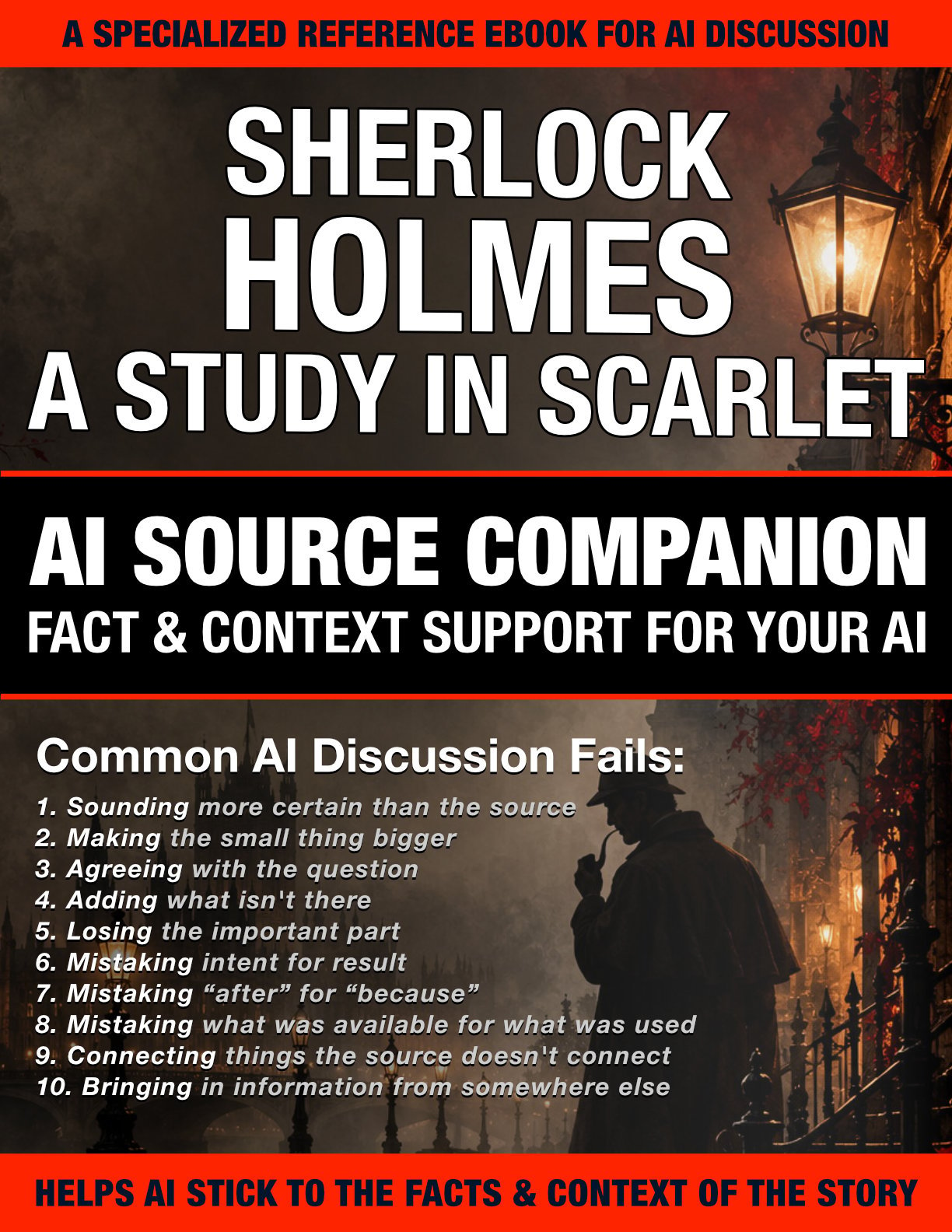
Sherlock Holmes: A Study in Scarlet by Arthur Conan Doyle • AI SOURCE COMPANION (PDF)
Sherlock Holmes: A Study in Scarlet by Arthur Conan Doyle • AI SOURCE COMPANION (PDF)
Structured analytical reference material for working with A Study in Scarlet in ChatGPT, Claude, Gemini, and other document-capable AI systems.
Arthur Conan Doyle’s A Study in Scarlet presents a different kind of reasoning environment from regulation, policy, or technical documentation.
The source is a narrative. Statements may come from a narrator, a character, an observed event, a recollection, an explanation offered after the fact, or an inference made from incomplete information. Relationships among events may depend on chronology, perspective, evidence, and what particular characters know at a particular point in the story.
Working with that material in an AI system creates a problem that ordinary text retrieval does not solve by itself.
Finding the right passage is only part of the task.
The AI must also distinguish what the text directly establishes, what a character claims, what is observed, what is inferred, which events are actually connected, and when a later explanation changes the reader’s understanding without rewriting what an earlier passage originally established.
The Sherlock Holmes: A Study in Scarlet — AI Reasoning Companion is designed to support that kind of sustained source-based work.
It is a reference publication intended for use alongside the source text of A Study in Scarlet in ChatGPT, Claude, Gemini, and other AI systems capable of working with uploaded documents.
It does not replace the novel.
Instead, it adds two layers of prepared analytical reference material:
AI Reasoning Instructions for governing how the AI handles source material, analytical records, inference, uncertainty, later explanation, new research, and other information introduced during a conversation.
72 Source Snapshot Records preserving bounded analyses of selected structures identified in the novel.
What the Source Snapshot Records cover
The records examine selected structures involving areas such as:
observation and inference
statements, claims, and evidentiary support
relationships among characters
investigative developments
narrative perspective
chronology and retrospective explanation
knowledge available to different characters
distinctions between observation, interpretation, and conclusion
clues and their supported relationships
competing explanations
qualifications and unresolved questions
relationships between earlier events and later disclosures
broader and more detailed structural views of the narrative
These are not chapter summaries or simplified retellings of the novel.
Each Source Snapshot Record is a bounded analytical reference tied to identified source material and a defined analytical boundary. A record may preserve a supported relationship, distinction, chronology, constraint, characterization, evidentiary connection, unresolved issue, or other analytically significant feature of the text.
The objective is to give a later AI conversation access to analytical work that has already been separated, bounded, and documented rather than requiring every relationship to be reconstructed from scratch.
Built for sustained AI-assisted reading and analysis
A single question about a novel can often be answered by retrieving the relevant passage.
Longer conversations are more difficult.
As questions accumulate, earlier interpretations become part of the conversational context. A character’s statement can begin to resemble an established fact. An inference made during the investigation may be remembered as though it had already been confirmed. Events that occur near one another can be treated as causally connected without sufficient support. Information revealed later in the story can migrate backward and change how earlier passages are described.
The Companion is designed to provide additional structure for that environment.
Its AI Reasoning Instructions require distinctions among source material, Source Snapshot Records, current analytical reasoning, character statements, inference, uncertainty, newly introduced information, and unsupported extensions.
Its Source Snapshot Records preserve selected analytical findings within documented boundaries so that later reasoning can refer to them without silently expanding what they establish.
Source material remains primary
The Companion is not a substitute for A Study in Scarlet.
It is designed to be uploaded alongside the source text used for the edition.
Arthur Conan Doyle — A Study in Scarlet
The source text A Study in Scarlet is not included with the Companion.
When a question extends beyond the existing Source Snapshot Records, the novel remains available for direct examination.
This allows the AI to work with both prepared analytical structure and the original evidence rather than forcing one to replace the other.
Designed to preserve narrative evidence
A Study in Scarlet is particularly suited to this kind of source-based analysis because the narrative repeatedly separates what is seen, what is said, what is inferred, and what is eventually explained.
Those categories are not interchangeable.
A character may state something without the narrative establishing that it is true.
An observation may support several possible interpretations.
An inference may later receive additional support, remain uncertain, or be displaced by new information.
A later explanation may clarify earlier events without changing what was actually available to the characters or reader at the earlier point in the narrative.
The Companion preserves those distinctions.
That makes it possible to ask not only:
What happens in the story?
but also:
What does the text actually establish at this point?
Who knows this information?
Is this an observation, a claim, an inference, or a later explanation?
What evidence supports the connection being made?
Was this relationship established at the time, or only understood later?
How far can the available evidence support the conclusion?
Those questions are useful when examining a work built around investigation, interpretation, and the gradual resolution of uncertainty.
Why chronology and perspective matter
Narrative order and event order are not always the same thing.
A Study in Scarlet changes perspective and moves between different periods and bodies of information. Later material can provide context for events presented earlier, while characters within the story may possess very different amounts of information at different times.
That creates an important distinction for AI-assisted analysis.
A later explanation should not be silently treated as though it were already established in an earlier scene.
Likewise, knowledge available to the reader should not automatically be attributed to a character who had not yet acquired it.
The Companion is designed to preserve these boundaries between event chronology, narrative presentation, character knowledge, and later interpretation.
This makes it possible to examine how the story develops without flattening its sequence of discovery into one retrospective account in which everything appears to have been known from the beginning.
Observation is not inference
The Sherlock Holmes stories are strongly associated with reasoning from evidence, but that makes careful distinctions especially important.
An observed detail is not automatically the conclusion drawn from it.
Two observations do not establish a relationship merely because they appear together.
A plausible explanation is not the same thing as a demonstrated explanation.
A character’s confidence does not itself establish that the character is correct.
The Companion therefore preserves distinctions among presence, observation, statement, inference, proposed relationship, and supported conclusion.
This does not prevent the AI from interpreting the novel.
It gives that interpretation a clearer basis.
Multiple analytical resolutions
The Companion contains records constructed at defined analytical resolutions.