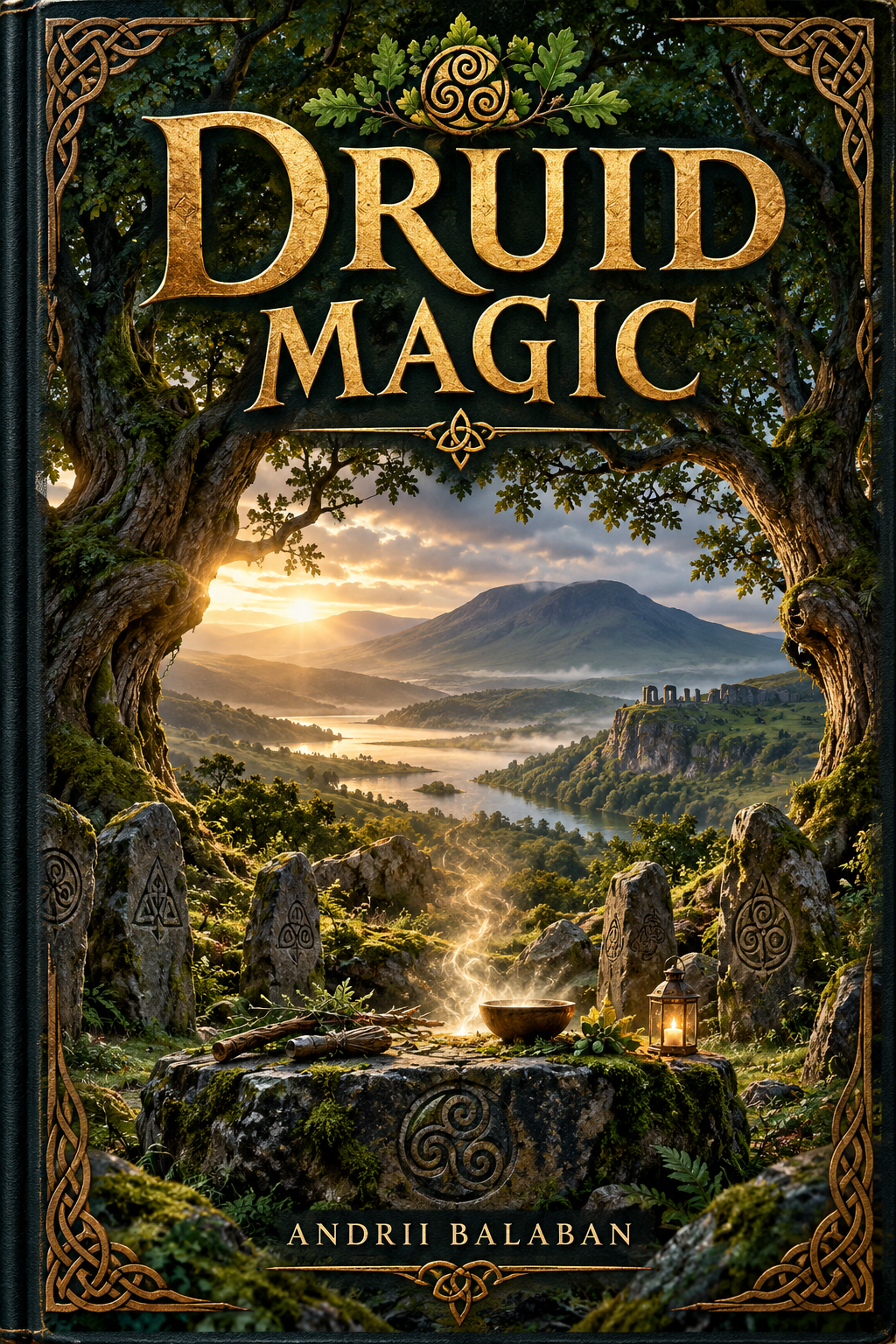
Druid magic
Contents
Chapter 1. The Druids: History, Mystery, and the Foundations of Druid Magic
The opening chapter examines who the historical Druids were and separates surviving evidence from later legend, Romantic reconstruction, and modern Druidic revival. It explores their reported roles as religious specialists, teachers, judges, philosophers, advisers, keepers of oral knowledge, and participants in ritual life, while also examining the limitations of classical accounts and the absence of surviving Druidic ritual manuals. The chapter introduces the ancient Celtic cultural environment, the importance of oral transmission, sacred authority, memory, poetry, law, and the relationship between knowledge and spiritual power. From this historical foundation, the reader begins constructing a practical understanding of Druid magic that respects the ancient sources without pretending that modern rituals can simply reproduce a lost tradition word for word.
Chapter 2. The Sacred Landscape: Forests, Groves, Rivers, Springs, Mountains, and the Spirit of Place
Druid magic begins not with an altar built inside a room but with an awareness of landscape. This chapter explores the sacred grove, forest, river, spring, lake, hill, mountain, boundary, crossroads, and other places that acquire spiritual significance through geography, tradition, memory, and ritual use. The reader learns how to approach a natural location, observe it before performing magical work, establish a respectful ritual boundary, recognize the symbolic character of different landscapes, and create a temporary sacred space without damaging the environment. Practical rites include entering and leaving a sacred place, establishing a personal grove, making non-destructive offerings, working with the four directions, and developing a disciplined relationship with the genius loci or spirit of place.
Chapter 3. The Wisdom of Trees: Oak, Yew, Rowan, Hazel, Hawthorn, Apple, and the Living Forest
Trees stand at the center of the popular and spiritual imagination surrounding Druidry, and this chapter develops their symbolism into a practical magical system. Oak is explored through strength, sovereignty, endurance, and sacred authority; yew through death, continuity, and ancestral memory; rowan through protection; hazel through wisdom and inspiration; hawthorn through boundaries and liminality; apple through abundance, beauty, healing, and the Otherworld. The chapter also examines later traditions associated with tree alphabets and Ogham while carefully distinguishing historical evidence from modern esoteric interpretation. Rituals teach the reader how to work symbolically with living trees, fallen branches, leaves, wooden talismans, meditation, tree contemplation, and a personal tree oracle without injuring or exploiting the living forest.
Chapter 4. Herbs, Mistletoe, Sacred Plants, and the Green Mysteries
This chapter enters the magical symbolism of plants, herbs, flowers, seeds, berries, and the legendary place of mistletoe in accounts of Druidic ritual. It examines the relationship between plant life and ideas of purification, fertility, protection, healing, prosperity, vision, death, and renewal. The practical system emphasizes symbolic and external ritual uses while clearly distinguishing magical tradition from pharmacology and medicine. The reader learns methods for gathering plant material responsibly, creating ritual bundles, botanical talismans, protective wreaths, symbolic offerings, incense where safe, and seasonal plant rites. The chapter also develops the idea of the magician as a keeper rather than merely a consumer of the green world.
Chapter 5. Earth, Air, Fire, and Water: The Powers of Nature in Druid Ritual
The forces of nature become the operational language of ritual in this chapter. Earth represents stability, embodiment, boundaries, fertility, and endurance; air represents breath, movement, speech, thought, and inspiration; fire represents illumination, transformation, courage, purification, and sacrifice; water represents emotion, cleansing, memory, healing, and transition. Rather than forcing later occult elemental systems mechanically onto ancient Celtic religion, the chapter uses these natural forces as a transparent modern ritual framework inspired by the landscape-centered character of Druidic spirituality. The reader learns elemental invocations, purification rites, balancing ceremonies, methods of constructing an elemental altar, and a complete fourfold ritual in which the powers of nature are called, acknowledged, worked with, thanked, and released.
Chapter 6. Stones, Circles, Wells, and Ancient Places of Power
Standing stones and stone circles have become inseparable from modern imagery of the Druids, even though many famous megalithic monuments were built long before the historical Celtic Druids. This chapter explains that distinction while exploring why ancient stones nevertheless possess such powerful symbolic importance in later Druidic imagination. Stone is treated as a symbol of memory, endurance, boundary, witness, permanence, and ancestral time. The reader learns how to create a personal ritual circle using movable stones, work with a single ritual stone as an anchor of intention, perform ceremonies near historical sites without damaging or appropriating them, and combine stone symbolism with springs, wells, water, and landscape. A complete Stone Circle Rite teaches how to establish a temporary ceremonial center wherever responsible practice permits.
Chapter 7. The Wheel of the Year: Samhain, Imbolc, Beltane, Lughnasadh, and the Seasonal Mysteries
The changing year provides one of the most powerful structures for nature-centered magical practice. This chapter examines the major Gaelic seasonal festivals commonly incorporated into modern Druidic and Celtic-inspired practice — Samhain, Imbolc, Beltane, and Lughnasadh — together with the solstices and equinoxes as part of a broader contemporary ritual calendar. Each festival is explored through its historical background, later folklore, symbolism, natural environment, and possible modern ritual meaning. The reader learns ceremonies for endings, beginnings, purification, fertility, creativity, harvest, gratitude, remembrance, and renewal. Rather than treating the calendar as a collection of decorative festivals, the chapter teaches how repeated seasonal observance can become a long-term magical discipline through which personal life is consciously placed within the greater cycles of nature.
Chapter 8. Sun, Moon, Stars, Dawn, Twilight, and the Sacred Measure of Time
Druid magic is inseparable from observation of the changing natural world, and this chapter turns attention toward the heavens. The Sun is explored through illumination, vitality, visibility, sovereignty, growth, and completion; the Moon through change, reflection, rhythm, mystery, and inward attention; dawn and sunset through transition; darkness through rest, uncertainty, and hidden potential. The chapter distinguishes historically supportable ideas from later astrological and occult additions while developing a practical system for choosing ritual times through natural observation. Solar rites, lunar meditations, dawn ceremonies, twilight workings, and simple methods of recording celestial and seasonal cycles teach the practitioner to experience magical time not merely as a date on a calendar but as a quality of relationship between human intention and the surrounding world.
Chapter 9. The Druid’s Ritual Tools: Staff, Wand, Cauldron, Sickle, Robe, Fire, and Sacred Symbols
This chapter examines the objects that have become associated historically, folklorically, or symbolically with Druidic practice and explains how they may be adapted responsibly for contemporary ritual. The staff becomes a symbol of authority, direction, journey, and connection between earth and sky; the wand represents focused intention; the cauldron represents transformation, inspiration, abundance, and mystery; the robe marks the transition into ritual identity; fire establishes a living ceremonial center. The sickle and other historically charged objects are discussed primarily through their symbolism rather than as requirements for dangerous imitation. The reader learns how to select, prepare, consecrate, use, store, and eventually retire personal ritual tools, culminating in a complete ceremony for establishing a Druidic working set.
Chapter 10. Divination, Ogham, Omens, Dreams, and the Art of Sacred Interpretation
Divination in a Druidic framework is approached as disciplined interpretation rather than unlimited prediction. This chapter examines Ogham in its historical context and then explores the later development of tree-based and divinatory interpretations associated with it. The reader learns how to construct and use a personal Ogham-inspired divination set while remaining aware of where historical evidence ends and modern esoteric practice begins. Dreams, weather, animal encounters, natural patterns, intuitive impressions, and apparent omens are also discussed, together with the danger of turning ordinary coincidence into compulsive sign-reading. Practical exercises teach how to formulate questions, record interpretations, compare them with later events, tolerate uncertainty, and close a divination session without repeatedly asking the same question until a desired answer appears.
Chapter 11. Protection, Purification, Healing, and the Restoration of Balance
This chapter develops a system of Druid-inspired protective and restorative magic based on boundaries, cleansing, natural symbolism, emotional stabilization, and the restoration of order. Water, smoke where appropriate, sound, fire, stone, branches, circles, spoken formulas, and symbolic offerings are incorporated into rituals for purification of a person or place, strengthening personal boundaries, ending periods of emotional heaviness, and marking recovery after conflict, exhaustion, grief, or disruption. Healing magic is presented as spiritual and symbolic support rather than a replacement for medical or psychological care. The deeper purpose of protection is defined not as living in constant fear of invisible attack, but as developing a stable center from which the practitioner can distinguish genuine problems from anxiety and respond appropriately to both.
Chapter 12. Ancestors, Spirits, the Otherworld, and the Veil Between Worlds
The ancient Celtic imagination contains a rich landscape of ancestors, divine beings, spirits, sacred places, and Otherworld narratives. This chapter explores these traditions without pretending that later literary material provides a literal manual of ancient Druidic spirit work. The reader learns methods of ancestral remembrance, symbolic offerings, meditation at thresholds, respectful invocation, dream preparation, and ritual communication framed by clear openings and closings. Particular attention is given to Samhain, liminal places, silence, darkness, memory, and the ethical boundaries of spirit-oriented practice. The chapter also addresses discernment: powerful dreams, emotions, coincidences, and altered states may carry personal meaning without automatically proving an external supernatural cause. A complete Otherworld Threshold Rite brings together protection, invocation, contemplation, offering, thanksgiving, and formal return to ordinary awareness.
Chapter 13. The Complete Path of Druid Magic
The final chapter unites the entire book into a coherent personal practice. The sacred landscape, trees, plants, elements, stones, seasonal festivals, celestial cycles, ritual tools, divination, protection, restoration, ancestors, and the Otherworld are brought together as parts of one living system rather than isolated techniques. The reader learns how to establish daily, weekly, monthly, seasonal, and annual forms of practice; how to maintain a Druidic journal; how to create a personal grove or ritual space; how to develop ceremonies without falsely attributing modern inventions to antiquity; and how to allow ritual forms to become simpler as experience grows. The book culminates in a complete Druidic ceremony that begins with entering sacred space, establishes the center and directions, acknowledges the powers of the natural world, states the intention, performs the central magical work, gives thanks, releases what has been invoked, and returns the practitioner to ordinary life. The final teaching is simple: observe before speaking, understand before acting, take only what is needed, leave the place unharmed, remember those who came before, and allow every ritual to deepen rather than replace the practitioner’s relationship with the living world.