
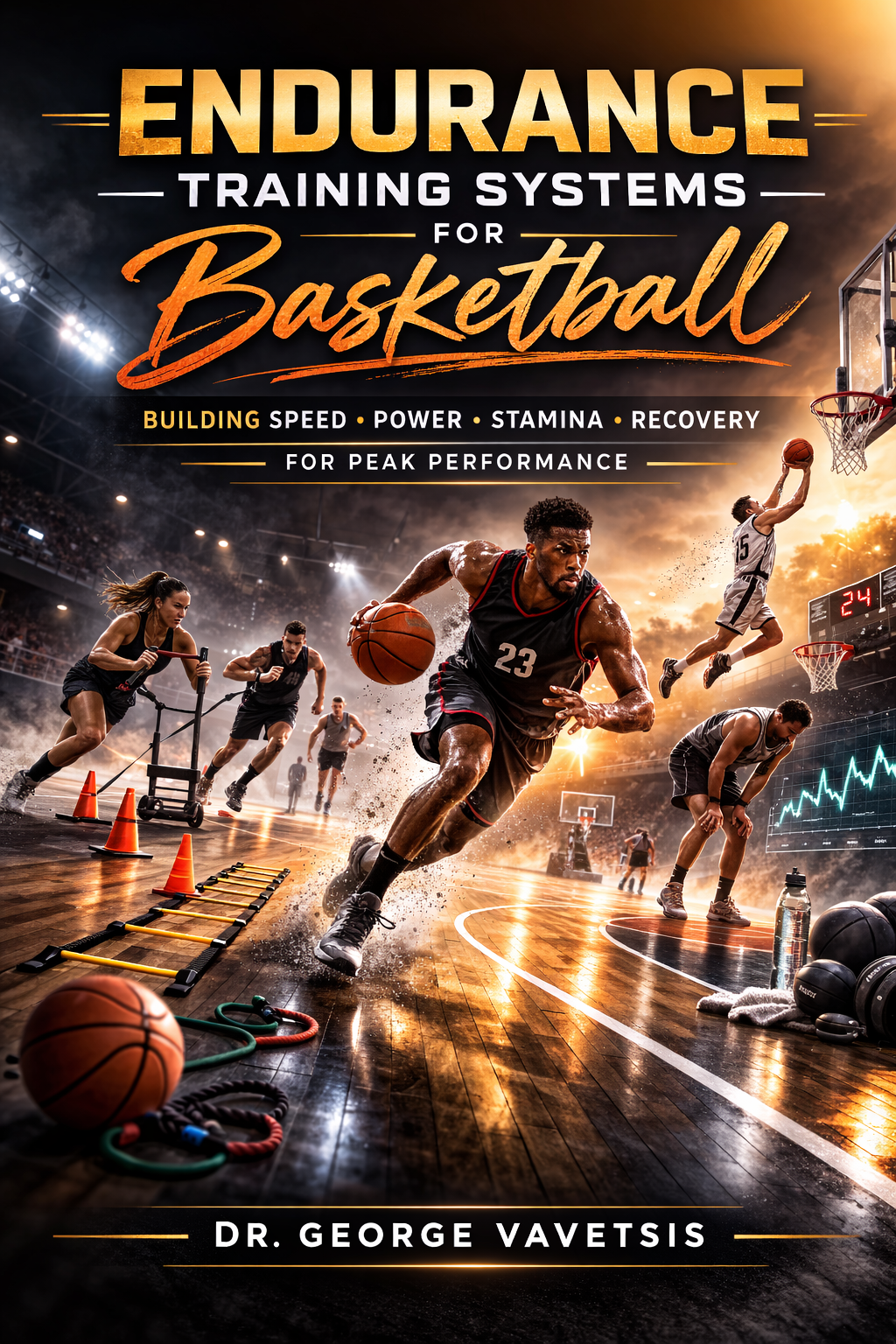
Endurance Training Systems for Basketball
Pages: 1105
Basketball is a sport defined by explosive effort, relentless pace, and repeated transitions between maximal intensity and strategic recovery. While strength, skill, and tactical intelligence often dominate discussions about elite performance, the physiological foundation that sustains these qualities across an entire game—and across an entire season—is endurance. However, endurance in basketball is fundamentally different from endurance in traditional cyclic sports such as distance running or cycling. It is intermittent, chaotic, and multidimensional. It requires the capacity to repeatedly produce high power outputs while maintaining cognitive precision, technical execution, and tactical awareness under fatigue.
This book, Endurance Training Systems for Basketball, was written to address the complex physiological and performance demands of modern basketball and to provide strength and conditioning coaches, sport scientists, and performance specialists with a structured, evidence-based framework for developing basketball-specific endurance. The objective is not merely to increase an athlete’s ability to run longer or tolerate fatigue, but rather to optimize the athlete’s ability to sustain repeated high-intensity efforts that mirror the true energetic and mechanical patterns of competition.
Game analysis consistently shows that basketball performance is dominated by short bursts of explosive activity—accelerations, decelerations, changes of direction, jumps, and defensive slides—typically lasting only a few seconds and separated by brief recovery periods. The majority of these movements occur over distances shorter than 15 meters, with more than 95% of all movements during a game remaining under 50 meters. These patterns clearly demonstrate that basketball endurance is not based on continuous locomotion but on the ability to repeatedly execute explosive efforts within an intermittent structure.
Because of this intermittent structure, the physiological demands of basketball require the coordinated interaction of all three major energy systems: the phosphagen system (ATP-PC), anaerobic glycolysis, and the aerobic oxidative system. While explosive actions rely primarily on ATP-PC energy pathways, the aerobic system plays a crucial role in facilitating recovery between repeated high-intensity efforts. The ability to resynthesize phosphocreatine, remove metabolic by-products, and maintain neuromuscular function throughout extended competition depends heavily on aerobic capacity.
Consequently, basketball endurance must be conceptualized not as a single physical quality but as an integrated performance capacity composed of multiple interacting components:
• Repeated sprint ability
• Explosive endurance and phosphagen recovery
• Glycolytic tolerance during repeated possessions
• Aerobic recovery capacity between bursts of activity
• Neuromuscular resilience under fatigue
• Technical and tactical execution during physiological stress
Traditional conditioning methods—long-distance running, generic aerobic work, or non-specific interval training—fail to replicate the dynamic and multidirectional demands of the sport. As a result, these methods often produce limited transfer to actual game performance. Modern basketball conditioning must instead be built around sport-specific movement patterns, realistic work-to-rest ratios, and drills that reproduce the physiological tempo of competition.
Research on elite basketball competition reveals that possessions typically follow work-to-rest ratios between approximately 1:3 and 1:6, with explosive efforts lasting between three and six seconds followed by active recovery periods of 15–30 seconds. These patterns provide a clear blueprint for designing conditioning systems that closely reflect the metabolic and mechanical structure of the game.
This book therefore adopts a systems-based approach to basketball endurance training, integrating physiological science, performance analytics, and applied coaching methodology. Rather than presenting isolated conditioning drills, the book organizes endurance development into structured training systems that align with the tactical, metabolic, and neuromuscular realities of elite basketball.
Throughout the chapters, readers will explore:
• The physiological foundations of basketball endurance
• The interaction between aerobic and anaerobic energy systems in intermittent sport performance
• Methods for developing repeated high-intensity effort capacity
• Strategies for improving recovery kinetics between explosive actions
• Basketball-specific conditioning drills that replicate game tempo and movement patterns
• Advanced approaches to conditioning periodization across the competitive season
• Monitoring tools for evaluating endurance performance, including heart rate metrics, Yo-Yo testing, and repeated sprint protocols
Particular attention is given to the principle of specificity. Conditioning must replicate not only the metabolic intensity of the game but also the exact movement patterns and decision-making environments encountered in competition. For this reason, many of the training systems described in this book integrate basketball-specific movements such as sprint–deceleration sequences, multidirectional transitions, defensive slides, jumps, and reactive decision-making tasks.
Another central theme is the concept of intermittent endurance—the capacity to repeatedly produce high power outputs across extended periods without significant decline in performance. This capacity is essential in modern basketball, where players must execute explosive actions dozens of times during a single game while maintaining tactical awareness and technical precision.
Furthermore, endurance training must be carefully integrated within the broader performance development framework. Strength training, plyometrics, tactical practice, and recovery strategies all interact with conditioning loads. Effective endurance programming therefore requires thoughtful periodization and individualized monitoring to ensure that training stress enhances performance rather than producing excessive fatigue.
Ultimately, the goal of this book is to bridge the gap between physiological theory and practical coaching application. By translating scientific principles into clear training systems and actionable protocols, this work aims to provide coaches and performance specialists with tools that can directly improve basketball performance at the highest levels of competition.
Basketball is a sport of speed, precision, and relentless intensity. Players who can sustain explosive performance deep into the fourth quarter—and deep into the season—possess a decisive competitive advantage. Developing that advantage requires more than conditioning; it requires a scientifically grounded system for building basketball-specific endurance.