


The Psychology of Humor
Opening Chapter: The Science and Soul of Humor
Humor is one of the most underestimated powers of the human mind. It is both a psychological tool and a social art, an invisible thread that binds people together, lightens emotional burdens, and sharpens creativity. In moments of laughter, our brains reveal something profoundly human: the ability to transform confusion into clarity, fear into courage, and isolation into connection.
As a psychologist, I’ve spent decades exploring the ways people cope with life’s challenges, how they recover from failure, maintain emotional balance, and connect meaningfully with others. Again and again, I’ve seen one factor stand out across cultures and personalities: humor. Those who can laugh, especially at themselves, tend to be more resilient, more creative, and ultimately, more fulfilled. Humor, when understood deeply, isn’t a trivial escape from life’s seriousness; it is an intelligent response to it.
This eBook explores the psychology, purpose, and practice of humor, from its roots in the brain to its real-world applications in leadership, relationships, and wellbeing. You will learn not only why humor matters, but how it works, neurologically, emotionally, and socially. We’ll explore how humor activates reward centers in the brain, strengthens trust between people, and reduces stress by reshaping our emotional responses.
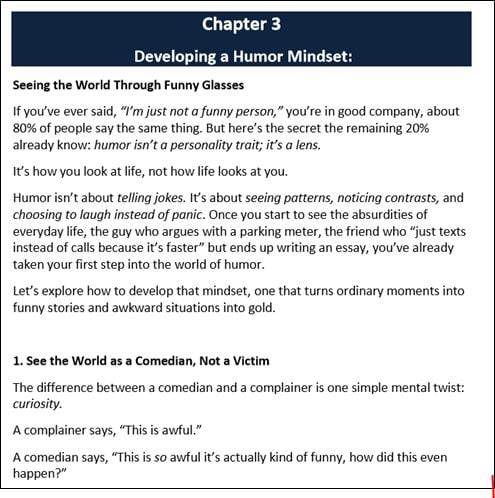
You’ll also discover how to develop a humor mindset: a way of seeing the world that invites lightness even amid pressure. We’ll discuss how to overcome the fear of embarrassment, and how to practice humor as a skill that can be learned, refined, and mastered.
In the professional realm, you’ll learn how to use humor wisely and effectively, not as a gimmick, but as a form of emotional intelligence. From the boardroom to the classroom, humor can strengthen
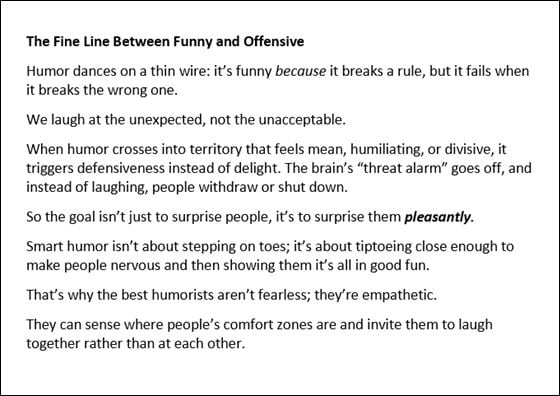
influence, foster collaboration, and make leadership more human. We’ll explore how to read the room, balance confidence with respect, and use laughter as a bridge rather than a barrier.
You’ll also learn to craft your unique humor voice, your authentic way of being funny. Whether your style is witty, observational, self-deprecating, or playful, you’ll discover how to make humor feel natural rather than forced. We’ll even dive into the mechanics of great humor writing, timing, rhythm, and the element of surprise, and how these same principles apply to spoken communication.
Later chapters will explore improvisation and spontaneous humor, how quick thinking and mindful listening create moments of effortless laughter. We’ll also see how humor fuels creativity and problem-solving, helping us think more flexibly and approach challenges with an open mind.
And because life isn’t always easy, we’ll discuss humor in difficult situations: how laughter can disarm tension, bring perspective, and remind us of our shared humanity without minimizing pain. There are limits to humor, of course, and wisdom lies in knowing when to use it and when to simply be present.
Finally, this book will help you put humor into practice - in conversations, writing, leadership, and daily life. Through stories, exercises, and real-world examples, you’ll build your personal “humor toolkit,” a set of habits and insights to make laughter a steady companion rather than an occasional guest.
At its core, this eBook is not about being a comedian, it’s about being more human. Humor doesn’t demand you to be loud, quick, or clever; it asks you to be alive, present, and open to joy.
By the end of this journey, you will see humor not as an accessory to life, but as one of its essential forms of wisdom, a gentle, brilliant way to connect, to heal, and to lead.
Dylan Byrne