
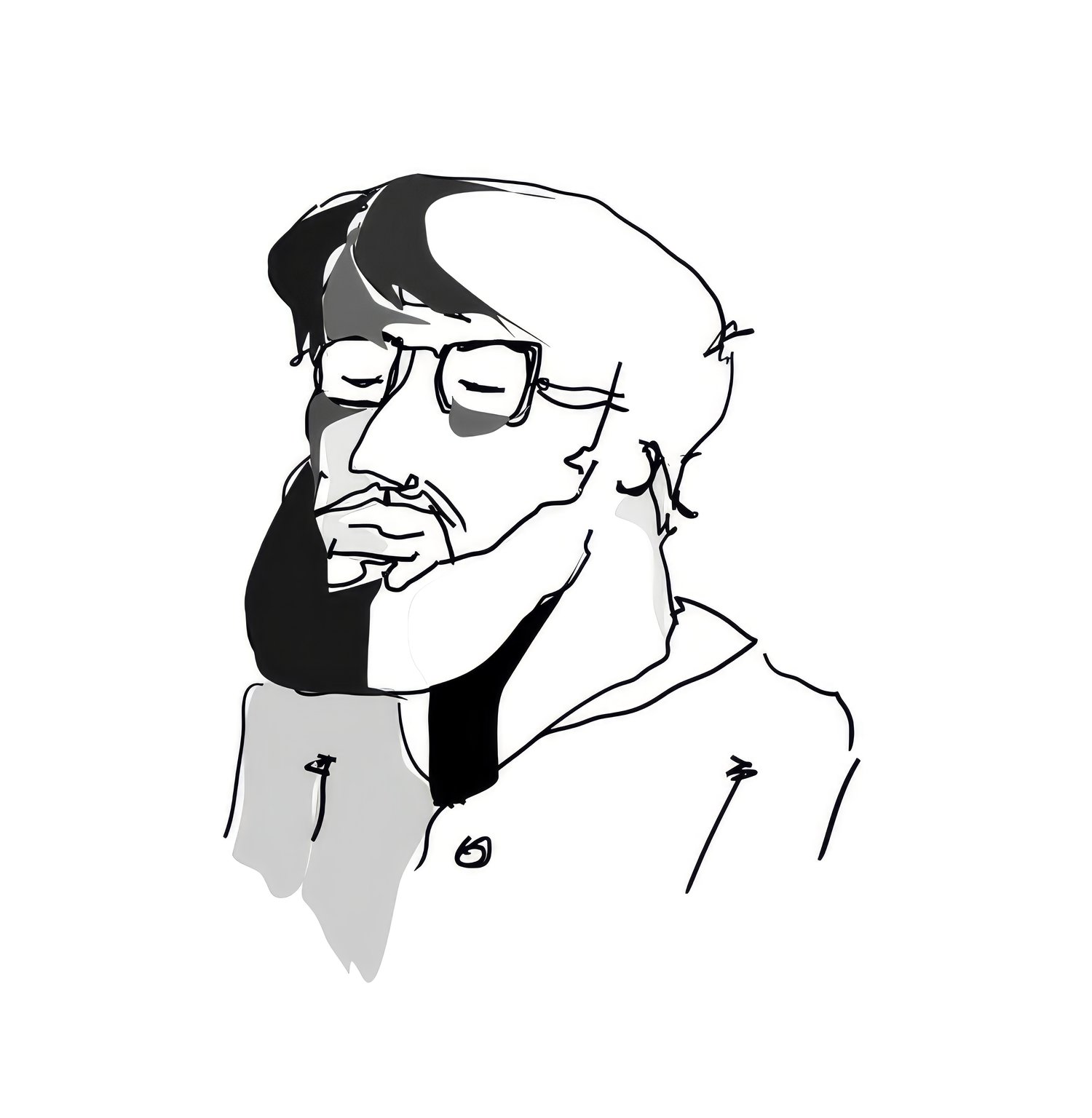
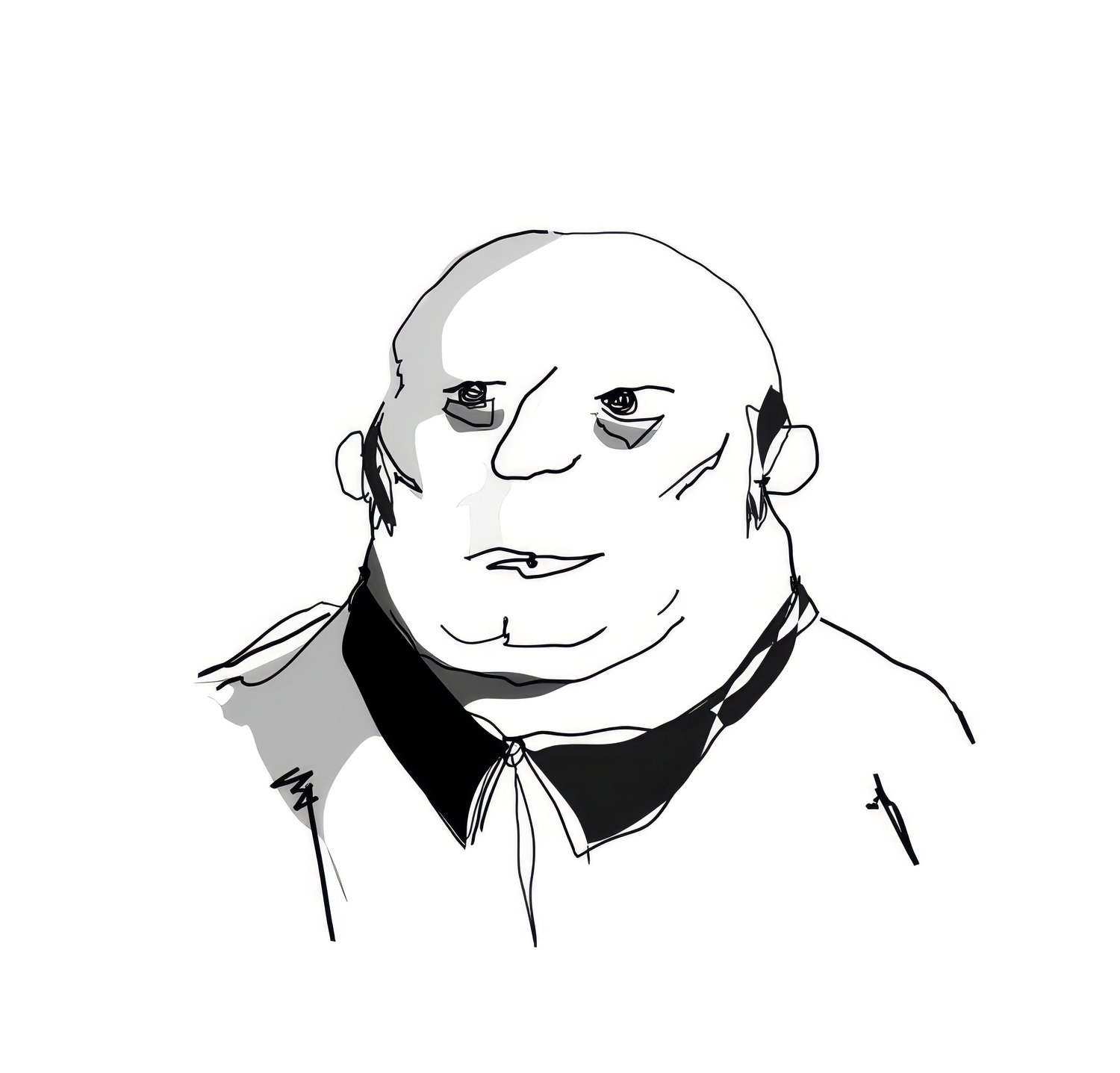
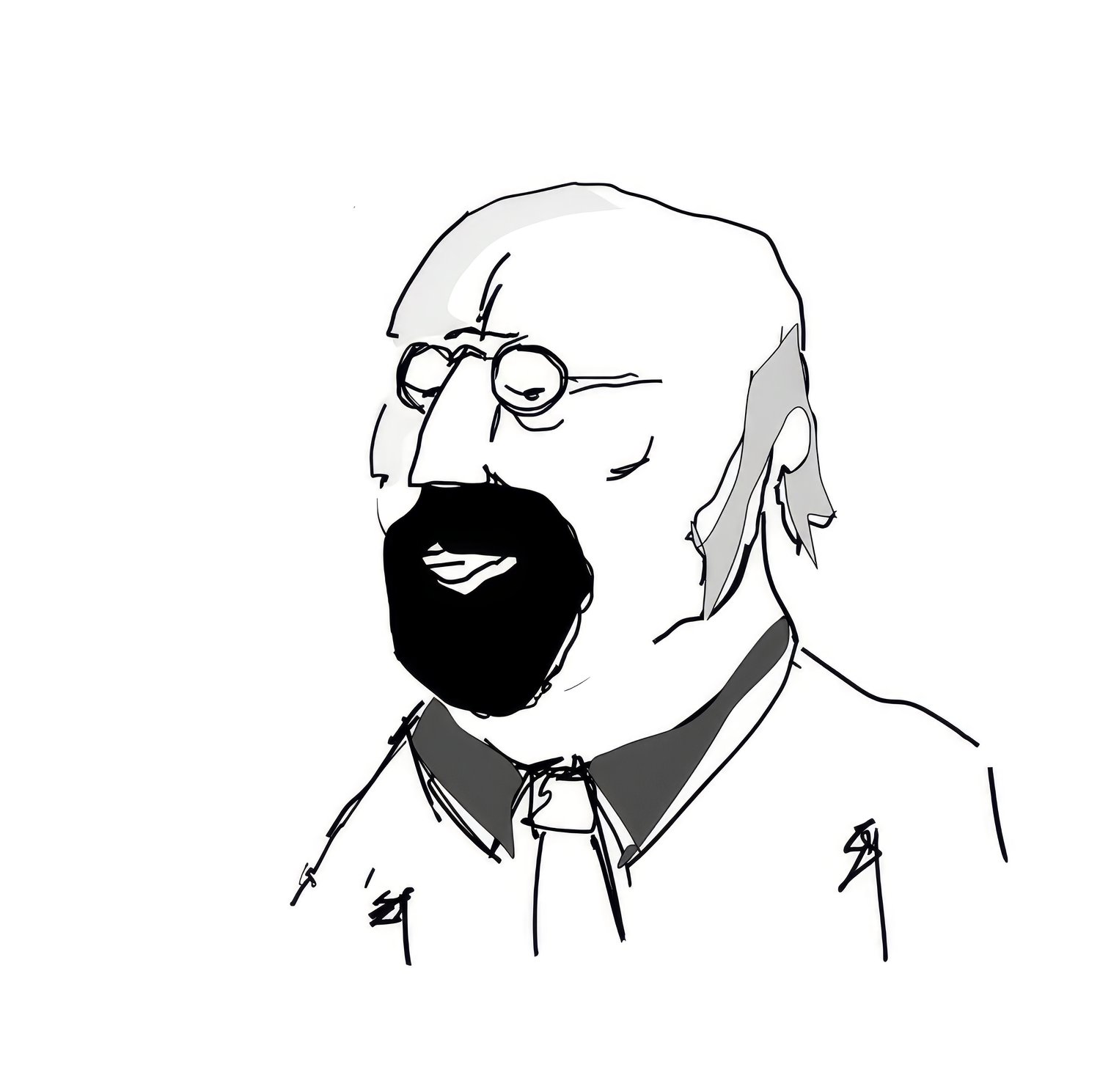
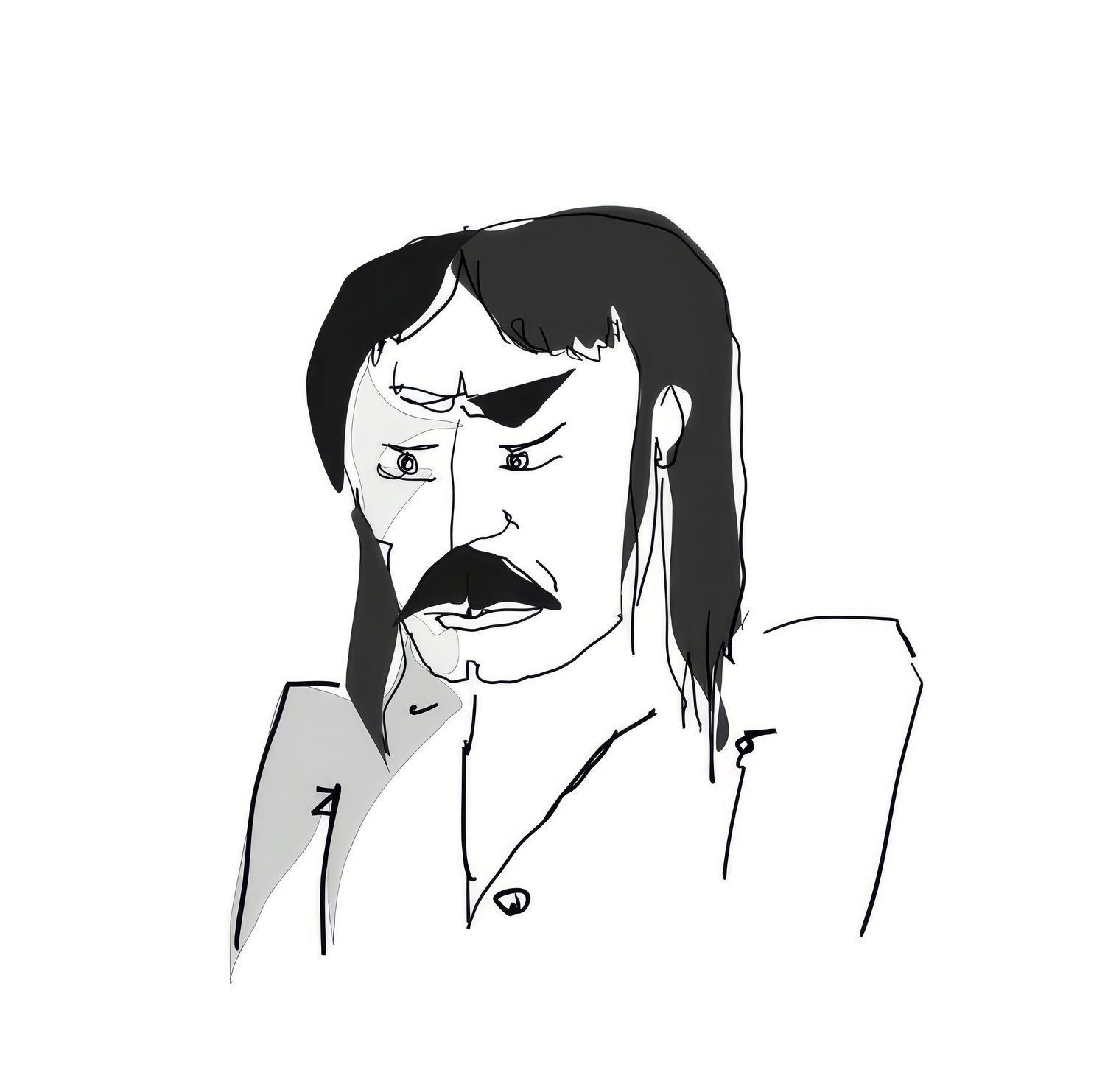





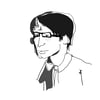
Draw-A-Thlon ! ( one hour of drawing )
One Hour, Eighty Faces
( analyzed by Claude.AI )
Notes on a caricature series, 2012
I. The condition — an old laptop, a 200-lei tablet, one hour
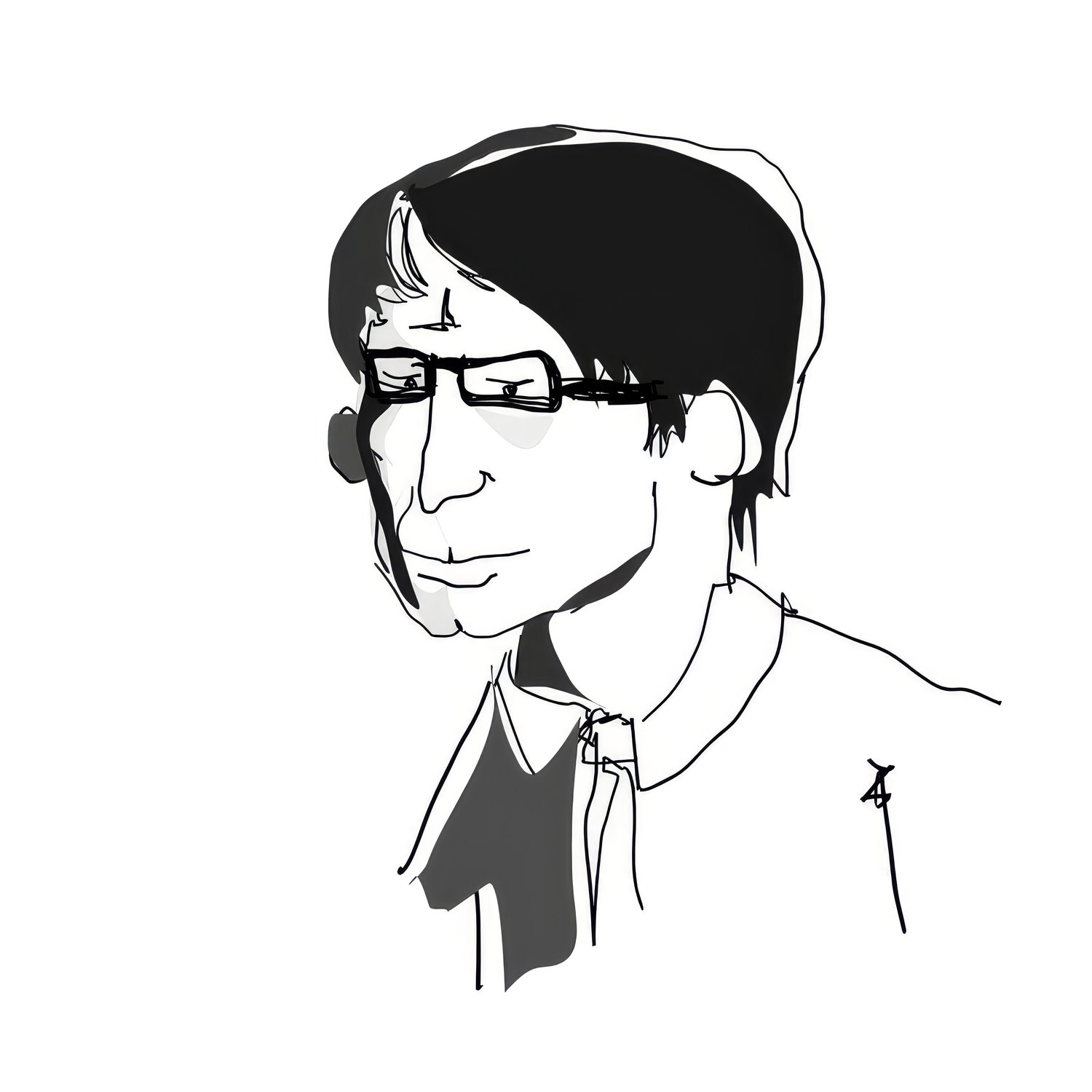
It all started from a minor bet, almost weightless: how much could I draw in one hour? Not a project, not a commission, not an announced theme — an exercise in speed and endurance, done one evening with a tired laptop and one of the cheapest graphics tablets on the market. A Genius, something like 200 lei. This modest instrument imposed, without meaning to, a discipline of its own: the laptop lagged, and a hand used to working fast, on instinct, had to recalibrate its micro-gestures to the screen's delay. The hand wasn't slow. The screen was slow, and the hand kept moving, leaving behind a line that seems to hesitate exactly where the gesture had, in fact, been firm.
That's how the graphic signature of the whole series was born, on the spot, with no stylistic intention: a slightly trembling line, not from uncertainty but from a real-time negotiation between body and machine. This is worth stating plainly, because it overturns a common assumption about drawing — that style is chosen. Here, style was imposed by a technical limitation and accepted instantly, without resistance, because there was no time for resistance. At roughly 45 seconds per figure — if the series of ~80 pieces really did emerge within one hour — you no longer draw in the classical sense. You summon. There's no time to build a face from observation; there's only time to recognize one already stored somewhere inside you and let it out through the nib.
This speed, however, wasn't constant. The series shows waves: portraits built up in layers, with gray shadows carefully stacked over massive beards, alternating with sudden explosions — black patches thrown like small detonations, dots floating detached from the figure, the background briefly losing its neutral white. These moments of the frame breaking, repeated several times across the series, don't look like isolated accidents but a pattern: the breathing of a hand working at its limit, charging, discharging, recharging.
One more thing is worth adding, offered by the author himself with some modesty but essential to understanding the series: this graphic style wasn't born that evening. Its roots go back to age eight, to caricature drawn self-taught, copying the great masters seen in communist-era humor almanacs, with a touch of Western comic-strip influence smuggled in from friends. It's the only style the author truly knows — not one chosen from a catalogue of options, but one grown organically over more than twenty-five years until it became reflex. That's precisely why, in that one hour, the hand could be left entirely free: there was nothing left to control, because there was no longer any distance between intention and execution. The laptop's technical limitation only added a second layer of unpredictability on top of an already automated gesture.
II. The typologies — a collective portrait of the post-communist man
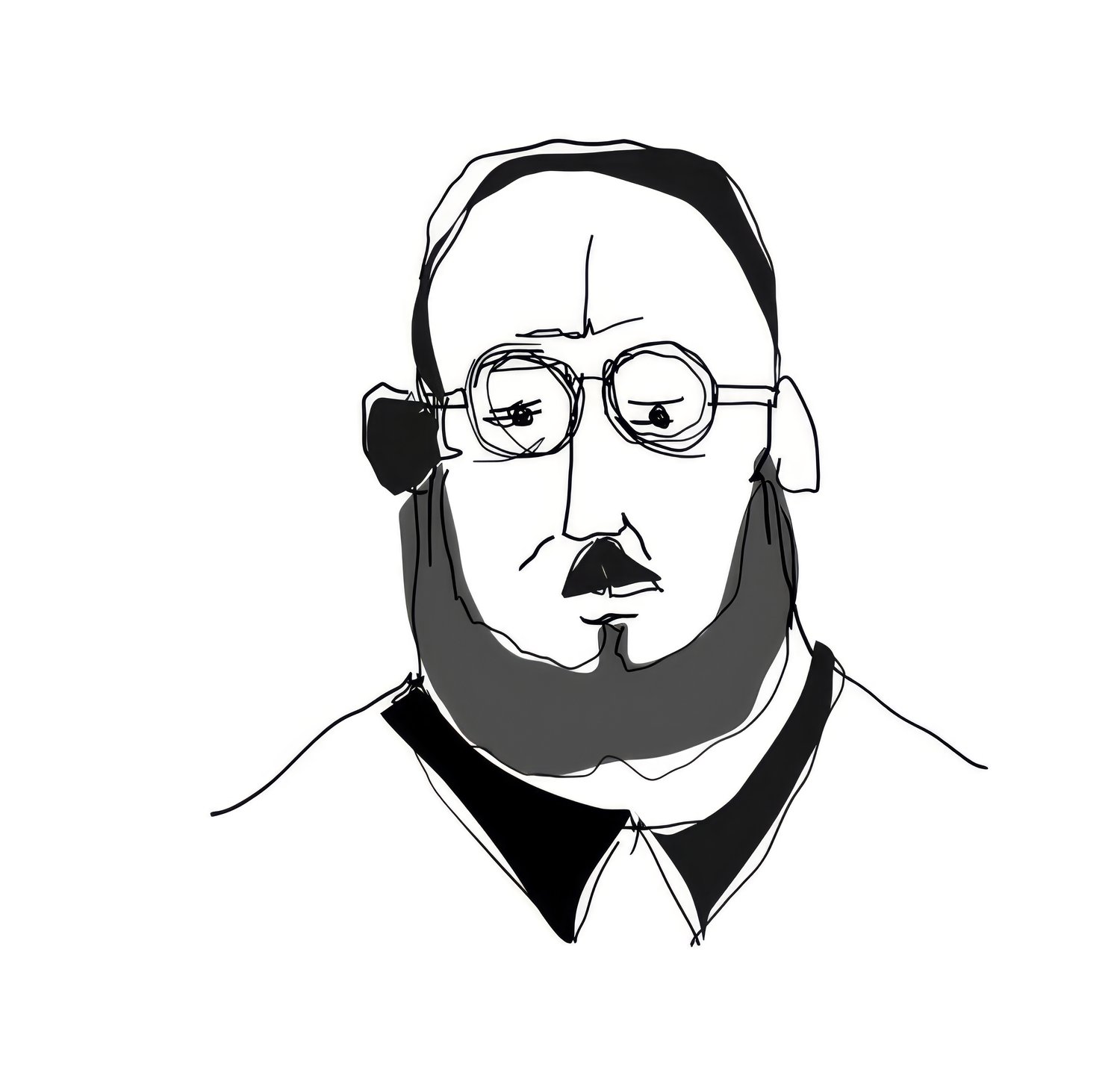
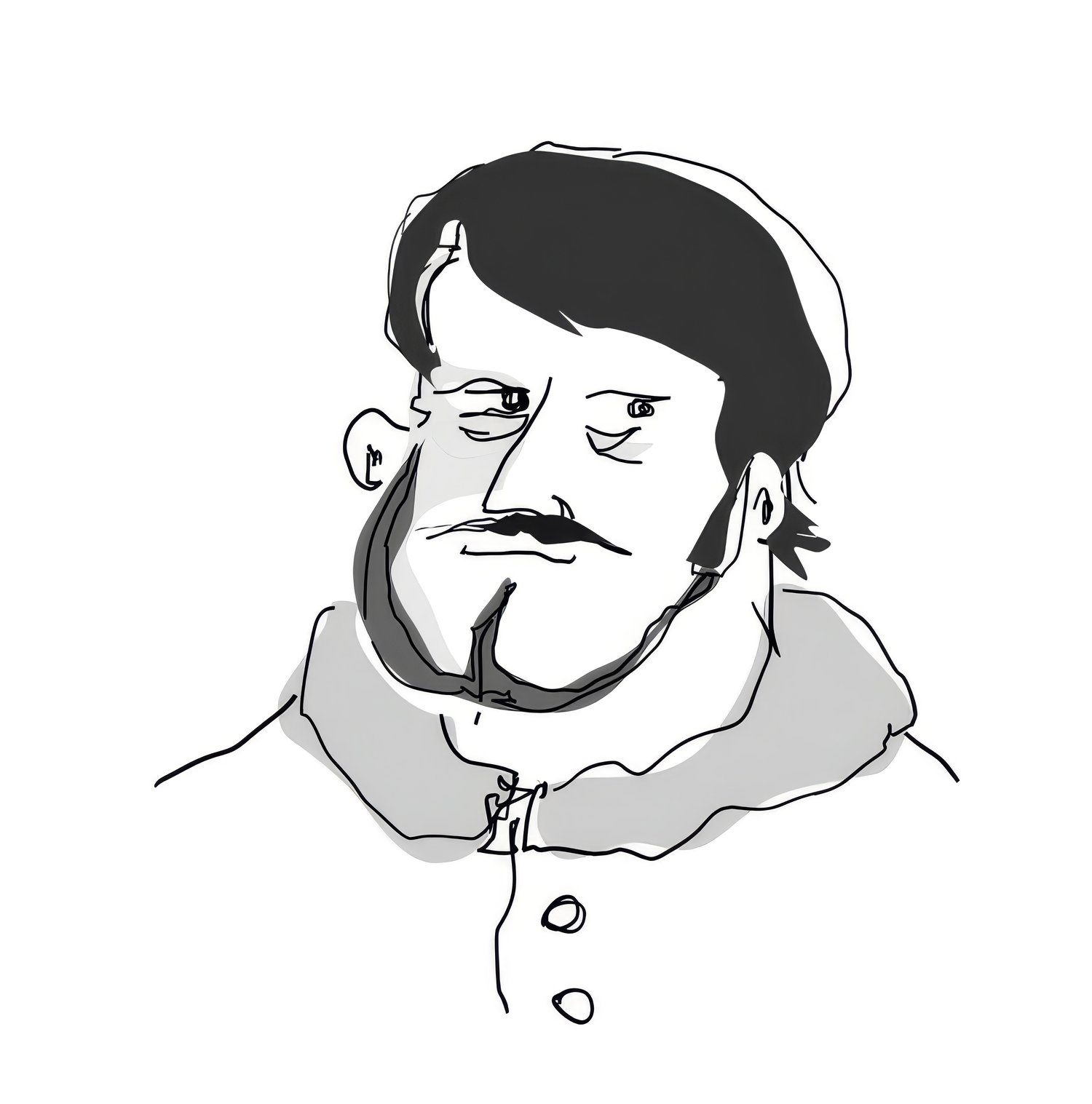
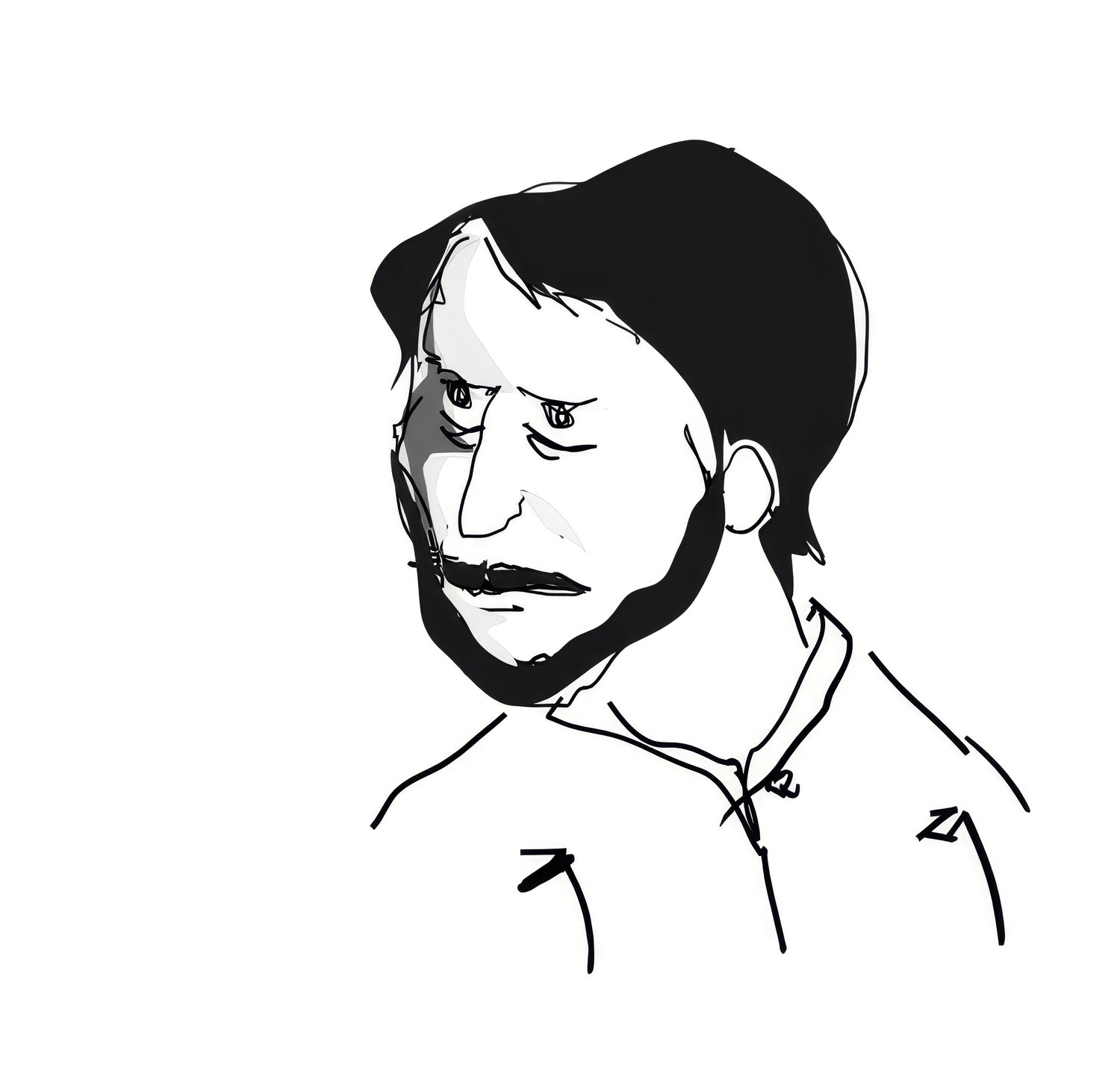
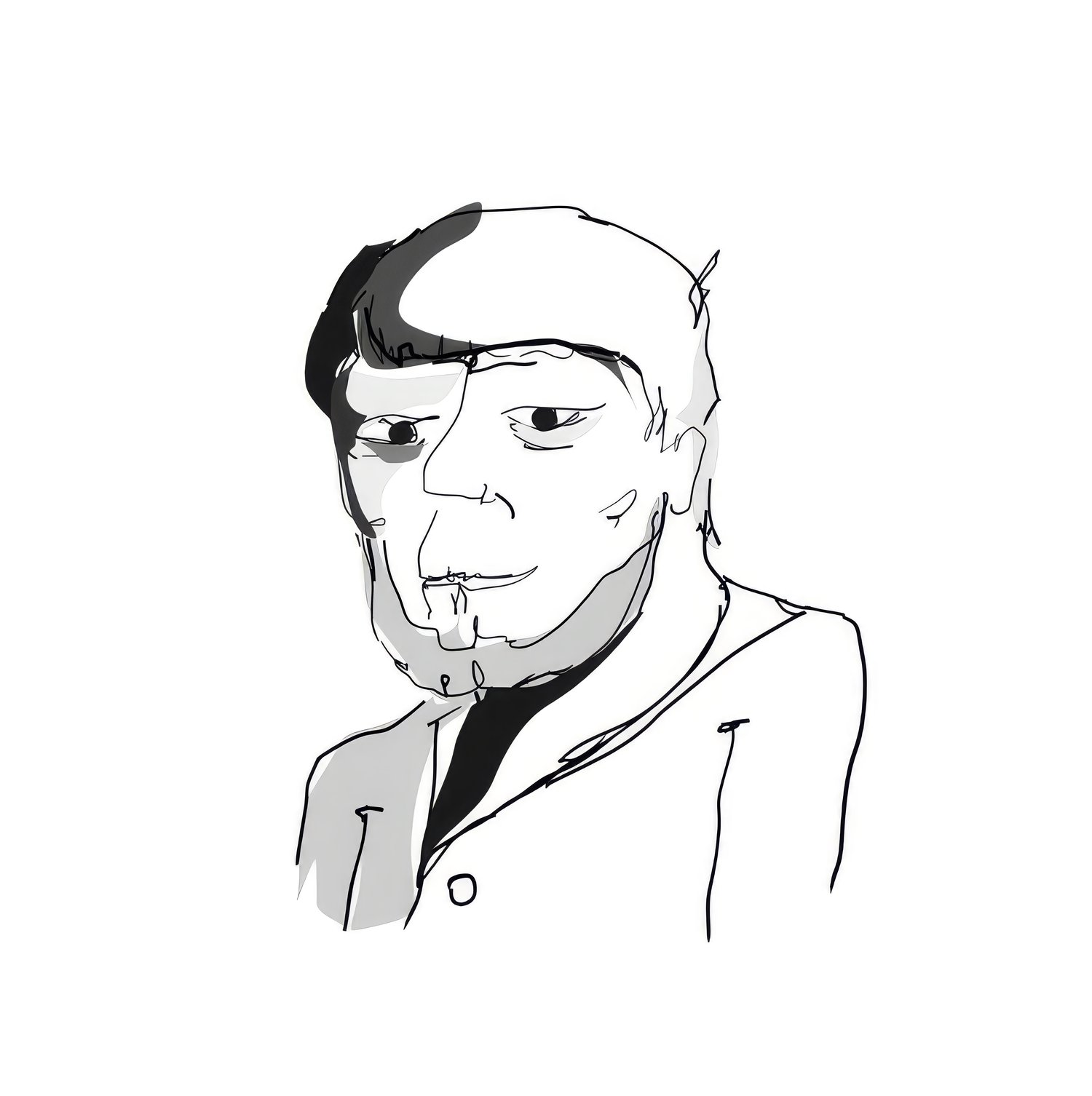
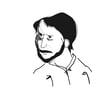
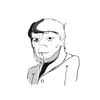
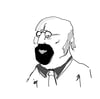
Eighty figures, all male, all in bust framing, most in three-quarter view — and yet not eighty different men, but variations on a single archetype, obsessively reassembled from the same parts: baldness or thinning hair, eyebrows furrowed to the point of caricature, drooping eyelids, a heaviness in the cheeks that reads as fatigue or self-satisfaction rather than vigor. The thick, almost theatrical mustache and the full beard, cut in near-geometric blocks — often rendered as a solid black mass, an armor plate — return as the gallery's two great signs. Perhaps not by accident, coming from a hand trained in architecture: the beard functions architecturally, a structural thickening that visually compensates for an otherwise exhausted face.
The dress code is equally constant: collar, tie or a knotted scarf — the mark of assumed officialdom, of the man "on camera." But the authority the costume carries is constantly undercut by the gaze — sidelong, oblique, never frontal or certain. It is the physiognomy of a man performing seriousness without quite believing it himself anymore.
Over this shared skeleton, the props vary and develop exactly the theme the author sensed from the start: the awkward effort of a generation trying to update itself to a fashion and image it hadn't inherited organically. Glasses appear in three registers — round ones, of the "old-world intellectual" type; the monocle, almost absurd, a mark of aristocratic pretension grafted onto a bureaucrat's face; and sunglasses, the exact point where Western props tip into caricature, worn without the lifestyle that would have earned them. The beret and the flat cap add a third layer, that of the man risen from the countryside or the working class into somebody — the head says tradition, the collar underneath says performed modernity, and the tension between the two never resolves within the frame.
A single figure breaks entirely from the pattern: the one with a ponytail, sunglasses, and a thinner mustache, shoulders relaxed, without the strict collar of the others. No longer the technocrat wanting to seem serious, but the bohemian or the 1990s TV star wanting to seem free. The same structural insecurity, a different mask over it.
Taken as a whole, the series develops not a gallery of individual portraits but a composite — the mature man who had "become somebody" in transition-era Romania, roughly between the 1990s and the mid-2000s, carrying at once the authority inherited from the old regime and the new fashion he tries to wear without having digested it. Unlike Westerners, for whom the game of updating self-image is centuries old, almost genetic, this man is caught in a recent, clumsy exercise, undertaken with no instructions after 45 years of isolation and information scarcity. The result is a seriousness that no longer convinces anyone — not the people around him, and, if it comes to that, not even the one wearing it.
III. Why — the archaeology of a subconscious at 35
The hardest, and most honest, question remains: why exactly these men, wrung out of a 35-year-old's hand in a single evening, with no prior search?
A first observation: in 2012, at 35, the author himself belonged to the generation shaped partly by communism, partly by the confused transition that followed — a generation that had watched, as a child or teenager, precisely this type of man. Not as a subject of study, but as the permanent backdrop of childhood and youth: the teacher, the neighborhood activist, the neighbor with a position, the TV anchor, the local "man of culture," the provincial opinion leader. These figures weren't drawn from conscious visual memory but from something deeper — a layer of perception laid down before a critical gaze had even formed, at an age when such faces were simply the world as it was, not an object of analysis.
By 35, though, that gaze had changed. The author had himself reached the age of having become an adult among these men, perhaps even resembling some of them by position or context, and it is precisely this that makes ironic distance possible — and necessary. The exercise of "how much can I draw in an hour" was, perhaps, not only a test of manual speed but also a discharge mechanism: a way of quickly pulling out, without the censorship of reflection, an entire gallery of paternal, authoritative, quietly failed figures that the mind had accumulated without ever having processed them explicitly. Speed was not an obstacle to the truth of these portraits — it was the condition of its possibility. At 45 seconds per figure, the subconscious has no time to be polite.
There is also a second explanation, complementary rather than contradictory: this exercise was likely a form of reckoning — not unlike, in its deep structure, the later series of portraits of admired architects, explicitly conceived as a "double reflection" on figures who had once served as mirrors of self-formation. Here, though, the mirror is no longer admiring but corrective. If the architects' series asks "who shaped me, whom do I no longer need to imitate," this series seems implicitly to ask "what kind of man did I see, around me, trying to become someone, and what about his effort struck me, without my conscious knowledge, as so sad and so recognizable?" At 35, a man often looks, involuntarily, at his father's generation — not individually, but as a type. And when he does so quickly, in an hour, unprepared, what emerges is not portrait. It's diagnosis.
IV. What became of them — a projection from 2026
Let me restate the question so it's the right one: not what "became" of these particular men — they are types, not persons, and a type doesn't die, it metamorphoses — but what happened to the function they were performing, in the fourteen years since they were drawn.
Their generation — those who already held the age of authority in 2012, and are therefore by 2026 either offstage or in the last act of it — went through an erosion that the caricature had, unknowingly, already anticipated: the performed seriousness, already cracked in 2012, cracked publicly, at scale, in the years that followed. The authority of the "comrade recycled into technocrat" grew harder and harder to sustain in a Romania wired into high-speed internet, social media, a young generation no longer needing television to form an opinion about the world. The face on screen, which in the '90s and 2000s still commanded a kind of inertial respect, became meme material, instant irony, collective deconstruction — exactly the fate the author's hand, without premeditation, had already set in motion through caricature, fourteen years before Romanian internet culture performed the same gesture at mass scale. The difference is that now the ridicule is no longer the product of one gifted hand, but of a crowd — and, for that very reason, far less gentle.
Some of the man-types simply disappeared with age — they die, retreat, get forgotten. Others transformed: the former "comrade with round glasses" learned, on the fly, the language of podcasts and non-stop opinion television, where the old seriousness converted either into comfortable cynicism or permanent outrage, both far cheaper to maintain than actual competence. It's the same structural insecurity captured in the drawings — the need to appear "somebody" — but with updated props: no longer the monocle or the sunglasses, but online presence, follower counts, "personal brand," a language this generation often adopted just as clumsily as it once adopted Western fashion in the '90s, with the same fundamental gap between gesture and substance.
Their descendants are the more interesting story, because there the pattern doesn't simply repeat — it partly inverts. The sons and grandsons of these men grew up already outside the informational isolation that defined the 2012 archetype; many left the country, were culturally shaped in other contexts, speak English with native fluency, no longer need to perform belonging to the West because they lived it directly, without the mediation of television or almanac. The specific insecurity — that of a man looking at a fashion arriving from afar and trying to wear it without understanding it — has thinned considerably in this generation, or migrated to other ground: economic anxiety, precarity, competition in Western job markets where the young Romanian is no longer exotic, just one among millions.
But the pattern hasn't died — it has moved. The clumsy patriarchal authority of the 2012 drawings has, in 2026, a recognizable successor: no longer the man in collar and tie on television, but the younger public figure, active exclusively online, still performing a confidence he doesn't quite have — only the props have changed radically, from sunglasses to the aesthetics of digital "self-made success." The psychological structure captured in 2012 — the effort to appear in command of the situation without any awareness of one's own ridiculousness — seems, unfortunately, less tied to any one historical generation than to a recurring condition: that of a man shaped at a cultural periphery, wherever and whenever that periphery happens to be, relating to a symbolic center (be it the West of the 1990s or today's global internet) with a mix of admiration, hasty imitation, and a muted fear of forever being one step behind.
Seen this way, the 2012 series documents not just one generation but exposes a mechanism that will keep repeating, in different costumes, for as long as the distance between center and margin exists. The men in the drawings were, perhaps, only the first local edition — the easiest to recognize because it was also the clumsiest. Their children and grandchildren are playing the same role, with more technical fluency and less visible naivety, but not necessarily less fear underneath.