
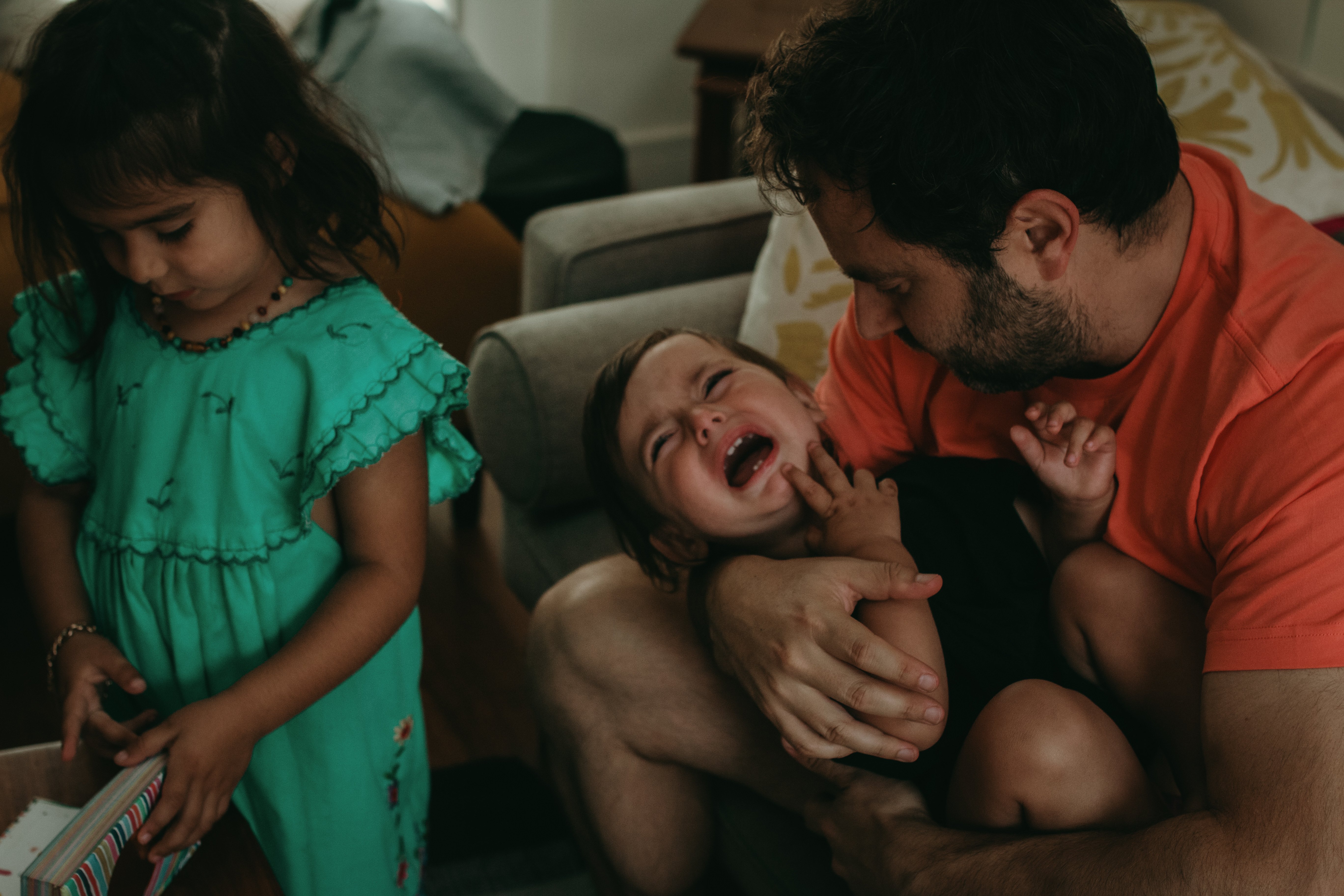
From playground tantrums to wrong-plate breakdowns — learn what tears are really telling you and how to meet them with calm instead of dread.
Imagine this: it’s bedtime, and instead of winding down, your child starts whining. You try cuddles, reasoning, feeding again, setting limits - anything to get them to sleep. Sometimes it works - your child stops whining but instead takes ages to fall asleep.
Other times, the whining turns to crying. The tears keep coming, and you don't know what to do, so you end up exhausted and dreading the next night.
Includes access to all future Q&A sessions
⋆
Join us!
⋆
Includes access to all future Q&A sessions
⋆
Join us!
⋆

The Story We’re Told About Crying
From the moment our baby is born, crying is one of those things most parents are desperate to stop.
- We’re told it means they have an unmet need and we need to fix it and respond to make the crying stop.
- It activates every single cell of our being and often we don't even know why.
- Without realising we're doing it, we're quick to distract them: "Look, there's an aeroplane!" or "Do you want more milk?"
- And from early on, we're told to that we need to help them by “co-regulating.”
And if you’re like most parents, you’ve tried all of it. The cuddles, the trying to meet their "needs", the validation "I hear you wanted the red cup" (which just escalates the tantrum) the “I see you're upset (I'm NOT upset! they shout back, still crying). The "don’t cry, please.”
But the crying doesn’t stop easily, or it stops but the behaviour is... driving you nuts.
Maybe you find yourself dreading bedtime because you know it’ll end in tears, or it will take forever, only for them to wake up 45 mins later.
Maybe you freeze in public, trying to manage the stares while your child lies on the supermarket floor.
Maybe you feel guilty when you lose it with them - even though you’re doing everything you can.
Maybe you've tried the "conscious/gentle parenting thing" of validating emotions, but they just cry more.
The theory is one thing.
But the moment your child starts crying in the supermarket aisle, your mum raises an eyebrow, or your nervous system screams,
“Make it stop!” - that’s where even the gentlest of parents feel lost.
If this is you, I want you to know: there is nothing wrong with your child. And you’re not doing it wrong either.
Aware Parenting: A new way of understanding tears
Crying as Communication
Most parents already know that crying is a way babies and children tell us something. They might be hungry, hot, cold, or needing closeness. This is the most familiar reason for tears — and it’s vital. When we respond promptly and accurately, we’re showing our children that they are safe and cared for, that their needs matter. This understanding is well-rooted in attachment theory, and most parenting approaches agree on this point.
Crying as Healing Release
This second reason for crying is the part most of us didn't know about when we first had a baby. It's the knowledge that babies and children cry to release stress, tension & feelings.
When we understand both reasons for crying, and especially when we trust the healing role of tears, everything shifts. The bedtime dread eases. Public meltdowns feel less like a reflection of “bad parenting” and more like an opportunity to offer presence. And parents finally have a map that makes sense of all those “crying over nothing” moments.
We can see when crying is healing and even help our children heal from stress and trauma.
The difference with Aware Parenting
What makes the Aware Parenting approach different is the recognition that crying isn’t only communication.
Often, once needs are met and a child still cries, those tears are releasing stress, frustration, or even trauma (big and small) stored in the body. Just like laughter releases tension through play, crying is the body’s natural way of restoring calm. If a child feels safe and supported, even loud, long, or “over the top” crying is part of this healing process. It isn’t a sign of something needing to be fixed.
Understanding this in depth, changes how we respond before, during and after a tantrum.

What you'll walk away with
By the end of this course, you’ll:
- Understand why your child cries, and know how to respond without panic or dread.
- Recognise the difference between cries for unmet needs and cries for stress release.
- Feel calmer and clearer in those “nothing works” moments.
- See through the mainstream myths that tell you to distract, ignore, or "co-regulate" tears.
- Stop beating yourself up because you're not "regulated enough" to help your child stop crying (that was never the aim!).
- Know how crying (and laughter) restore your child’s natural homeostasis — and why it matters for sleep, behaviour, and cooperation.
- Trust your child’s innate wisdom, instead of second-guessing yourself.
- Find more ease at bedtime, less stress in public meltdowns, and more confidence overall in your parenting.
- Watch your relationship with your child, and yourself, transform as you welcome the free expression of all feelings.


The course details
Tears Without Fear is a 9-part audio course you can listen to like a podcast - plus a live element twice a year. No slides, no checklists - just me in your ears, breaking down the things no one told you about crying and tantrums.
The course is split into 4 main modules:
- Why are they crying? – A fresh look at the science, nervous system, stress, and what happens when we don’t allow tears.
- Control patterns and dissociation – Why kids develop “habits” like thumb-sucking or screen obsession, and what’s really going on underneath. Includes a fresh look at "co-regulation" (and why I don't use that term).
- Responding in the moment – Practical ways to meet crying with confidence, both at home and in supermarkets, playgrounds, around family, or when there’s more than one child crying at once.
- Loving limits - An Aware Parenting perspective on saying No to the behaviour and Yes to the feelings. And what I do and don't recommend doing when a child cries.
- Plus bonus episodes on how to share this with family members and FAQs.
There are two live rounds per year, where we explore these topics in depth with time for Q&A.
You can also add a 1:1 session with me for a reduced fee if you’d like more personalised support.
You’ll have lifetime access to all recordings, so you can come back to them anytime — on a walk, in the car, or during the rare silence of nap-time.
Course contents
Six modules, ten recordings + bonus episodes
-
1The Science-y part
-
2Understanding control patterns
-
3A new perspective on "regulation" & "co-regulation"
-
4Crying at home
-
5Crying in the Wild: Public Tears + Judgment
-
6How to know crying is healing
-
7Extras
Acknowledgement
Everything inside this course is grounded in Aware Parenting, a model developed by Dr. Aletha Solter, a Swiss–American developmental psychologist who studied with Jean Piaget (in Geneva).
Her work brings together attachment theory, trauma research, anthropology, and decades of her own experience — and it offers a radically compassionate, deeply respectful understanding of children’s emotions.
FAQs
-
Not at all. This course is designed for parents who are curious but new to the approach. Everything is explained simply, with real-life examples you’ll recognise immediately.
-
Most advice tells you to either stop the crying (distraction, punishment, ignoring) or to meet every tear with a practical solution. Tears Without Fear offers the Aware Parenting perspective: crying is a healing process. You’ll learn how to listen in a way that helps you and your child become comfortable with expressing feelings and the calm that comes afterwards.
-
Whether your child is a crawling baby, toddler, or school-aged, the principles are the same. You’ll also hear about how crying shows up differently at different ages, so you can apply what you learn straight away.
-
This isn’t hours of video to sit through — it’s audio-only, like a private podcast, designed to be finished in less than 3 hours. You can listen on the go, in short bursts, and revisit whenever you need. Plus, you’ll have lifetime access.
-
Absolutely! One of the modules is specifically about handling crying in public (playgrounds, shops, restaurants), so you feel less panicked and more grounded — even with strangers watching.