
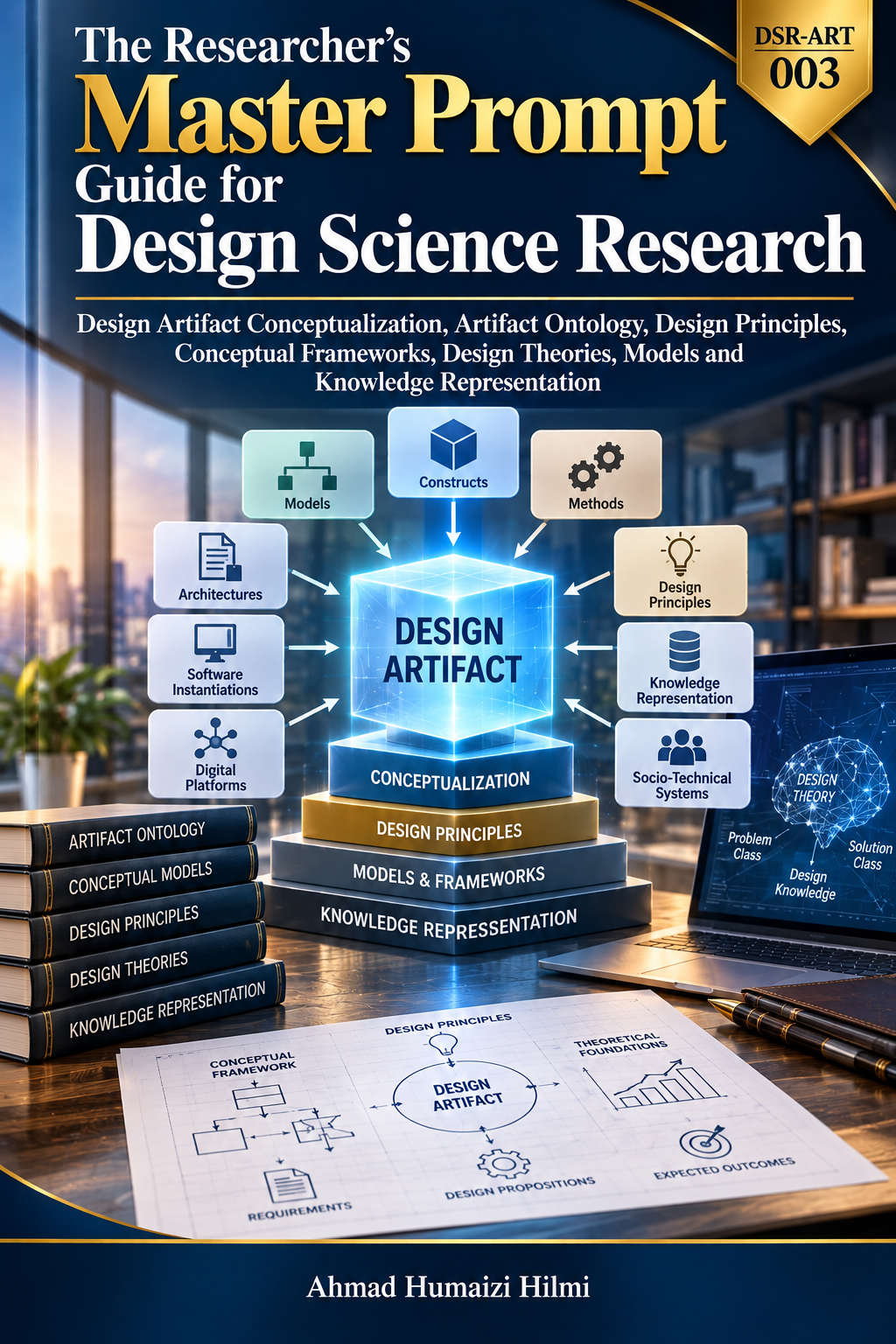
3. DSR-ART-003 — Design Artifact Conceptualization, Artifact Ontology, Design Principles, Conceptual Frameworks, Design Theories, Models and Knowledge Representation
Description
This Master Prompt establishes an integrated framework for conceptualizing, classifying, designing and theoretically justifying research artifacts developed through Design Science Research. It examines the nature and characteristics of design artifacts, including constructs, models, methods, frameworks, architectures, algorithms, decision-support mechanisms, software instantiations, digital platforms, organizational processes, design principles and socio-technical systems. Particular emphasis is placed on artifact ontology, conceptual abstraction, design knowledge representation, the relationships among problem classes and solution classes, the formulation of design requirements, and the transformation of theoretical knowledge into actionable artifact specifications. The framework integrates design theory, kernel theories, conceptual modeling, ontology development, systems thinking, model-based design, design patterns, design principles, reference architectures, knowledge engineering and artifact classification methodologies. Researchers are guided in establishing artifact purposes, identifying essential components, defining relationships among design elements, developing conceptual and theoretical frameworks, constructing design propositions, specifying design mechanisms and articulating how proposed artifacts are expected to generate desired outcomes. The Master Prompt further addresses the development of design principles, technological rules, design propositions, explanatory mechanisms, artifact boundary conditions, design rationale, abstraction levels and generalizable design knowledge. It supports the development of conceptual models, architectural diagrams, artifact ontologies, design structure matrices, functional decomposition diagrams, system interaction models and theoretical contribution frameworks. Particular attention is given to distinguishing an artifact's practical functionality from its theoretical contribution, evaluating the coherence of artifact components, identifying assumptions underlying proposed design principles, and ensuring that artifact conceptualization is sufficiently transparent, theoretically grounded and transferable to relevant problem contexts.