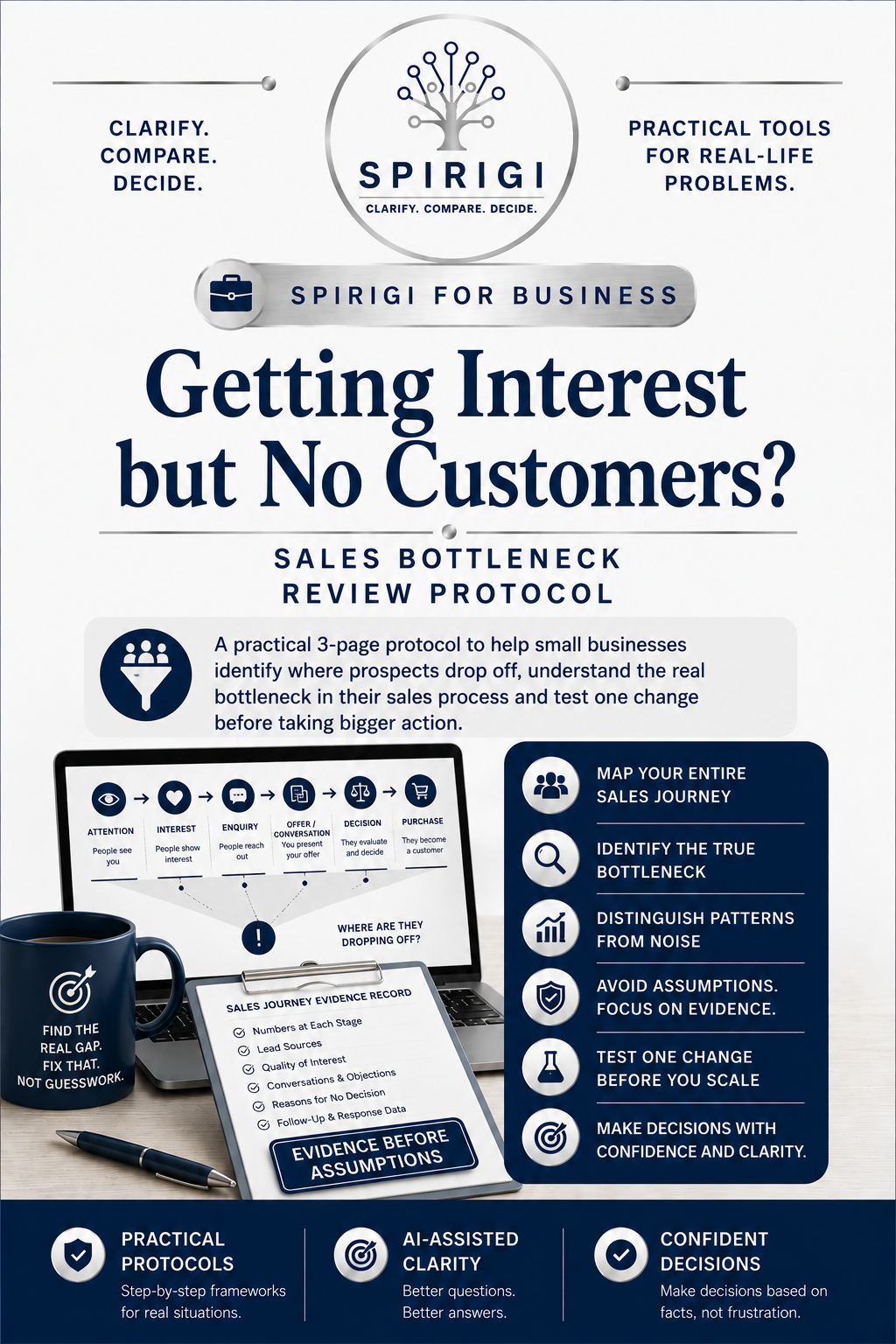
Getting Interest but No Customers? — Sales Bottleneck Review Protocol
People visit, enquire, respond or show interest — but too few actually become customers?
This practical 3-page protocol helps small businesses, freelancers and independent professionals identify where prospects are dropping out of the sales journey before spending more time or money trying to generate additional attention.
It guides you through:
- Mapping the journey from Attention → Interest → Enquiry → Offer / Conversation → Decision → Purchase
- Recording evidence at each stage of the sales process
- Tracking where prospects stall, disappear or decide not to buy
- Separating actual prospect behaviour from assumptions about why they did not convert
- Identifying the strongest supported sales bottleneck
- Distinguishing isolated incidents from recurring patterns
- Classifying the bottleneck as Wrong Audience, Value Not Clear, Trust / Proof Gap, Offer / Buying Friction, Follow-Up Gap, or Insufficient Evidence
- Reviewing objections, questions and lost opportunities systematically
- Building a Sales Bottleneck Evidence Matrix
- Using AI to analyse the sales journey without inventing customer motives or unsupported benchmarks
- Testing one targeted change before making larger changes to your sales or marketing activity
What you receive:
- 3-page practical PDF protocol
- Sales Journey Evidence Record
- Lost / Stalled Prospect Log
- Six sales bottleneck classifications
- Bottleneck Review Questions
- Sales Bottleneck Evidence Matrix
- Controlled AI Sales Review prompt
- 6-step AI prompt sequence
- Small Sales Test Plan
- Clear Stop Rule for situations where there is not yet enough evidence
Instead of assuming you need more traffic, more marketing or lower prices, use the protocol to find where the journey is actually breaking, examine the evidence and test one change before you scale.
No subscription required. Download the PDF and use it with the AI assistant of your choice.
Important: This protocol is an organisational and decision-support aid. It does not guarantee sales, diagnose every commercial problem, provide market benchmarks, or replace professional sales, marketing, financial or legal advice. Results depend on the quality and relevance of the evidence supplied.