

Music Tech Maths Part 2
Music Tech Maths - (Part 2)
Preparing for Numeracy Questions in Music Technology Edexcel A level. (Part 2)
This detailed resource follows on from part one and includes:
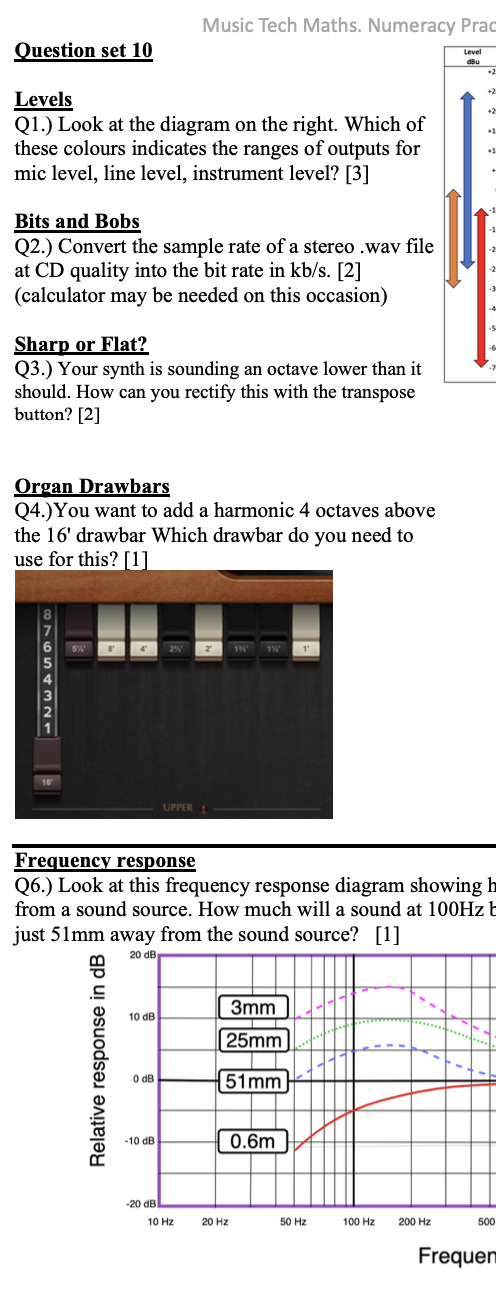
-10 new sets of practice questions
-10 new sets of worked answers
In total 66 new questions. All with worked answers.
**-A 50 slide Powerpoint presentation (same presentation as comes with Part 1)
The 10 sets of practice questions are designed to build students skills and confidence. They are carefully designed to increase confidence with the concepts that students need to understand for the exam.
**The Powerpoint covers the following topics: **
• Synthesis of waves from sine waves
• Number of semitones in intervals
• Cents in a semitone
• Intervals – Frequency relationships
• Low Frequency Oscillators
• Binary questions
• MIDI Questions – Bit depth (velocity etc)
• MIDI Questions – Bit depth (pitch bend)
• Low Frequency Oscillator Graph
• Compressor input / output
• Envelope graph
• Gate graph
• Compressor response time
• Microphone Technical Specifications
• Beats per minute (milliseconds per beat)
• Logarithmic scale – Decibels
• Logarithmic scale – EQ
• Signal to Noise ratio
• Label graphs (axes and more)
• Equalisation graph
• Cut off Frequency
• Amplitude Envelope
• Filter Envelope
• Label axes – audio waveform
• Low Frequency Oscillator Graph
• Nyquist’s Theory
• The Nyquist Frequency
• Compression ratios
• Reverb Time
• Phase relationship of waves
• Sample rate calculations
• Note values – dotted notes
• Note values – triplets
• Octave settings in feet on synths
The Powerpoint is as an aide memoire to help students answer the sets of Music Tech numeracy practice questions supplied. These, in turn should help with the exam questions when it comes to them.
The Powerpoint is not intended to be a comprehensive explanation of all the given topics, which would be impossible in 50 slides, but it is a reminder of important numeracy concepts.
The questions in part 2 are mostly possible without a calculator, just as required in the exam.
(there are one or two questions in Part 2 where a calculator may be needed for students who are out of practice in their multiplication skills. When this is the case, it is clearly indicated in the question. I have included these questions to help students to understand concepts using real world figures (e.g. 16 and 24 bit audio files, 44.1kHz, 48kHz sample rates etc.)
Do let me have any feedback / suggested improvements.