
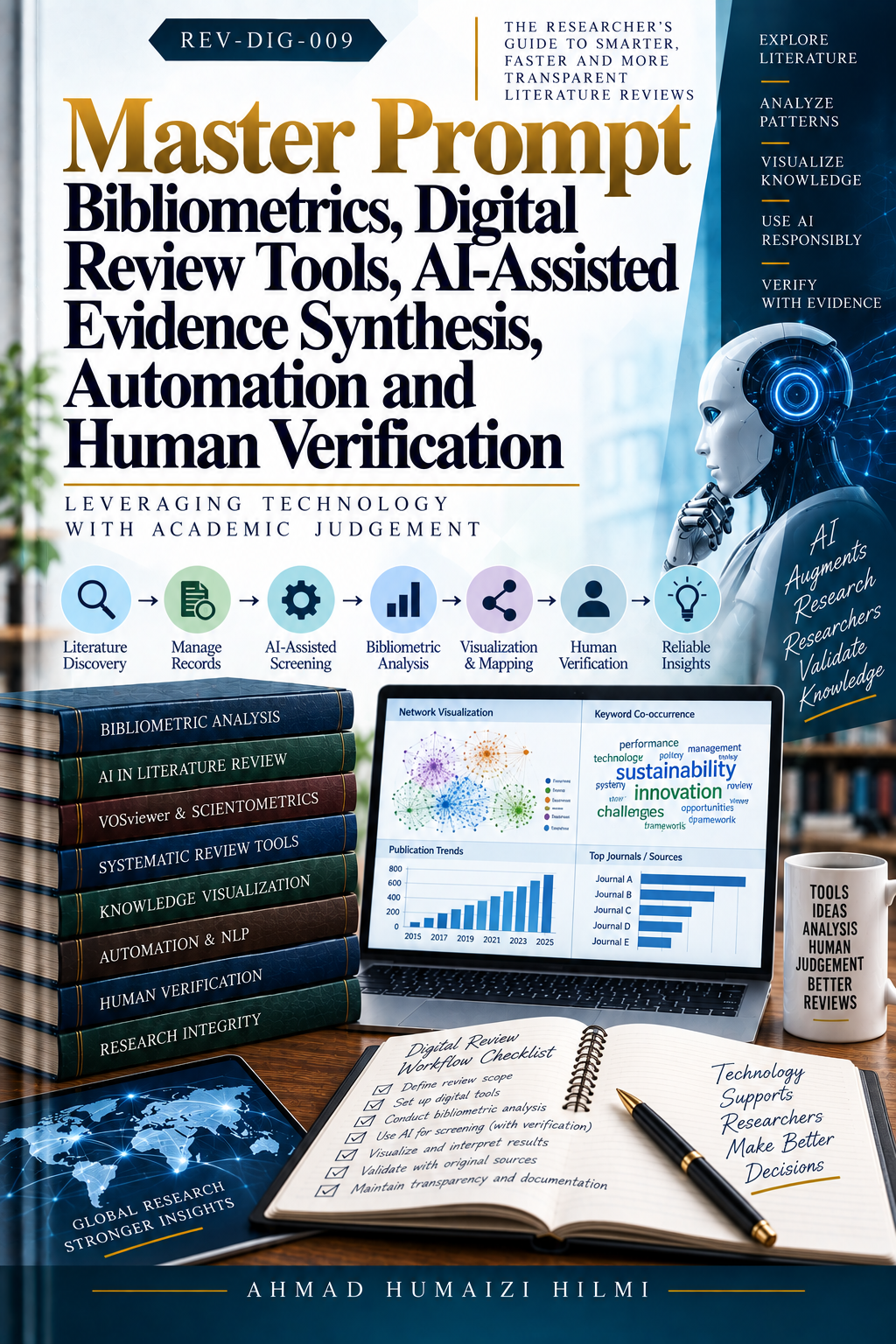
9. REV-DIG-009 — Bibliometrics, Digital Review Tools, AI-Assisted Evidence Synthesis, Automation and Human Verification
Description
This Master Prompt focuses on the responsible, transparent and methodologically controlled integration of bibliometrics, digital review-management systems, computational techniques, natural-language processing, machine learning and generative artificial intelligence into review-paper workflows. It guides researchers in determining which stages of a review may appropriately receive technological assistance—including bibliographic data collection and harmonization, duplicate detection, literature discovery, title/abstract screening, document classification, metadata analysis, citation analysis, bibliometric mapping, full-text processing, structured data extraction, evidence organization, clustering, topic identification, knowledge representation and visualization—while preserving the methodological architecture established in the preceding Master Prompts. Digital technologies should reduce repetitive workload, improve scalability and enable forms of analysis that would be difficult to conduct manually, but tool availability should never determine the review question or replace methodological justification. The uploaded literature demonstrates this range clearly: BiblioSelect integrates title/abstract screening, bibliographic-record inspection, classification and preliminary bibliometric visualization in a single workflow, while ExtractPDF automates extraction from scientific PDFs and uses the resulting output alongside human review.
A major emphasis is placed on distinguishing technological assistance, computational output and scholarly authority. Automated screening decisions, AI-generated classifications, extracted values, summaries, clusters, topics, bibliometric rankings and interpretations should remain provisional until their accuracy, relevance and methodological meaning have been evaluated by researchers. This requirement is particularly important for generative AI and LLM-supported workflows because fluent output does not establish factual accuracy or methodological validity. The uploaded collection demonstrates both the potential and the need for control: one large-scale review used Google Gemini to identify dataset types and availability statements and NMF to extract latent research topics, illustrating how AI and computational text analysis can support corpus-scale analysis. Another study applied automated PDF extraction to 299 included papers but deliberately used its outputs as a second reviewer alongside a human reviewer rather than treating automation as final authority. Knowledge-graph research further shows the potential of combining large-scale inter-paper structures with fine-grained intra-paper representations so that AI-supported findings can remain traceable to evidential roots.