





Break of Structure Explained — Mark it right (PDF Guide)
You mark up structure exactly the way the video did, and your chart still does not look like theirs. Same instrument, same candles, different breaks. You assume you are missing something subtle. You are missing something specific, and it is a number nobody said out loud.
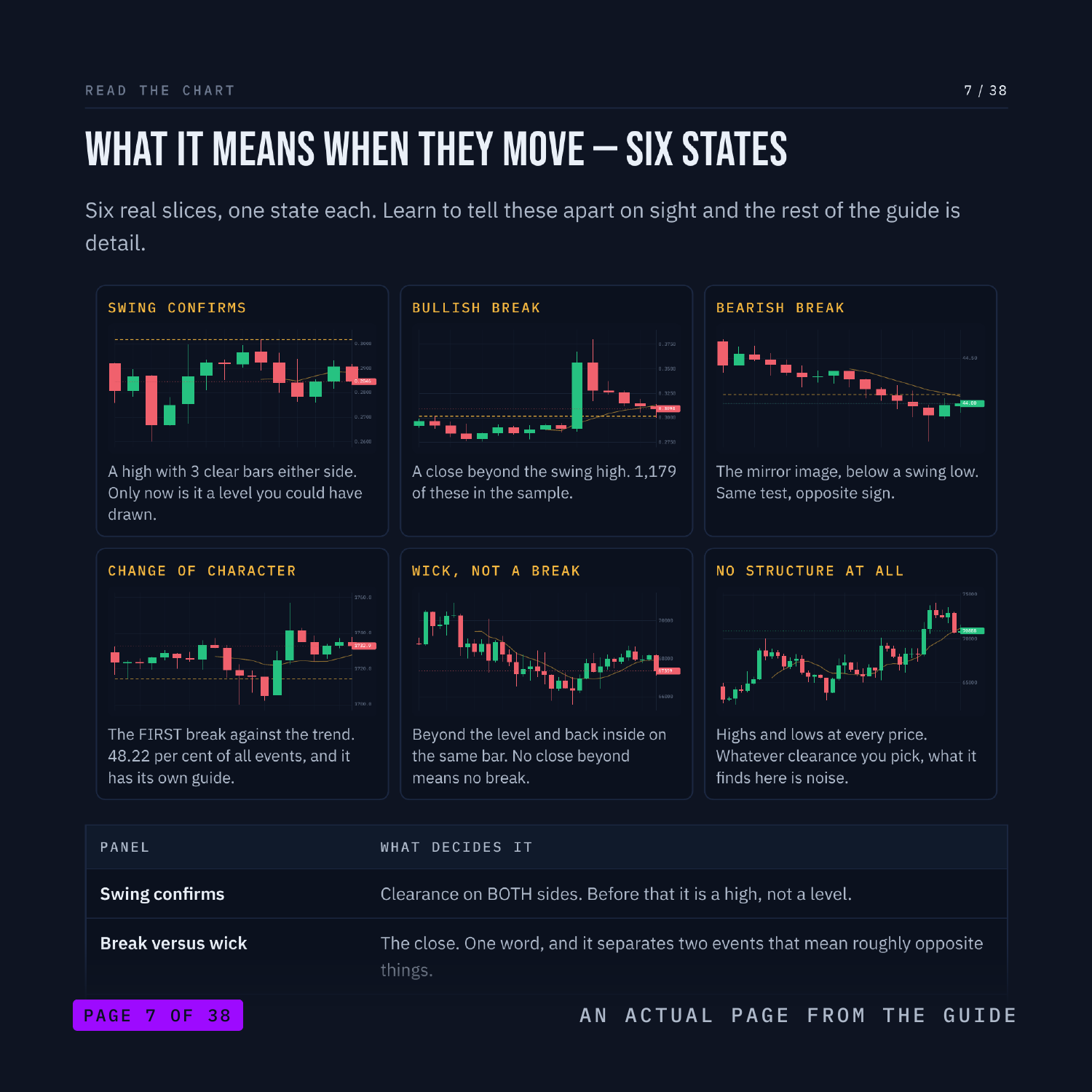
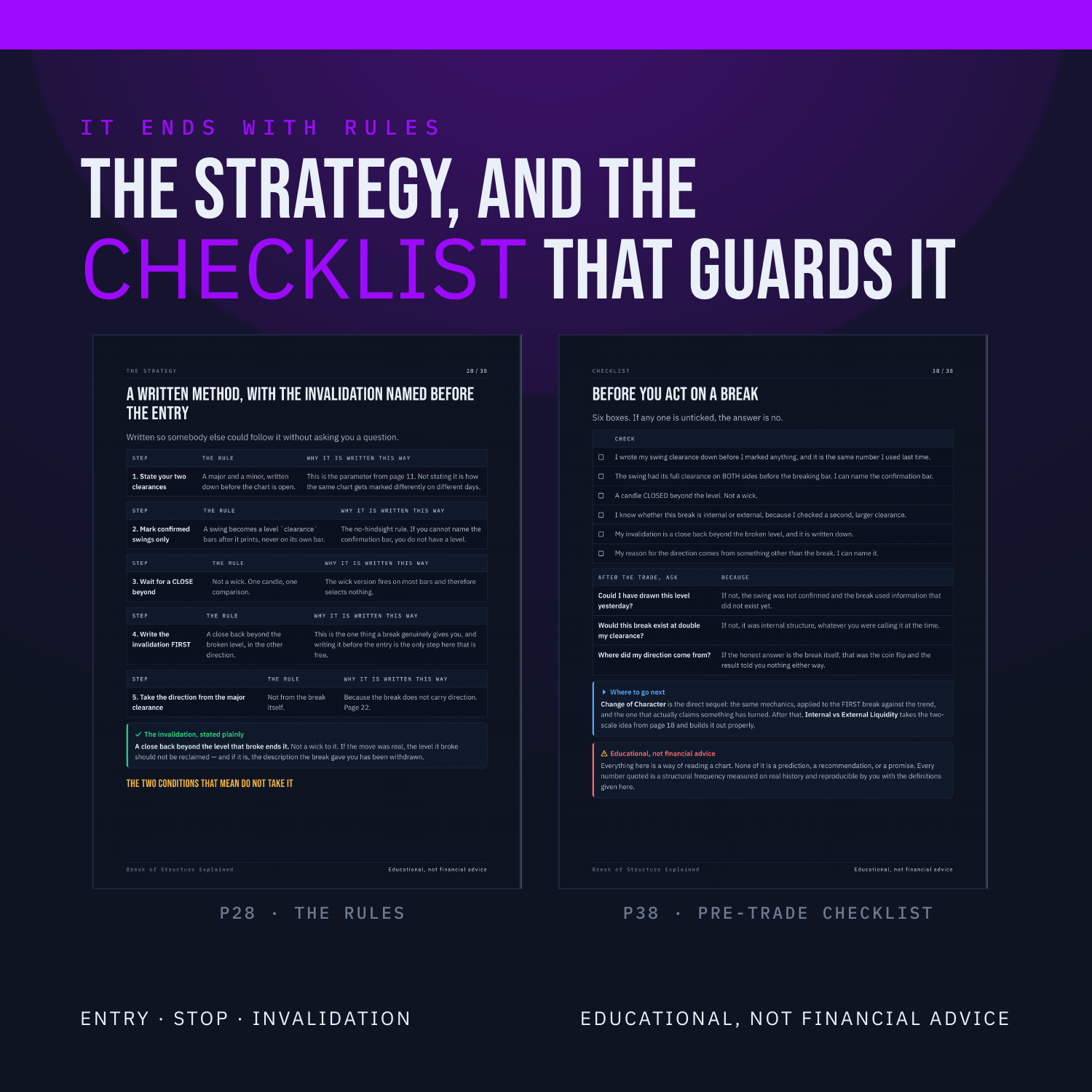
A break of structure is a CLOSE beyond a swing that was already confirmed at the time. Both halves matter, and the second one depends on a parameter almost no course states: how many bars of clearance a swing needs. Measured across 35,944 real bars, moving that number from 2 to 10 changes the count of structure breaks by 3.6 times, and only 30.9% of the breaks marked at one setting exist at the other. This guide gives you the definition, the parameter, and the discipline to mark the same chart the same way twice. This is a 38-page PDF that teaches Break of Structure from the first thing you see on the screen through to a written strategy with an entry, a stop and an explicit rule for when the trade is wrong.
Nothing is taught underneath a chart. Every label sits on the candle, the line or the level it is describing, on real market data. There are three quizzes on real charts, each followed by the same chart re-shown annotated with the reasoning, plus faded practice pages where the first steps are filled in and you finish the rest.
WHAT'S INSIDE
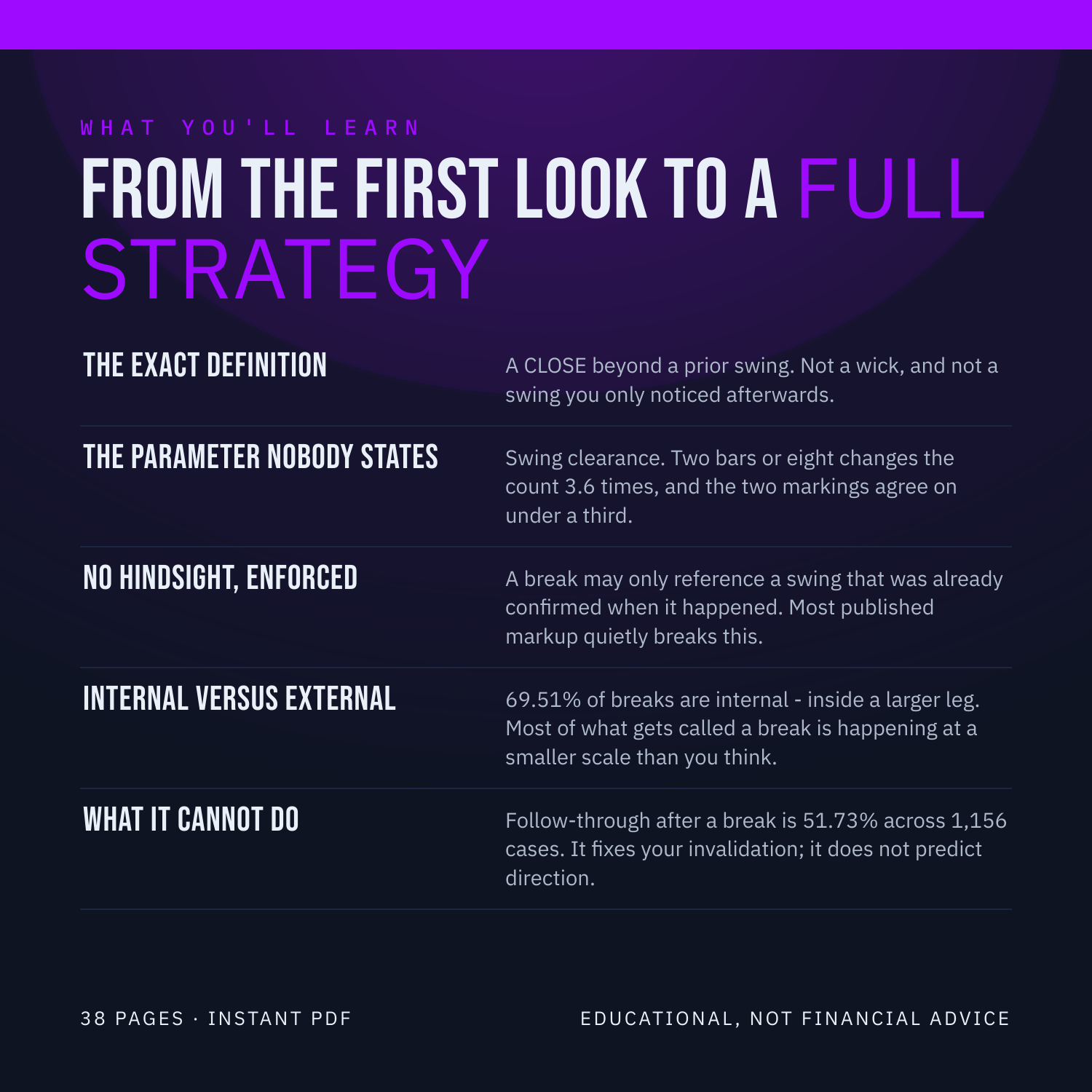
- The exact definition — A CLOSE beyond a prior swing. Not a wick, and not a swing you only noticed afterwards.
- The parameter nobody states — Swing clearance. Two bars or eight changes the count 3.6 times, and the two markings agree on under a third.
- No hindsight, enforced — A break may only reference a swing that was already confirmed when it happened. Most published markup quietly breaks this.
- Internal versus external — 69.51% of breaks are internal - inside a larger leg. Most of what gets called a break is happening at a smaller scale than you think.
- What it cannot do — Follow-through after a break is 51.73% across 1,156 cases. It fixes your invalidation; it does not predict direction.
WHAT YOU'LL BE ABLE TO DO
- Mark a break of structure by rule, and get the same answer twice.
- State the swing clearance you are using, and defend it.
- Spot markup that used a swing which was not confirmed at the time.
- Tell an internal break from an external one.
- Say what a break does and does not tell you, with the numbers.
AN HONEST NOTE
Break of Structure is a clue, not a crystal ball. It describes what price has already done. This guide contains no win-rates, no backtest results and no promises about what you will make, because nobody can verify those and you should not trust anyone who prints them. What it hands you instead is a set of rules you can test yourself on TradingView in an afternoon. Educational, not financial advice.
Instant download. 38 pages, PDF.