




Handling Losses Explained — Measured (PDF Guide)
A losing run is the moment almost every trader changes something, and it is the moment they have the least information. It feels like the market is telling you something, nobody has ever shown you how long a run is supposed to be, and so the only available reading is that something has broken.
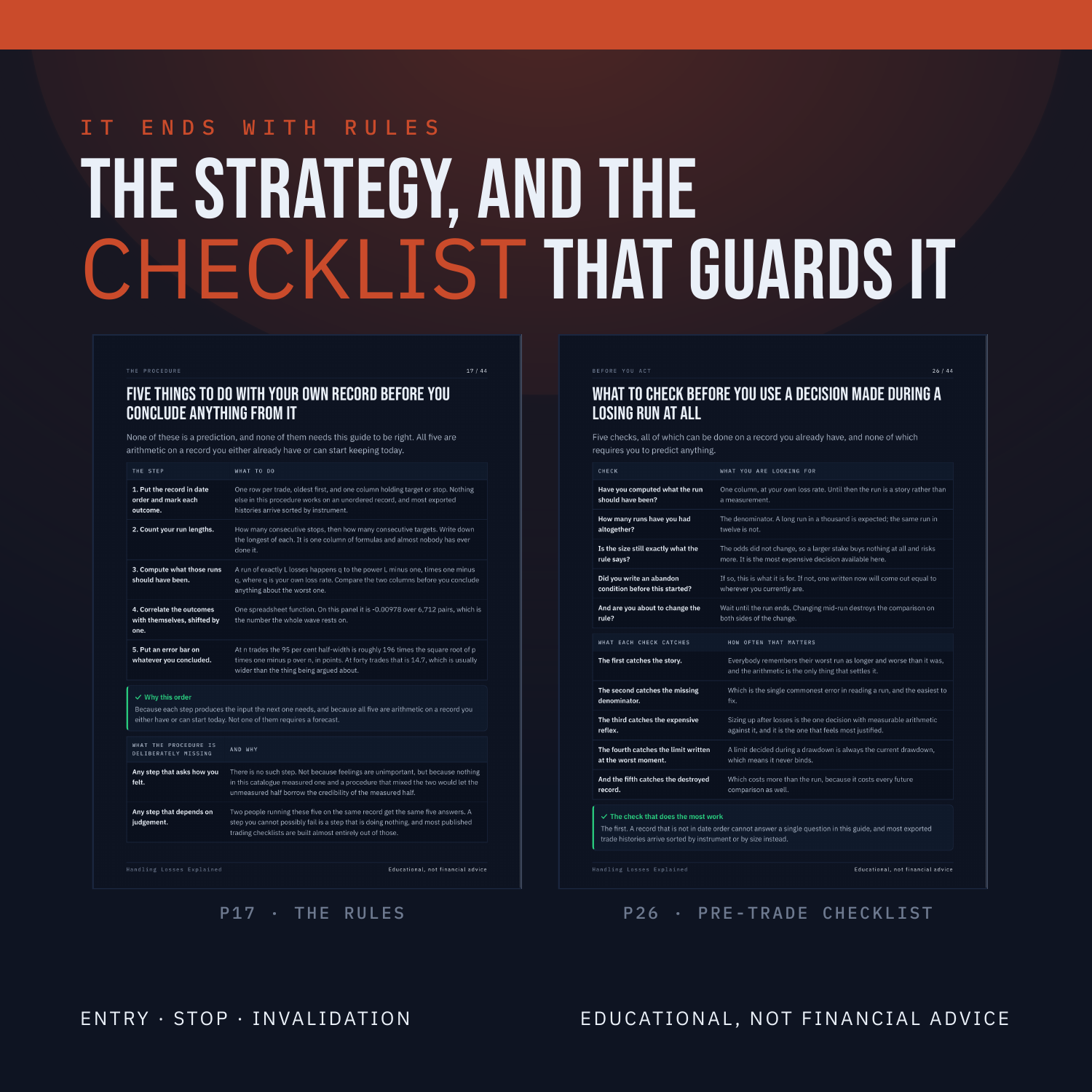
This guide prints how long runs actually get. The observed lengths on a stream of 6,722 independent trades are matched against a one-line prediction that never saw the data, and they agree at every length. Then it does the arithmetic of what a run costs, which is the part that is genuinely worth reacting to. This is a 44-page PDF that teaches Handling Losses from the first thing you see on the screen through to a written strategy with an entry, a stop and an explicit rule for when the trade is wrong.
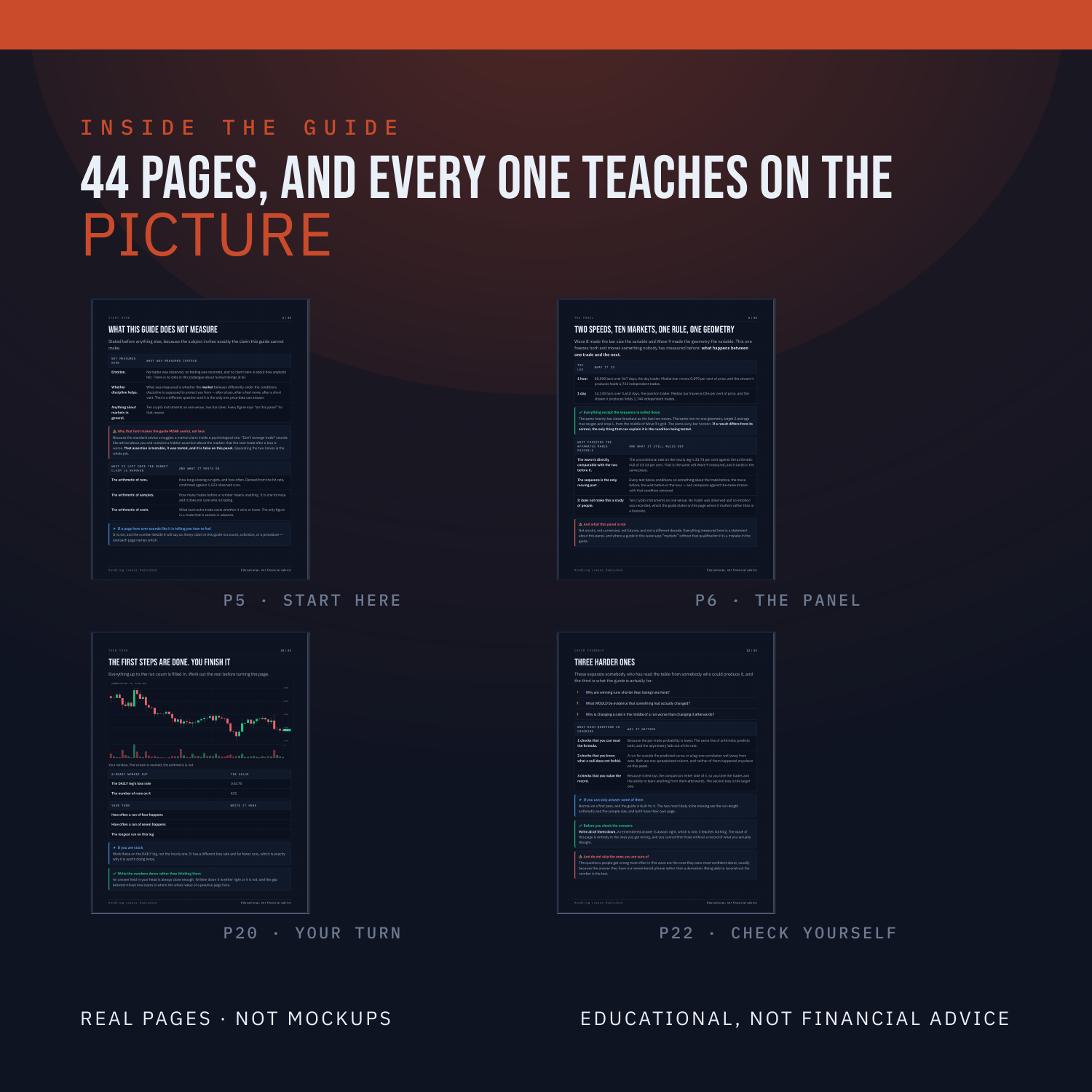
Nothing is taught underneath a chart. Every label sits on the candle, the line or the level it is describing, on real BTC, ETH, SOL and LINK charts. There are three quizzes on real charts, each followed by the same chart re-shown annotated with the reasoning, plus faded practice pages where the first steps are filled in and you finish the rest.
WHAT'S INSIDE
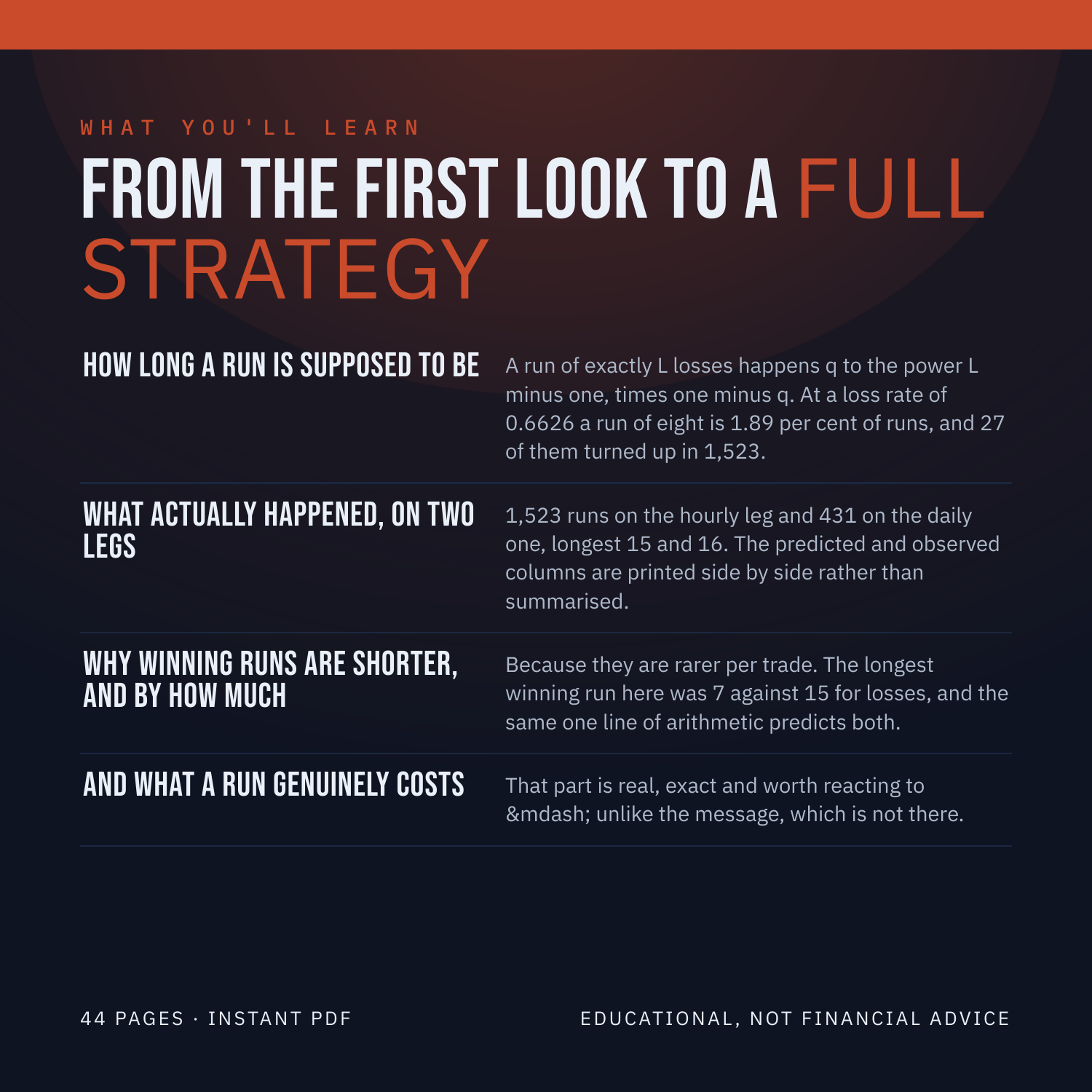
How long a run is supposed to be -- A run of exactly L losses happens q to the power L minus one, times one minus q. At a loss rate of 0.6626 a run of eight is 1.89 per cent of runs, and 27 of them turned up in 1,523.
What actually happened, on two legs -- 1,523 runs on the hourly leg and 431 on the daily one, longest 15 and 16. The predicted and observed columns are printed side by side rather than summarised.
Why winning runs are shorter, and by how much -- Because they are rarer per trade. The longest winning run here was 7 against 15 for losses, and the same one line of arithmetic predicts both.
And what a run genuinely costs -- That part is real, exact and worth reacting to -- unlike the message, which is not there.
WHAT YOU'LL BE ABLE TO DO
Say how long a losing run is supposed to be, at your own rate.
Compute what your worst run should have been, in one column.
Tell an ordinary run from evidence that something changed.
Say what a run costs without saying what it means.
Refuse to change a rule in the middle of one, for a stated reason.
AN HONEST NOTE
Handling Losses is a clue, not a crystal ball. It describes what price has already done. This guide contains no win-rates, no backtest results and no promises about what you will make, because nobody can verify those and you should not trust anyone who prints them. What it hands you instead is a set of rules you can test yourself on TradingView in an afternoon. Educational, not financial advice.
Instant download. 44 pages, PDF.