
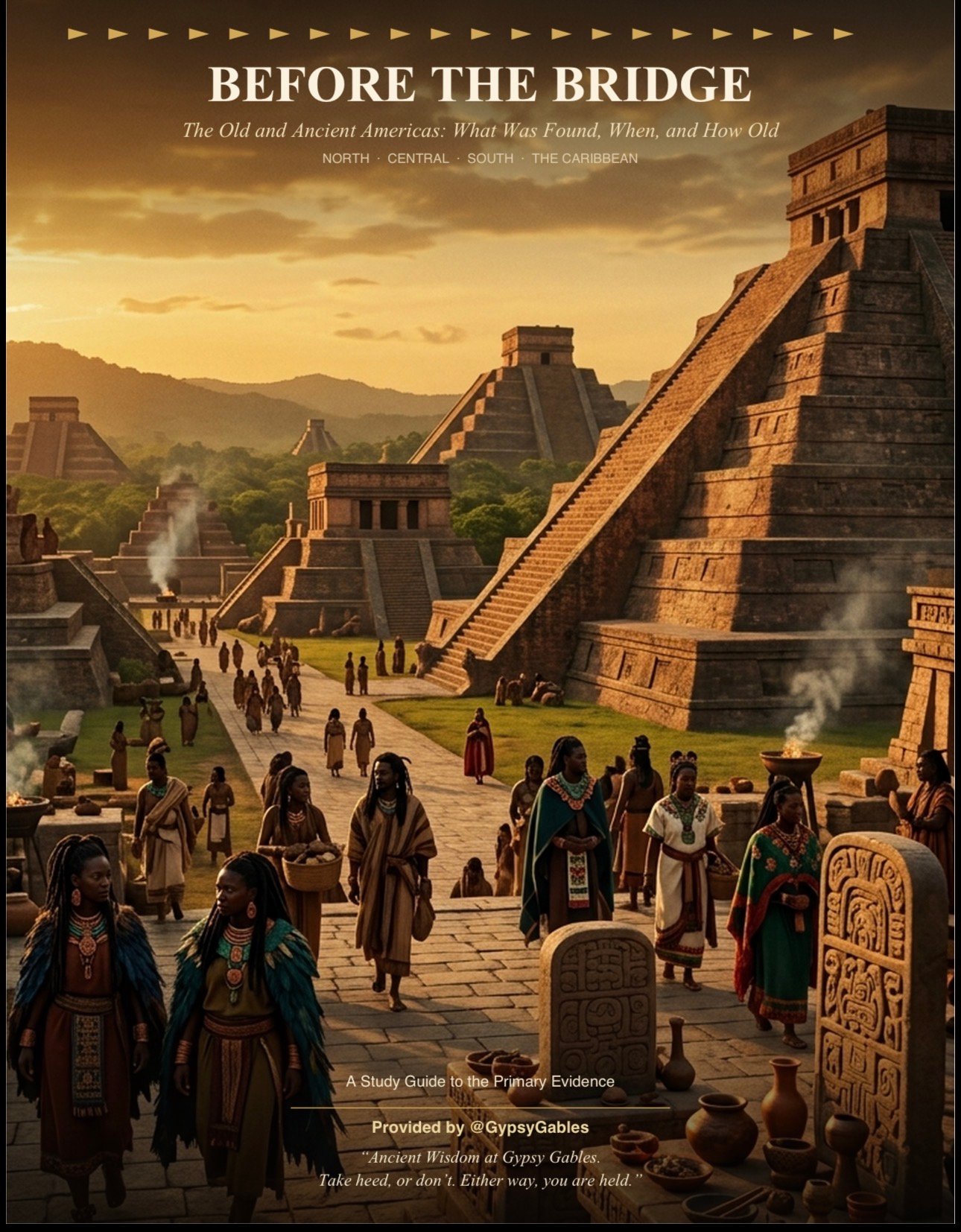
Ancient Americas: Before the Bridge
Before the Bridge: The Old and Ancient Americas
A study guide to what has actually been found across North, Central, and South America — thirty-two sites and finds, each given four things: the period it belongs to, its age in years, the year it was found and how long ago that was, and the honest state of the evidence behind it.
It opens by fixing the yardstick everything gets measured against. Beringia stood exposed roughly 36,000 to 11,000 years ago. The ice sheets closed the interior route from about 26,500 to 19,000. The corridor through Alberta only became passable around 14,800 to 13,000. The coastal route was open earlier, but the shorelines people would have walked are now underwater. Genetics places the founding separation somewhere around 25,000 to 20,000 years ago, after a long isolation in Beringia itself. Hold those numbers, and the rest of the guide has stakes.
Because several accepted sites are older than that corridor. The footprints at White Sands — 21,000 to 23,000 years, dated three separate ways across 2021, 2023, and 2025 — are older than the Last Glacial Maximum itself. Monte Verde sits at the far end of Chile at 14,500 years. Cooper’s Ferry, Paisley Caves, Page-Ladson, Buttermilk Creek. That is the live problem in the field right now, and it is stated as such.
The deeper claims get their own section rather than being buried or boosted: Chiquihuite, Pedra Furada, Cerutti at a claimed 130,000 years, Calico, Hueyatlaco — each with the specific objection it faces, named, so the argument can be followed rather than taken on someone’s say-so.
Then the monuments. Watson Brake, raised 5,500 years ago by people who farmed nothing. Poverty Point. Cahokia, larger than London at the same date. Chaco, dated to the calendar year by tree rings. L’Anse aux Meadows, pinned to exactly 1021 CE by a solar event recorded in wood. Caral, contemporary with the Old Kingdom, with no walls and no weapons. The Olmec heads. The sealed tunnel under Teotihuacan. The Maya LiDAR survey that found sixty thousand structures in a single pass. Nazca, Sipán, Tiwanaku, Machu Picchu, and the Amazonian geoglyphs and black earth that ended the idea of an empty basin.
The giants question is examined at length rather than waved off. The Paiute Si-Te-Cah tradition is real and was in print in 1883, before anyone dug. The excavations recovered normal-stature remains. The eight- and ten-foot figures come from newspapers. The red hair was genuinely there, and both explanations for it are laid out. The oversized sandals are real objects. And the Smithsonian story is told with the part that usually gets cut — that the Bureau of Ethnology’s 1894 report argued against the era’s popular vanished-white-race theory of the mounds, using its own excavations.
A closing section covers documented fabrications with confessions attached, the disputed objects that genuinely differ from them, and how to read any dating claim you meet: what was dated, by what method, and what it was lying next to.
No find in this guide is assigned to any race or ethnic group beyond what the physical evidence supports. Where scholars disagree, both sides are named. Where something was faked, the confession is cited. The reader does the weighing.
Provided by @GypsyGables — “Ancient Wisdom at Gypsy Gables. Take heed, or don’t. Either way, you are held.”