

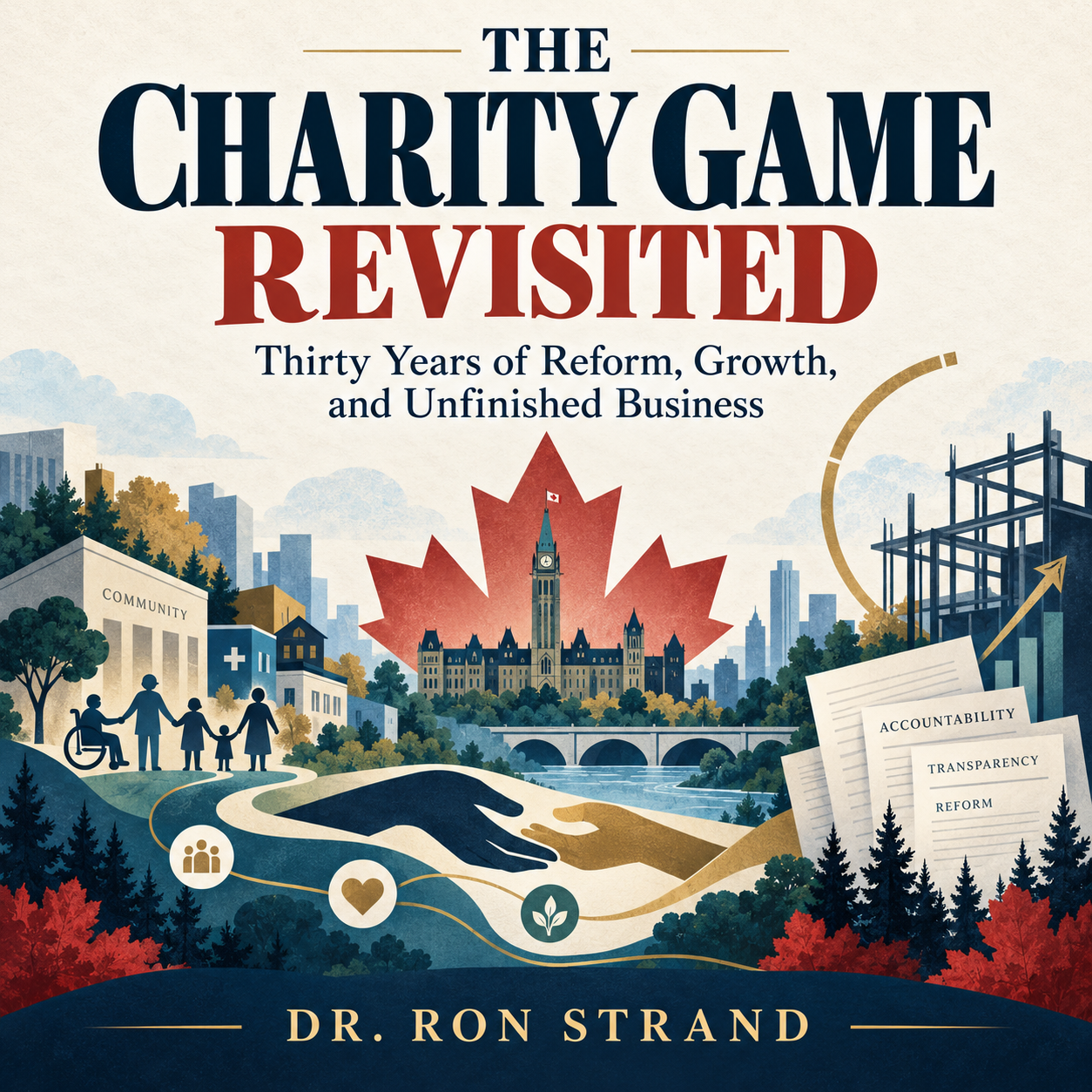
The Charity Game Revisited: Thirty Years of Reform, Growth, and Unfinished Business
Thirty years ago, Canadian journalist Walter Stewart published The Charity Game, a sharp critique of what he described as Canada’s “compassion industry.” He raised uncomfortable questions about charitable fundraising, administrative costs, accountability, regulation and the distance between public generosity and measurable results.
What has happened since?
The Charity Game Revisited: Thirty Years of Reform, Growth, and Unfinished Business examines how Canada’s charitable sector has changed since Stewart’s book appeared in 1996. The sector is larger, more professional and more transparent than it was three decades ago. Governments have strengthened regulation, charities disclose considerably more information, independent rating organizations have emerged, and expectations surrounding governance and accountability have increased.
Drawing on public records, sector reports, government data and contemporary research, Dr. Ron Strand explores the changing structure of Canadian charity. He considers the professionalization of fundraising, the growth of foundations and donor-advised funds, the rise of charity ratings, the influence of large donors and intermediaries, and the continuing debate over administrative and fundraising costs.
The book also looks beyond financial ratios. It asks whether greater disclosure has produced meaningful accountability, whether donors receive the information they actually need, and whether charities are being judged by their social impact or simply by what can be easily counted.
This is not a sequel to Walter Stewart’s book, nor an attempt to reproduce it. Instead, Stewart’s critique provides the historical starting point for a broader examination of thirty years of reform, expansion and institutional change.
Written for donors, volunteers, board members, nonprofit professionals, policymakers, students and anyone interested in how charitable resources are raised and used, The Charity Game Revisited offers a balanced assessment of a sector that is both indispensable and imperfect.
119 pages