
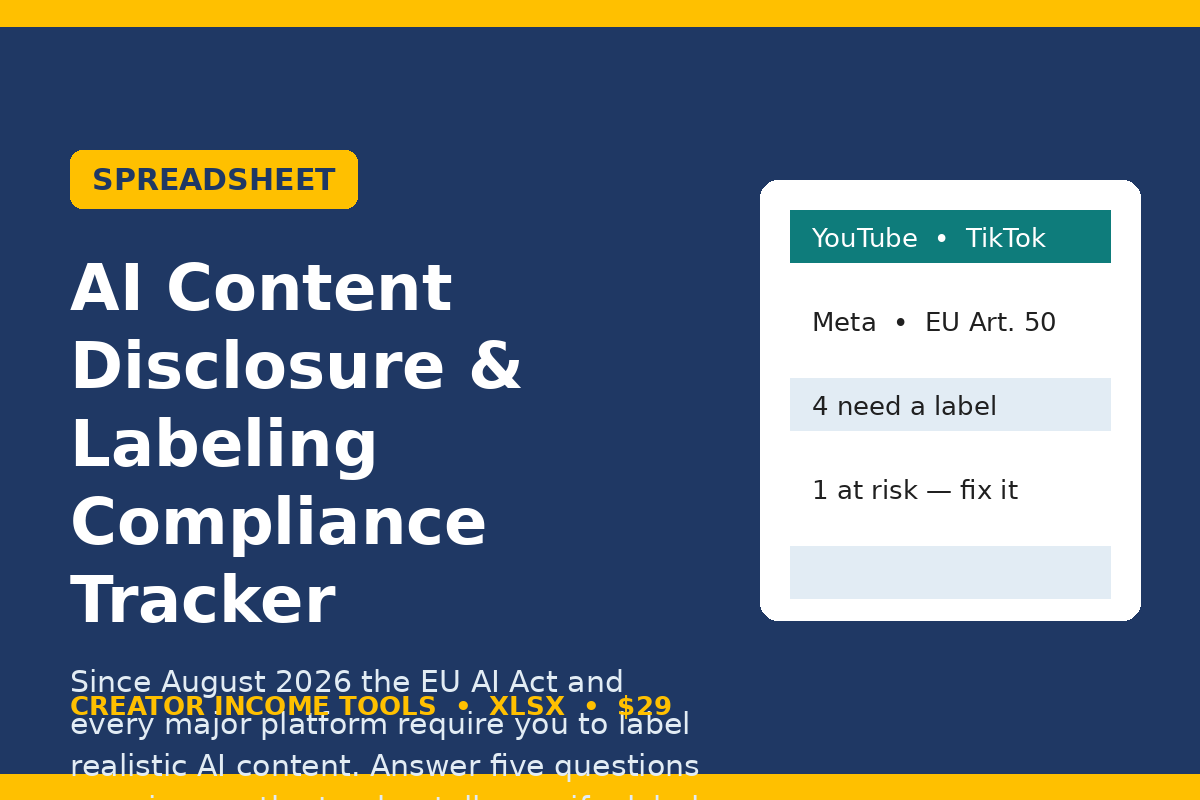
AI Content Disclosure & Labeling Compliance Tracker
Since August 2, 2026, the EU AI Act's transparency rules have been in force — and the three platforms most creators live on, YouTube, TikTok and Meta, each require you to label realistic AI content yourself.
The penalties sit on non-disclosure. TikTok can remove or restrict unlabeled content. YouTube can remove it or suspend you from the Partner Program. Meta says it may apply penalties. And the EU fines reach EUR 15,000,000 or 3% of worldwide annual turnover.
The fix is small and mechanical — if you don't forget a piece. For every piece you publish, answer five yes/no questions and this tracker tells you whether a label is required, which label to use, and whether you actually applied it.
Disclosing does not cost you reach. TikTok states in writing that turning the AI label on does not affect distribution as long as the post follows the Community Guidelines. What costs you is forgetting one piece.
WHAT YOU GET
A formula-driven Excel workbook with 5 sheets:
1. Start Here — the method, the decision rule in one paragraph, the worked example, and what changed recently: EU AI Act Article 50 in force since August 2, 2026; the provider grace period for machine-readable marking ends December 2, 2026; OpenAI's textGrain watermark for ChatGPT text in the EU (announced October 5, 2026); the European Commission's Article 50 guidelines (November 5, 2026); India's amended IT Rules on synthetic media (in force since February 20, 2026).
2. Rules Reference — the rules as of November 2026, platform by platform and law by law: YouTube, TikTok, Meta (Facebook, Instagram, Threads), X, EU AI Act Article 50, the US FTC fake-review rule, India IT Rules, and Pinterest / LinkedIn / Google. Each row gives what triggers a label, where to set it, what happens if you don't, and what needs no label.
3. Content Log — one row per piece you publish. Fill in the date, title, platform, format, and five yes/no answers: Was AI used? Does it look realistic? Does a real person appear to say or do something they didn't? Is it clearly artistic, satirical or fictional? Is it an ad or sponsored? "Label required?" and "Status" are formula-driven. Anything that needs a label and doesn't have one shows as AT RISK.
4. Label Library — copy-paste disclosure lines: a short on-screen badge and a longer line for the caption, description or show notes, for video, image, audio, ads, artistic work, text, chatbots, thumbnails and client handovers.
5. Dashboard — headline counts: pieces logged, pieces needing a label, labeled, at risk, and pieces where a lighter label is recommended. One next action tells you what to fix first, plus the next rules re-check date (every 90 days — platform rules change fast).
WORKED EXAMPLE INCLUDED
8 pieces logged. 4 need a label, 3 labeled, 1 at risk, 1 lighter label recommended, 3 need no label. The at-risk piece is an Instagram Reel with an AI-generated customer testimonial — not only unlabeled, but the FTC fake-review rule bans AI-generated fake reviews and testimonials outright, so that piece should not be published as a testimonial at all. Delete the example rows and start with your own content.
THE DECISION RULE, IN ONE PARAGRAPH
Label it when it looks or sounds real: a real person saying something they didn't, a scene that never happened, an AI face or voice. Using AI for ideas, scripts, captions or thumbnails usually needs no label — that is production help, not the content itself. Clearly artistic, satirical or fictional work gets a lighter label, not the full warning. Ads and sponsored posts made with AI always need a disclosure, and an AI presenter may present your product but must never pose as a customer or give a review. A hidden watermark from your generator is not enough on its own: the European Commission says deployers cannot simply rely on the machine-readable marking embedded by the provider — you must disclose visibly to the viewer, at first exposure at the latest.
WHAT IT IS NOT
General information, explicitly not legal advice. The rules are summarised from the platforms' published policies and reputable legal analyses as of November 2026; platform rules change often, so re-read the original policy pages before you rely on a detail, and check how a rule applies to you with a qualified lawyer if it affects your income or a client contract. This tracker covers the disclosure decision and the label record — it does not file anything, it does not apply labels for you, and it does not cover copyright, data protection, or the AI training opt-out.
Log every piece. Label what needs it. Re-check the rules every 90 days.