
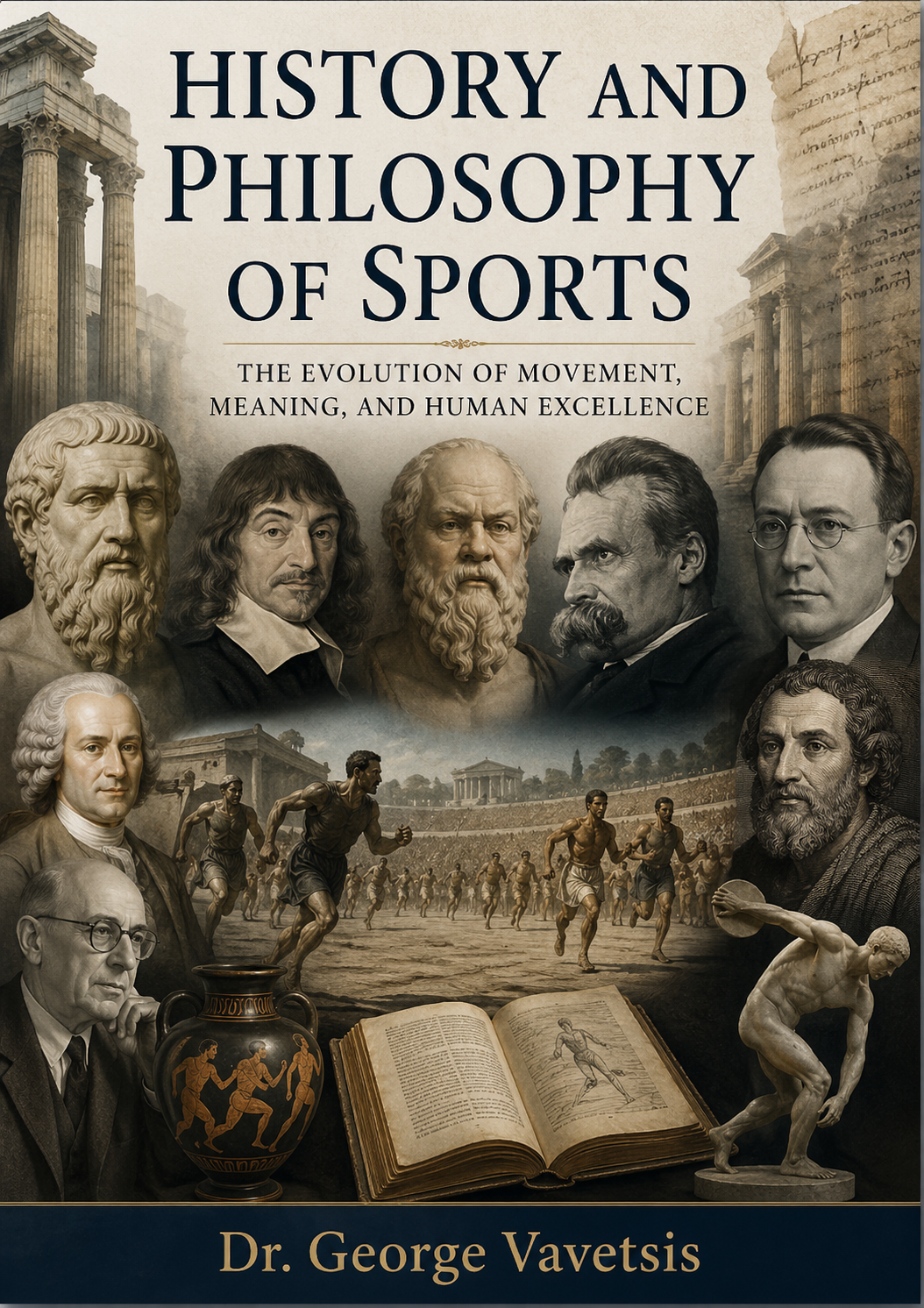
History and Philosophy of Sports
Pages: 834
Movement precedes thought. It precedes language, structure, and even identity. Before the emergence of systems, before the codification of rules, before the abstraction of philosophy itself, there was motion—pure, unfiltered, and essential. This book begins from that fundamental premise: that movement is not merely an activity performed by human beings, but the very condition through which human existence is realized.
To understand sport, therefore, is not simply to analyze competition, performance metrics, or institutional frameworks. It is to engage with one of the most profound ontological questions: what does it mean to exist as a being-in-movement? Within this inquiry lies a shift away from traditional interpretations that treat the body as a mechanical object and toward a more integrated, phenomenological understanding of the human organism as a dynamic, adaptive, and meaning-generating system.
Historically, the philosophy of sport has oscillated between two poles. On one side, reductionist paradigms have attempted to explain performance through biomechanics, physiology, and quantifiable outputs. On the other, humanistic and existential approaches have emphasized experience, intention, and meaning. This work does not reject either perspective; instead, it seeks to synthesize them into a unified framework in which movement is both measurable and meaningful, both mechanical and existential.
At its core, sport represents a transformation: the evolution of movement from necessity to expression. In its most primitive form, movement is survival-driven—an adaptive response to environmental constraints. Yet as human societies evolved, so too did the nature of movement. What was once purely functional became symbolic. What was once instinctive became intentional. Through this transition, movement acquired value beyond survival; it became a medium through which individuals express identity, creativity, and purpose.
This transformation is not arbitrary. It is governed by the emergence of structure—rules, constraints, and systems that shape the way movement is performed. Contrary to the intuitive belief that constraints limit freedom, this book argues that constraints are the very conditions that enable it. Within the bounded environment of sport, athletes are not restricted; they are challenged to innovate, adapt, and discover new movement solutions. Freedom, therefore, is not the absence of rules, but the capacity to operate creatively within them.
The athlete, in this context, is not a static entity but a continuously evolving system. Drawing from principles of complex systems theory, the athlete is conceptualized as a non-linear adaptive organism, constantly reorganizing in response to internal and external stimuli. Performance is not a fixed attribute but an emergent property of interactions between physiology, cognition, environment, and intention. Identity itself becomes fluid—reshaped through each training session, each competition, each moment of adaptation.
Such a perspective demands a re-evaluation of traditional coaching and training methodologies. If the athlete is an adaptive system, then training cannot be reduced to linear progressions or isolated variables. It must be understood as a process of guided adaptation, where variability, constraint manipulation, and perception-action coupling play central roles. The coach, therefore, is not merely a prescriber of exercises but an architect of environments—designing conditions that facilitate the emergence of optimal movement patterns and decision-making processes.
Equally important is the role of temporality in movement. Every action exists within a continuum of past experiences, present conditions, and anticipated futures. Memory informs execution, perception guides adaptation, and anticipation shapes outcomes. High-level performance is not reactive but predictive; it is the ability to act in the present while being informed by the past and oriented toward the future. This temporal integration is what allows athletes to operate with precision under conditions of uncertainty and pressure.
Beyond its scientific and practical implications, sport also holds a deeper philosophical significance. It is a domain where fundamental human experiences—struggle, effort, uncertainty, and achievement—are distilled into observable form. In sport, the abstract becomes concrete. The concept of effort is no longer theoretical; it is embodied in the athlete’s struggle against resistance. The idea of meaning is no longer speculative; it is enacted through purposeful movement. In this sense, sport becomes a microcosm of life itself—a structured environment in which the dynamics of existence are intensified and made visible.
This book is therefore not only an exploration of sport but an exploration of being. It invites the reader to reconsider movement not as a secondary attribute of human life but as its primary expression. It challenges conventional distinctions between body and mind, action and thought, structure and freedom. And it proposes a new lens through which sport can be understood—not merely as competition or performance, but as a fundamental mode of human existence.
For the strength and conditioning coach, the sport scientist, and the performance practitioner, this perspective carries profound implications. It calls for a shift from fragmented approaches toward integrated systems thinking. It emphasizes the importance of context, variability, and adaptability in training design. And it reinforces the idea that performance is not simply built—it emerges.
Ultimately, this work is an invitation: to think differently about movement, to see sport not as an isolated domain but as a central expression of life, and to recognize that in every act of movement lies a deeper process of becoming.