
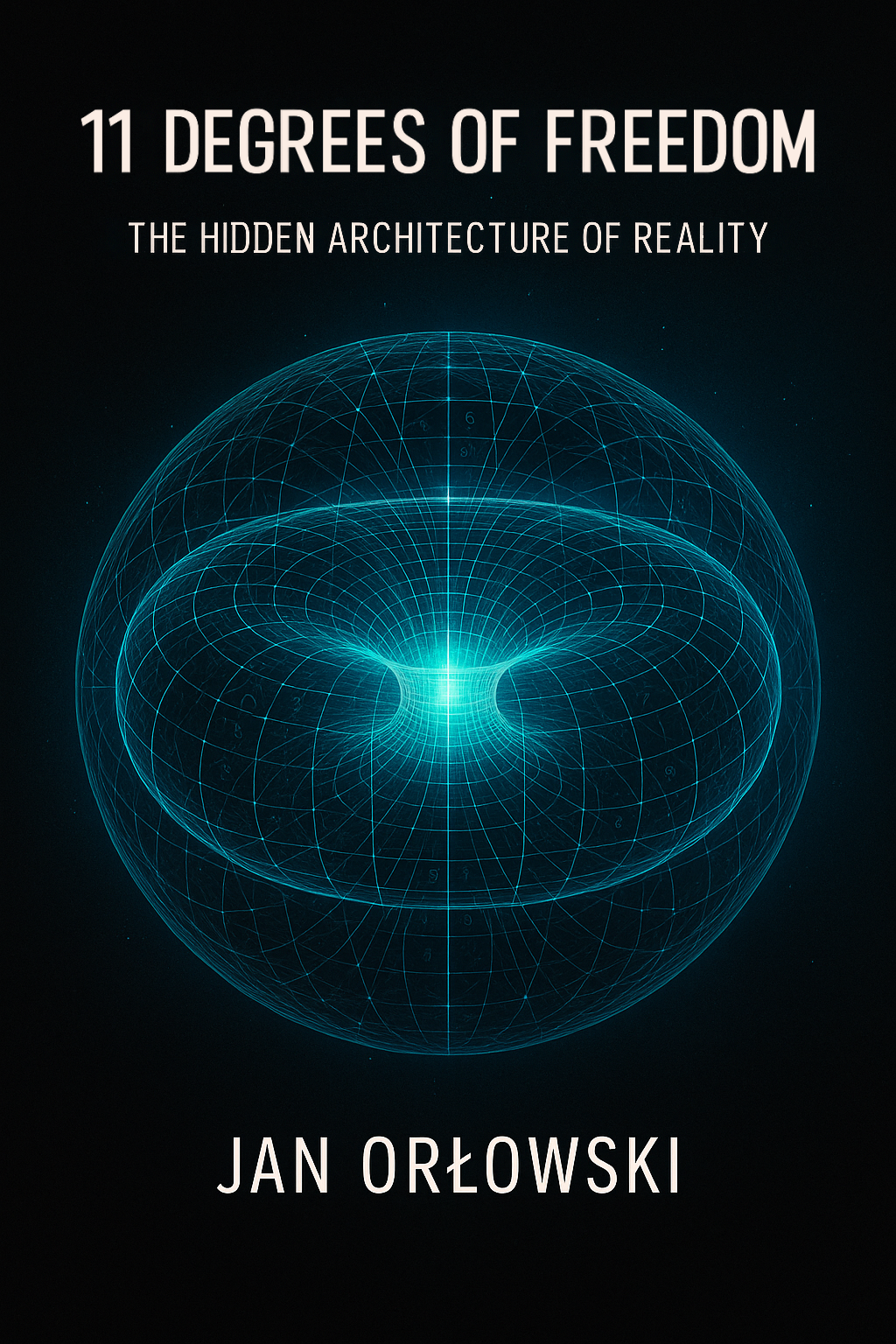
11 degrees of freedom
11 DEGREES OF FREEDOM
- Step outside the three-dimensional illusion.
- Learn how the engine that drives your reality works.
- 11 Degrees of Freedom questions the foundations of our modern picture of the world.
- It starts from the idea that matter is not fundamental, time is not linear, and reality works like an information system that depends on the observer.
What if physics' greatest discoveries only describe how reality works, without explaining why reality exists at all?
The Standard Model describes the behavior of matter, fields and interactions with remarkable precision. It explains how the Universe works. Yet it leaves the most fundamental questions open:
- Why do the laws of physics exist?
- Where does information come from?
- What is consciousness?
- How is it possible for different states and potential realities to exist?
11 Degrees of Freedom does not compete with modern physics. It attempts to create a meta-theory: a model of the conditions that must be met for any universe to emerge at all.
The book draws on philosophy, information theory, physics, mathematics and the simulation hypothesis. From these it builds the author's own concept of eleven fundamental degrees of freedom. These are the levels from which space, time, matter, energy, consciousness and the very possibility of existence may emerge.
This book is for readers who aren't satisfied with an answer to "How does reality work?" They want to understand "Why does this particular reality exist, and could it have been different?"
If Codes to the Game Called Life teaches you the rules of the game, 11 Degrees of Freedom tries to explain where the board, the rules and the chance to play came from in the first place.