
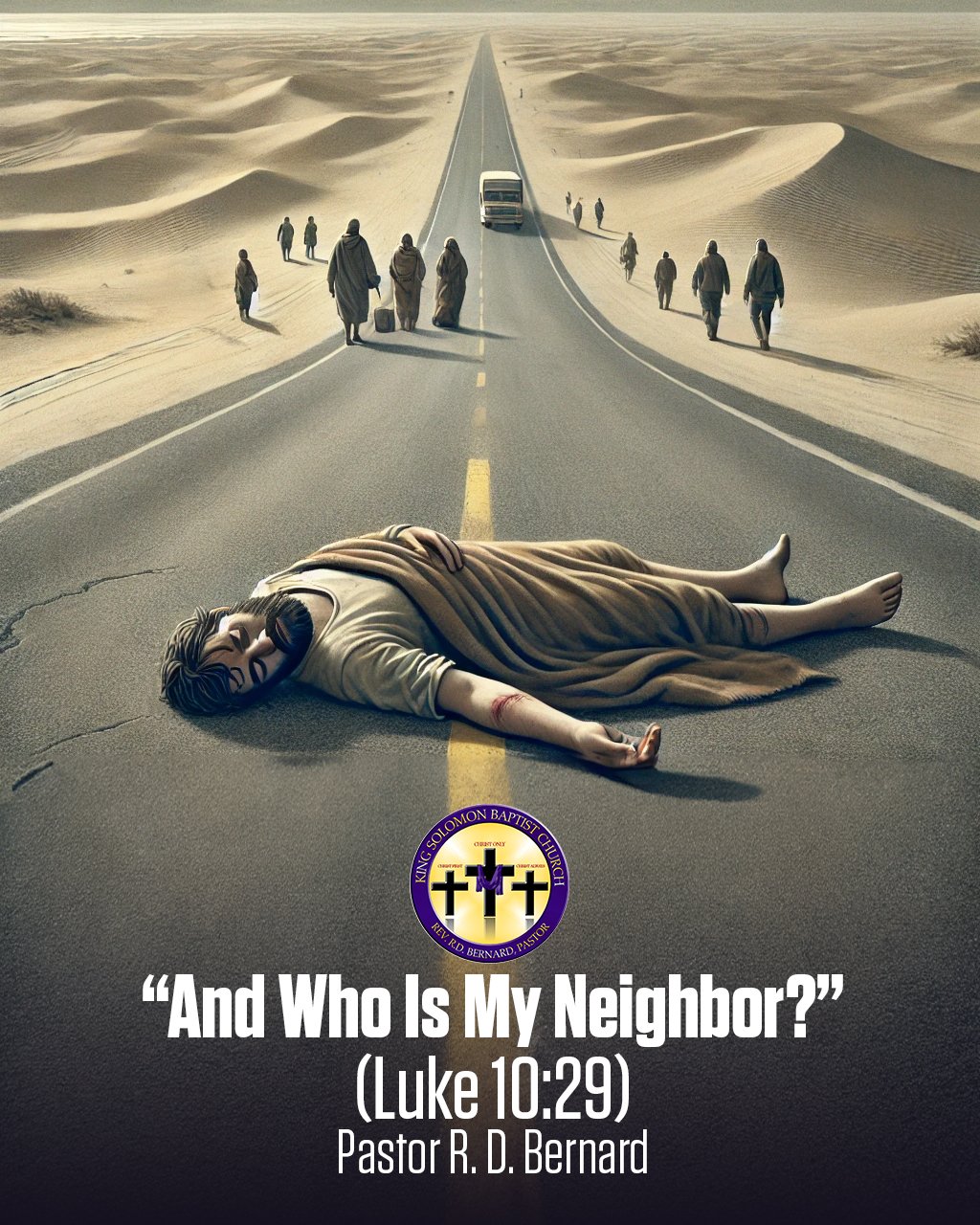
“And Who Is My Neighbor?” (Luke 10:29)
“And Who Is My Neighbor?” (Luke 10:29)
With this question, the expert in religious law sought to trap Jesus. His error is the same as so many of ours: we read the Word of God as poetry and not as something to be obeyed. We have all read the parable of the Good Samaritan (Luke 10:30-37). Some of us who have been in church all our lives know its tenets by heart. The problem is that we fail to practice these tenets.
Helping another is so basic. It is so Christian at heart. The issue at hand is one of selfishness. How far does my obligation as a Christian extend to my neighbor?
We live in the age of common sense. It is also the age of Christian selfishness: one in which we don’t mind giving from our abundance, but we will not risk our own safety and security.
Like the expert in religious law, we all proclaim that we love God (Luke 10:27). I stand here as your Pastor and proclaim. The Mothers, Deaconesses, Deacons, ushers, choir members sing about it, and those among us who sit quietly in the service would like to be known as someone who loves God. Love of God is not the problem.
We don’t know what the depth of each person’s relationship with God is, because we cannot examine it. What we can examine is whether we love our neighbors. I believe that the Lord would have been content to leave well enough alone, but the expert was not satisfied (Luke 10:29).
He wanted to embarrass Jesus by proving that there are some things and some people that are excluded from the category of “loving thy neighbor.” Jesus used the occasion to bring forth one of the more basic tenets of Christianity: loving your neighbor. Consider the following three points.
1. You can’t love your neighbor if you don’t get involved with their hurt.
a. It is not said that the priest (verse 31) and the Levite (verse 32) didn’t want to get involved. We don’t know whether the Priest was going to send help back or not. We don’t know what the Levite reasoned in his heart when he came to take a closer look (verse 32).
b. How we treat others, in their season of hurt and nastiness, determines whether we will inherit eternal life. Remember, that is the question that the religious expert used to start the discussion (verse 25).
c. Good works will not get you into Heaven, but if you have faith in Christ, you will get involved with your neighbor’s hurt because faith without works is not faith at all (James 2:14-17).
2. Selfish people only look out for themselves and their loved ones, but Christians look out for all mankind, especially other Christians.
a. Contextually speaking, the “certain man” who “fell among thieves” was a Jew (Luke 10:30). The Jews (the priest and the Levite) had an obligation, in love, to help (Luke 10:27; Micah 6:8; Isaiah 1:17; Deuteronomy 15:7-8).
b. Christians have an obligation to help the wounded. Paul put it this way in Galatians 6:10 in the KJV: “As we have therefore opportunity, let us do good unto all men, especially unto them who are of the household of faith.”
c. The Samaritan not only entered the man’s hurt, but he ministered to him, not only in words but also in deeds. He put him on his donkey, took him to an inn, and took care of him (verse 34).
3. Christians have an obligation to help others return to full health.
a. The Samaritan “bound up his wounds, pouring in oil and wine, and set him on his own beast, and brought him to an inn and took care of him” (Luke 10:34). This solved the neighbor’s immediate needs.
b. “And on the morrow when he [the Samaritan] departed, he took out two pence, and gave them to the host, and said unto him, ‘Take care of him; and whatsoever thou spendest more, when I come again, I will repay thee” (Luke 10:35). This would ensure the neighbor's return to full health.
“Christ First, Christ Only, Christ Always”