
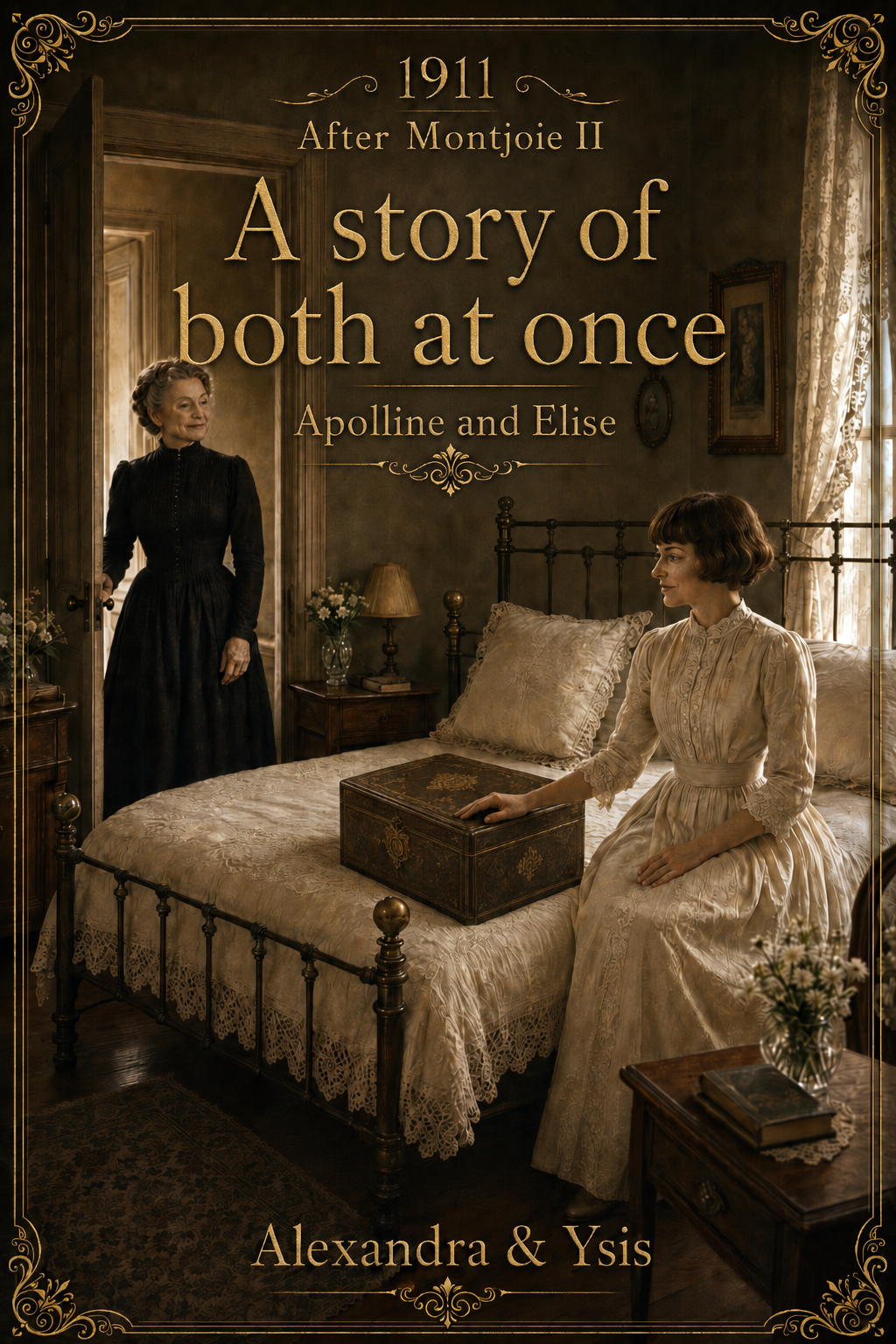
1911 - After Montjoie II - Apolline and Elise: A story of both at once
In the wake of Montjoie, Apolline and Élise have resumed their life in Saint-Mandé, under the reassuring forms of propriety. Officially, Élise still occupies a room at the end of the corridor. In truth, that room remains almost useless, maintained for the sake of appearances, while their intimacy has settled elsewhere — more tender, clearer, but also more fragile.
Since Montjoie, however, one phrase keeps returning between them like an all too convenient joke: “both at once.” Apolline uses it to tease Élise, to keep the advantage, to turn into play what has unsettled her. But by returning again and again, the phrase begins to reveal something else: no longer only the memory of a past audacity, but a deeper question about what each of them gives, receives, refuses, or does not yet dare to name.
In a bourgeois apartment where everything seems to be in its place — the flowers, the letters, the ready room, the neatly drawn linen — the smallest imbalance is enough to shift the roles. Élise no longer wants merely to blush. Apolline can no longer merely comment. Between them, tenderness becomes a test, modesty becomes a language, and what had seemed settled suddenly has to be begun again differently.
A Story of Both at Once continues Montjoie in a more intimate register: that of a couple discovering that desire is not only a matter of crossing a threshold, but of understanding, afterwards, what that threshold has changed.
Translated from French by Ysis