
Ecosystems Investigation (6th -8th)
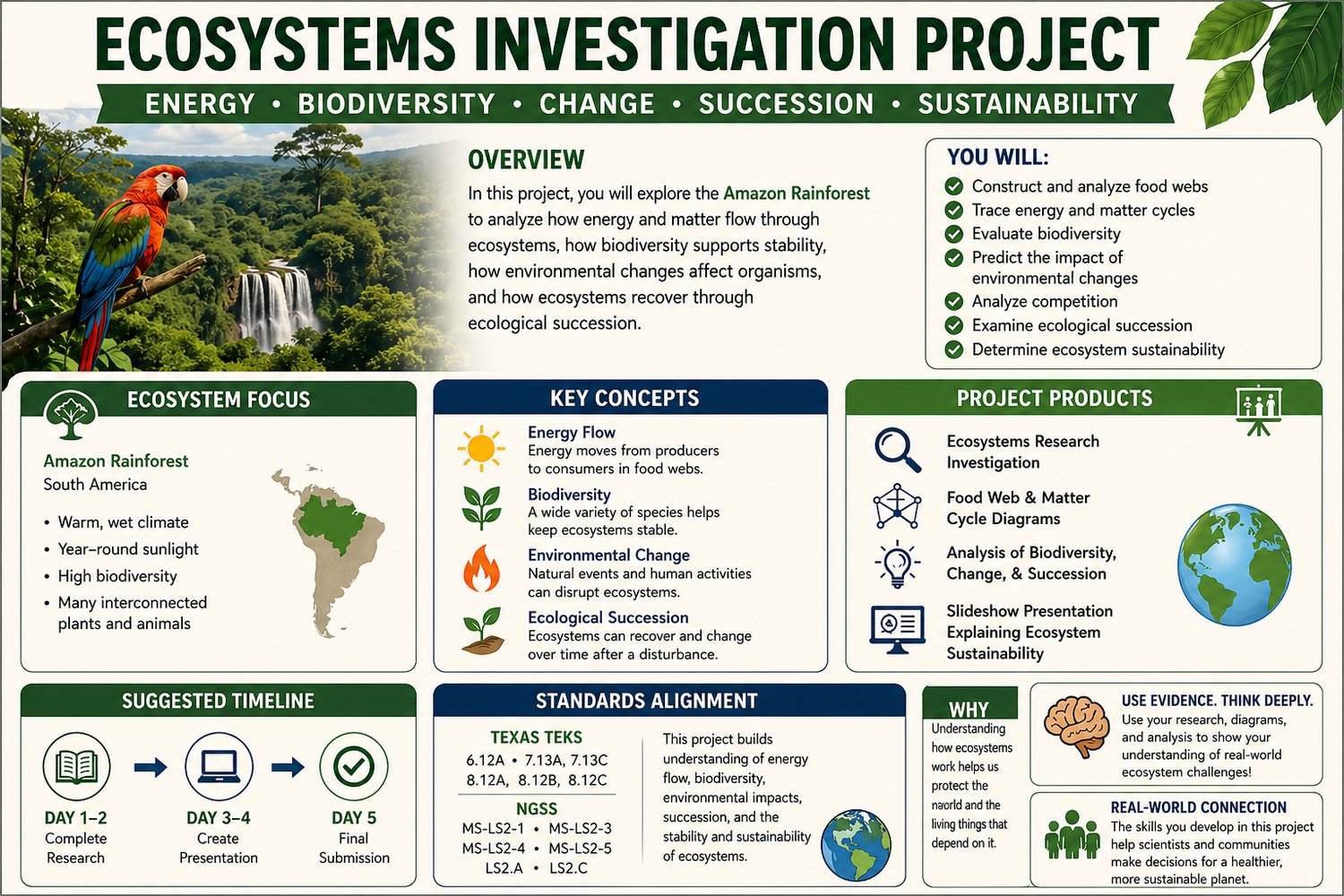
Ecosystems are made up of living organisms interacting with each other and their environment. Energy moves through ecosystems as organisms obtain food from plants or other animals, creating interconnected food webs. The variety of organisms living in an ecosystem, known as biodiversity, helps maintain stability and supports survival. However, environmental changes such as climate shifts, natural disasters, or human activity can disrupt ecosystems and affect populations over time. In this investigation, you will analyze energy transfer through food webs, evaluate biodiversity, predict how environmental changes impact ecosystems, and examine how ecosystems recover through ecological succession.
Standards Alignment:
Texas TEKS (New Standards):
- 6.12A – Energy Flow: Diagram the flow of energy through living systems, including food chains, food webs, and energy pyramids
- 7.13A – Environmental Impacts: Analyze how environmental changes, including those caused by human activity, affect biodiversity and how changes in biodiversity impact ecosystem stability
- 7.13C – Biodiversity and Sustainability: Analyze how biodiversity contributes to the sustainability of an ecosystem
- 8.12A – Environmental Disruptions and Energy Transfer: Explain how environmental disruptions, such as population changes, natural disasters, and human activities, affect the transfer of energy in food webs
- 8.12B – Ecological Succession: Describe how primary and secondary ecological succession affect populations and species diversity after ecosystems are disrupted by natural events or human activity
- 8.12C – Biodiversity and Ecosystem Stability: Describe how biodiversity contributes to the stability and sustainability of an ecosystem and the organisms within the ecosystem
NGSS (Middle School Life Science):
- MS-LS2-1 – Analyze and interpret data to provide evidence for the effects of resource availability on organisms and populations in ecosystems
- MS-LS2-3 – Develop a model to describe the cycling of matter and flow of energy among living and nonliving parts of an ecosystem
- MS-LS2-4 – Construct an argument supported by evidence that changes to ecosystems affect populations
- MS-LS2-5 – Evaluate competing design solutions for maintaining biodiversity and ecosystem stability
- LS2.A – Interdependent Relationships in Ecosystems
- LS2.C – Ecosystem Dynamics, Functioning, and Resilience
Includes teacher key