
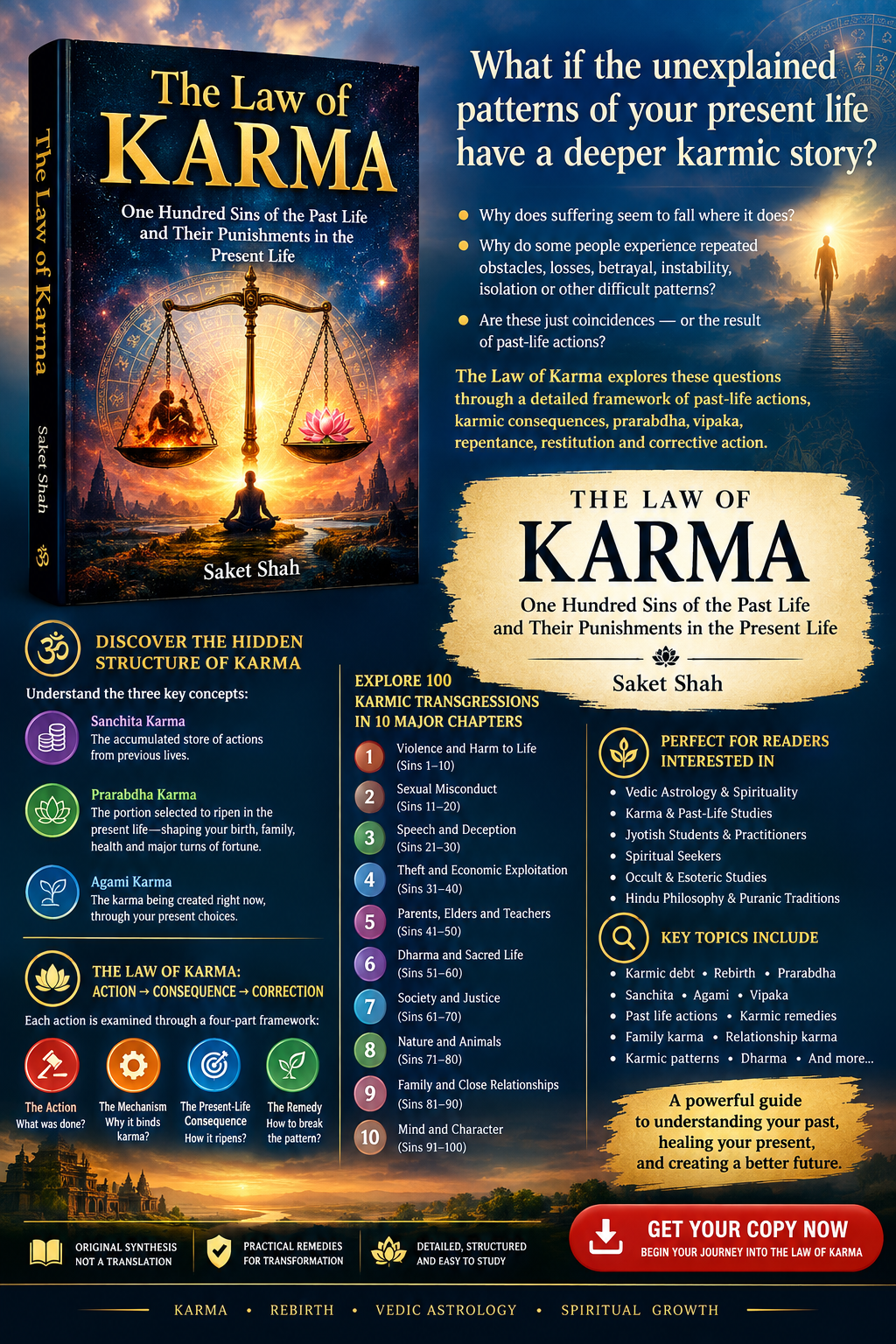
The Law of Karma One Hundred Sins of the Past Life and Their Punishments in the Present Life
The Law of Karma
One Hundred Sins of the Past Life and Their Punishments in the Present Life
By Saket Shah
What if the unexplained patterns of your present life have a deeper karmic story?
Why does suffering seem to fall where it does?
Why do some people experience repeated obstacles, losses, betrayal, instability, isolation, or other difficult patterns that appear to have no obvious explanation?
The Law of Karma explores these questions through a detailed framework of past-life actions, karmic consequences, prarabdha, vipaka, repentance, restitution, and corrective action.
This book examines 100 specific actions and explores the karmic mechanism traditionally associated with each one, the form in which that karma may ripen in a subsequent life, and the practices described as ways of counteracting the underlying tendency.
🔥 DISCOVER THE HIDDEN STRUCTURE OF KARMA
This is not simply a collection of stories about good and bad deeds.
The book introduces three important concepts:
Sanchita Karma
The accumulated store of actions from previous lives that have not yet ripened.
Prarabdha Karma
The portion of accumulated karma selected to ripen in the present life—described in the book as influencing areas such as birth, family, health and major turns of fortune.
Agami Karma
The karma being created through the choices and actions of the present moment, potentially producing consequences in the future.
The book then focuses particularly on prarabdha and the concept of vipaka—the ripening of karma.
⚖️ THE LAW OF KARMA: ACTION → CONSEQUENCE → CORRECTION
One of the central ideas presented in the book is that karmic consequences may unfold according to a principle of resemblance.
The text discusses examples such as:
- Violence → violence suffered or bodily consequences
- Deception → being deceived or living with suspicion
- Theft → loss and financial instability
It also emphasizes that karma is not presented as a simplistic one-to-one formula, while resemblance remains the organizing principle of the book.
Each of the 100 entries follows a structured approach:
1. The Action
What was done and why it is considered karmically significant.
2. The Mechanism
How the action is believed to create or bind karma.
3. The Present-Life Consequence
The specific form of suffering or circumstance traditionally associated with its ripening.
4. The Remedy
A traditional or practical counter-action intended to interrupt or transform the pattern.
📖 EXPLORE 100 KARMIC TRANSGRESSIONS
The book is divided into 10 major chapters, covering 100 individual karmic actions.
Chapter 1 — Violence and Harm to Life
Sins 1–10
Explore karmic themes involving killing, cruelty, hunting, abandonment of the dying, violence toward vulnerable beings, and other forms of harm.
Chapter 2 — Sexual Misconduct
Sins 11–20
Examine betrayal, exploitation, adultery, abuse of authority, sexual violence, hidden relationships, and other violations of trust and consent.
Chapter 3 — Speech and Deception
Sins 21–30
Discover karmic themes surrounding lying, false testimony, slander, backbiting, broken promises, curses, betrayal of secrets, manipulation and spreading panic.
Chapter 4 — Theft and Economic Exploitation
Sins 31–40
Explore theft, business deception, employee exploitation, predatory lending, bribery, corruption, fraudulent property acquisition and misuse of entrusted resources.
Chapter 5 — Parents, Elders and Teachers
Sins 41–50
Examine abandonment of parents, betrayal of teachers, disrespect toward elders, stealing a mentor's work and misuse or commercialization of sacred teaching.
Chapter 6 — Dharma and Sacred Life
Sins 51–60
Explore sacred spaces, religious property, spiritual knowledge, false spiritual authority, broken vows and disrespect toward sacred texts.
Chapter 7 — Society and Justice
Sins 61–70
Examine corruption, unjust judgment, oppression, discrimination, forced labor and exploitation of vulnerable communities.
Chapter 8 — Nature and Animals
Sins 71–80
Explore karmic consequences associated with harming nature, animals and the wider living environment.
Chapter 9 — Family and Close Relationships
Sins 81–90
Investigate karmic patterns arising through betrayal, neglect and destructive behavior within close relationships.
Chapter 10 — Mind and Character
Sins 91–100
Go deeper into the subtle inner patterns of thought, intention, character and disposition that can underlie outward actions.
🕉️ KARMA IS NOT PRESENTED AS A WEAPON
An important warning appears near the beginning of the book:
This book is intended for self-examination—not for judging the suffering of other people.
The text specifically cautions readers against looking at another person's suffering and assuming they know which past-life action caused it. Instead, the framework is presented as a mirror for examining one's own actions and tendencies.
This distinction is central to understanding the book.
🌱 EVERY KARMIC PATTERN HAS A DOOR OUT
The book does not stop at punishment.
Its practical emphasis is on repentance, restitution, service and cultivation of the opposite virtue.
The text explains that while karma already ripening as prarabdha may need to be experienced, the underlying tendency can potentially be weakened so that it does not continue generating the same pattern.
This makes the book not merely an examination of karmic consequences, but also an exploration of karmic correction and transformation.
🔍 WHAT YOU WILL FIND INSIDE
Inside this book, you will encounter detailed discussions of karmic themes including:
- Past-life karma
- Present-life consequences
- Prarabdha karma
- Sanchita karma
- Agami karma
- Vipaka
- Karmic debt
- Karmic punishment
- Past-life actions
- Rebirth and karmic patterns
- Violence and cruelty
- Sexual misconduct
- Betrayal
- Lies and deception
- Theft and financial exploitation
- Parents and ancestral duties
- Teachers and gurus
- Dharma and sacred obligations
- Social injustice
- Nature and animals
- Family karma
- Mental and character-based karma
- Repentance
- Restitution
- Service
- Karmic remedies
- Cultivation of opposite virtues
📚 WHY THIS BOOK IS DIFFERENT
Rather than presenting a simple list of "sins and punishments," the book uses a repeated four-part framework:
ACTION
What was done?
KARMA
Why does the action create a karmic bond?
RIPENING
How is that karma traditionally described as manifesting?
REMEDY
What can be done to cultivate the opposite tendency?
This structure makes the material easier to study, compare and revisit.
⚡ A GLIMPSE INSIDE THE FIRST CHAPTER
The opening chapter begins with Violence and Harm to Life, described as the heaviest category within the framework because life is regarded as something every living being values profoundly.
The first entries include:
Sin No. 1 — Killing Another Human Being
Naravadha
Sin No. 2 — Hunting for Sport
Mrigaya
Sin No. 3 — Cruelty to Working Animals
Pashu Himsa
Sin No. 4 — Ending a Pregnancy for Convenience
Bhrunahatya
Sin No. 5 — Poisoning Food or Water
Visha Prayoga
Sin No. 6 — Arson
Agnidaha
Sin No. 7 — Torturing the Powerless
Yatana
Sin No. 8 — Abandoning the Dying Without Aid
Upeksha
Sin No. 9 — Inciting Others Toward War
Yuddha Prerana
Sin No. 10 — Cruelty to the Aged, Sick, or Disabled
Durbala Himsa
The entries then examine the action, described karmic consequence and corresponding remedy.
🧭 FROM GROSS ACTIONS TO SUBTLE CHARACTER
The organization of the book itself follows a progression.
It begins with visible and severe forms of harm, then moves through sexuality, speech, economics, family duties, sacred obligations, society, nature, relationships and finally the subtle patterns of mind and character.
The stated reason is significant: the subtler tendencies can ultimately be the hardest to overcome.
👁️ WHO IS THIS BOOK FOR?
This book may appeal to readers interested in:
Vedic Astrology & Spirituality
Readers exploring karma, rebirth and the deeper philosophical foundations often associated with Vedic traditions.
Karma & Past-Life Studies
Readers fascinated by the relationship between previous actions and present-life circumstances.
Jyotish Students & Practitioners
Those who want additional conceptual material for thinking about karmic patterns.
Spiritual Seekers
Readers interested in self-examination, personal responsibility, repentance and corrective action.
Occult & Esoteric Studies
Readers exploring traditional ideas surrounding karmic consequences, past lives and spiritual transformation.
Readers of Hindu Philosophy & Puranic Traditions
Those interested in contemporary synthesis and interpretation of traditional karmic concepts.
💎 KEYWORDS FOR DISCOVERY
The Law of Karma, karma, karmic debt, karmic punishment, past life karma, past life sins, present life punishment, reincarnation, rebirth, prarabdha karma, sanchita karma, agami karma, vipaka, Vedic astrology, Jyotish, Hindu astrology, Vedic spirituality, karmic astrology, karmic patterns, karmic consequences, past life regression, spiritual karma, karma and suffering, karmic remedies, karmic lessons, past life actions, destiny and karma, Hindu philosophy, Puranic karma, spiritual books, occult books, esoteric spirituality, astrology books, Vedic astrology books, karma book, past life book, reincarnation book, spiritual transformation, karmic healing, karmic relationships, karmic cycles, dharma, spiritual growth, self-examination, repentance, restitution, karmic transformation.
📕 GET THE COMPLETE BOOK
The preview gives you the first 8 pages of The Law of Karma so you can experience the opening presentation, preface, karmic framework and beginning of Chapter 1 before purchasing the complete work.
The complete edition contains 100 karmic entries across 10 chapters, followed by the conclusion and author section.
If you want to explore the complete framework of:
100 Past-Life Sins
100 Karmic Consequences
100 Traditional Counter-Actions
10 Major Karmic Categories
Sanchita • Prarabdha • Agami • Vipaka
then this book offers a structured journey through the subject.
⚠️ IMPORTANT NOTE
The book explicitly describes itself as an original synthesis rather than a translation of one particular scripture. It draws on the general framework of Vedic and Puranic literature concerning karma, prarabdha and vipaka, while stating that its interpretations, reasoning and present-life correspondences are the author's own.
Keywords
law of karma, karma in Vedic astrology, past life karma, karmic debt, karmic consequences, past life sins, karma and rebirth, Hindu karma, Vedic karma, karma and suffering, prarabdha karma, sanchita karma, agami karma, karma vipaka, karmic astrology, past life astrology, karmic suffering, karmic remedies, spiritual karma book, Vedic astrology ebook, karma ebook, past life karma book, karmic debt book, law of karma ebook, karma and reincarnation, past life sins and consequences, karmic causes of suffering, present life karma, Vedic spirituality, Hindu spirituality