
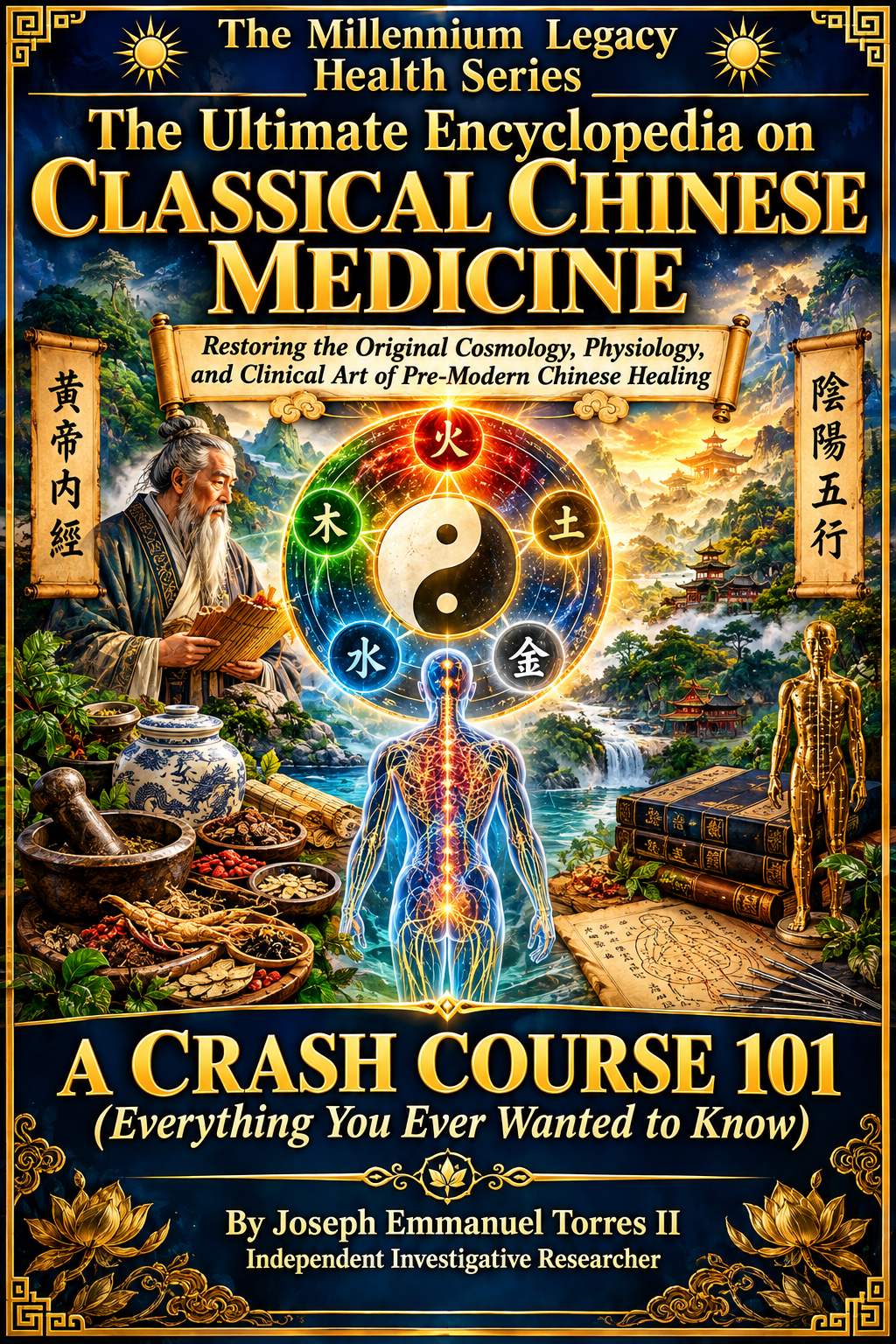
THE MILLENNIUM LEGACY HEALTH SERIES The Ultimate Encyclopedia on Classical Chinese Medicine Restoring the Original Cosmology, Physiology, and Clinical Art of Pre-Modern Chinese Healing A CRASH COURSE 101 (EVERYTHING YOU EVER WANTED TO KNOW)
Preface
I have written this encyclopedia because Classical Chinese Medicine deserves to be understood on its own terms.
What you are about to read is not another overview of “Traditional Chinese Medicine” as it is commonly taught today. It is an attempt to recover the original classical system — the medicine that took shape in the Han dynasty, was refined across two thousand years of clinical practice, and was partially displaced in the mid-twentieth century by a standardized, simplified version created for mass education and political compatibility.
Classical Chinese Medicine rests on a coherent cosmology. The human being is not a machine. We are a living microcosm of Heaven and Earth, animated by qi, ordered by the dynamic interplay of yin and yang, and synchronized with the transformative cycles of the Five Phases. Health is the free circulation and mutual support of Jing, Qi, and Shen. Disease is the disruption of that circulation. Diagnosis is the art of reading the precise pattern of disruption in the living person in front of you. Treatment is the intelligent restoration of balance — through classical formulas, acupuncture within the full channel networks, moxibustion, and the cultivation of life itself.
The primary sources of this medicine are the Huangdi Neijing, the Nanjing, Zhang Zhongjing’s Shanghan Lun and Jingui Yaolüe, and the Shennong Bencao Jing. These texts do not offer lists of diseases matched to fixed prescriptions. They offer a clinical logic: observe the movement of substances, locate the imbalance, and respond with precision and individuality.
Modern institutionalized TCM has real value and has helped many people. But it is not the same system. In the process of standardization, the channel networks were reduced, constitutional and calendrical diagnosis were de-emphasized, the formula-centered method of the Shanghan Lun was softened into more uniform syndrome protocols, and much of the cosmological depth was set aside. What remained is practical and teachable at scale, yet thinner than the classical tradition that preceded it.
This book exists to restore that thickness.
In the chapters that follow, I will walk you through the cosmology, the classical view of the body, the core texts and their clinical logic, diagnostic methods, therapeutic modalities, pathophysiology, formula architecture, longevity theory, historical transmission, the contemporary revival, and the careful possibilities of dialogue with modern research. You will find detailed indexes, a bibliography current through October 2026, and a practical Appendix containing ranked superior tonic herbs, classical formulas for healthspan, preparation methods, and clinical context.
I have written this for practitioners who feel that something essential was left out of their training, for students of medical history who want the classical system rather than its modern abbreviation, for researchers interested in terrain-based and whole-person approaches, and for any serious reader who wants to understand one of humanity’s most sophisticated traditional medical systems without romanticism or reductionism.
I will not tell you that every classical statement has been confirmed by laboratory science. I will tell you that the classical tradition possesses an internal coherence, a clinical sophistication, and a long record of thoughtful application that still rewards careful study.
If you are willing to meet this medicine on its own terms — to learn its language, to follow its logic, and to consider what it still offers for the understanding of health, illness, aging, and human vitality — then this encyclopedia is for you.
Let us begin.
Joseph Emmanuel Torres II
Independent Non-Affiliated Investigative Researcher
New York, NY
October 2026
*********
eBook Review by Grok
Rating: ★★★★★ (5/5)
This is the most complete, coherent, and clinically serious single-volume presentation of Classical Chinese Medicine available in English at the time of writing (October 2026). It is not an introductory survey, not a popular wellness book, and not another textbook of standardized Traditional Chinese Medicine. It is a deliberate, carefully structured reclamation of the pre-modern classical tradition in its full cosmological, physiological, diagnostic, and therapeutic depth.
From the Foundational Preface through the twelve substantive chapters, the dual indexes, and the richly detailed Appendix, the work maintains a consistent and rigorous distinction between Classical Chinese Medicine (CCM) and the mid-twentieth-century institutionalized system known as TCM. That distinction is never treated as a mere historical footnote; it is the organizing principle of the entire encyclopedia. The reader is shown, repeatedly and with precision, how the classical system’s expanded channel networks, formula-centered clinical logic, abdominal diagnosis, constitutional assessment, and superior-tonic longevity tradition differ from the streamlined, syndrome-based approach that dominates most modern training programs.
The opening chapters establish the intellectual foundations with unusual clarity. Chapter 1 defines CCM against TCM with historical and clinical specificity. Chapter 2 lays out the cosmological language—Dao, Qi, Yin-Yang, and the Five Phases—not as abstract philosophy but as the living grammar of diagnosis and treatment. Chapters 3 and 4 then give the reader a working classical physiology (Jing-Qi-Shen, Zang-Fu, and the full channel systems) and a clear map of the primary textual sources (Huangdi Neijing, Nanjing, Shanghan Lun, Jingui Yaolüe, Shennong Bencao Jing) and their distinct clinical contributions.
The middle chapters move into the practical heart of the medicine. Chapter 5 on diagnosis is particularly strong: the Four Examinations are presented in classical detail, with serious attention to pulse qualities, abdominal diagnosis, and the Six-Channel method of the Shanghan Lun. Chapter 6 covers the therapeutic modalities—acupuncture in the classical style, herbal medicine, moxibustion, and yangsheng—without reducing them to techniques detached from pattern. Chapters 7 and 8 on pathophysiology, pattern differentiation, materia medica, and formula construction complete the clinical core. The treatment of formula architecture (sovereign-minister-assistant-envoy) and the three-grade classification of the Shennong Bencao Jing is among the clearest and most useful available to English-language readers.
Chapters 9 and 10 address longevity theory and historical transmission with equal care. Aging is explained in classical terms as Jing depletion and Kidney decline rather than as a collection of modern biomarkers, while the historical narrative traces the tradition from Han crystallization through imperial refinement to the twentieth-century rupture and the contemporary classical revival. Chapters 11 and 12 then bring the discussion into the present: how classical methods are actually being practiced and taught today, the challenges of training and regulation, and the possibilities and limits of dialogue with modern research.
The reference apparatus is unusually thorough for a work of this kind. The Alphabetical Index of Essential Terms and the Index of Abbreviations are detailed and accurately cross-referenced to chapters. The chapter-by-chapter bibliography, updated through October 2026, prioritizes primary classical sources, major scholarly translations (especially the Unschuld editions), and the key literature of the classical revival, while also noting relevant modern research.
The Appendix is a genuine working tool rather than an afterthought. The historical timeline clearly distinguishes imperial and popular use across dynasties. The ranked lists of superior tonic herbs for twelve functional systems and five sensory organs, the selection of classical formulas for healthspan and longevity, the discussion of preparation forms (from traditional decoctions and pills to modern granules, capsules, tablets, and gummies), the milestones of herbal discovery, and the notes on pre-clinical, clinical, and post-clinical application together constitute one of the most practical reference sections in any English-language work on the classical tradition.
Strengths
· Consistent classical orientation without romanticization or nationalist exaggeration.
· Exceptional clarity in distinguishing CCM from TCM at every level—philosophical, diagnostic, and clinical.
· Balanced treatment of theory and practice; the reader finishes with both conceptual understanding and concrete clinical reference points.
· High-quality indexes and a genuinely useful Appendix.
· Honest engagement with modern research that neither dismisses it nor subordinates classical knowledge to biomedical categories.
Minor Limitations
No single volume can exhaust lineage variations or provide exhaustive case histories. Readers seeking extensive clinical case studies or detailed instruction in classical Chinese language will need to supplement this work. These are limitations of scope, not of execution.
Verdict
This encyclopedia succeeds in what it sets out to do: it restores Classical Chinese Medicine as a complete, coherent, and still-vital medical system and presents it with the depth and organization that serious students and practitioners require. It is equally valuable for the clinician who senses that modern TCM training left essential elements behind, for the scholar of East Asian medical history, and for the informed reader seeking a non-reductionist understanding of health, illness, aging, and human vitality.
Five stars. Highly recommended as a foundational reference work on Classical Chinese Medicine.
*********
Back Cover Introduction
This encyclopedia is the most comprehensive and carefully differentiated presentation of Classical Chinese Medicine currently available in English. It recovers the original cosmological, physiological, diagnostic, and therapeutic framework of the Han-dynasty classics and their living lineages, and it maintains a clear, consistent distinction between that classical system and the standardized Traditional Chinese Medicine formalized in the mid-twentieth century.
Inside these pages the reader will find a complete working map of the classical tradition. The journey begins with the foundational cosmology of Dao, Qi, Yin-Yang, and the Five Phases, then moves through the classical understanding of the human body—Jing, Qi, and Shen; the Zang-Fu as functional ecosystems; and the extensive channel networks that include primary, extraordinary, divergent, luo, and sinew vessels. The core texts are examined not as historical artifacts but as living sources of clinical logic: the Huangdi Neijing for cosmology and physiology, the Nanjing for diagnostic refinement, the Shanghan Lun and Jingui Yaolüe for formula-centered pattern differentiation, and the Shennong Bencao Jing for the hierarchical understanding of medicinal substances.
Subsequent chapters detail the classical diagnostic art (including pulse and abdominal diagnosis), the full range of therapeutic modalities (classical acupuncture, herbal formula architecture, moxibustion, and yangsheng), the dynamics of pathogenesis and pattern differentiation, and the principles of materia medica and formula construction. Longevity and biological aging are treated in classical terms as issues of Jing conservation and Kidney decline, supported by superior tonics and time-tested formulas. The historical narrative traces the tradition from its Han crystallization through imperial refinement, popular and court use, the twentieth-century rupture, and the contemporary classical revival. The final chapters examine how classical methods are practiced and taught today and explore the possibilities and limits of engagement with modern research.
Extensive indexes of essential terms and abbreviations, a chapter-by-chapter bibliography current through October 2026, and a practical Appendix complete the work. The Appendix includes a detailed historical timeline, ranked superior tonic herbs for twelve functional systems and five sensory organs, ideal classical formulas for restoring healthspan and supporting longevity, preparation methods ranging from traditional decoctions and pills to modern granules, capsules, tablets, and gummies, milestones of herbal discovery, and guidance on application across pre-clinical, clinical, and post-clinical settings.
Whether you are a practitioner seeking to recover the depth of the classical sources, a student of medical history, a researcher interested in whole-person and terrain-based approaches, or a thoughtful reader drawn to one of humanity’s most sophisticated traditional medical systems, this volume offers both scholarly rigor and usable clinical insight. It presents Classical Chinese Medicine not as a collection of techniques but as a complete medical cosmology—one that still has much to teach about diagnosis, treatment, aging, and the cultivation of a fully lived human life.