
The FDA-Defensible Pharmaceutical Risk Assessment System (Former FDA Investigator’s Methodology, Editable Word Template and Fully Executed Example)
The FDA-Defensible Pharmaceutical Risk Assessment System (Methodology Developed by a Former FDA Investigator, Editable Working Template and Fully Executed Example)
A Risk Assessment Should Determine the Decision—not Legitimize One Already Made
A batch is released. A deviation is closed. A supplier remains approved. A validation gap is accepted. A recall recommendation is rejected.
Then someone asks Quality to write the risk assessment.
During an FDA inspection, the existence of that document may not protect the company. It may instead create a written record showing that assumptions were treated as facts, important uncertainties were minimized, patient and product impact were defined too narrowly, or the conclusion had been selected before the assessment began.
The FDA-Defensible Pharmaceutical Risk Assessment System was created to prevent that failure.
Developed by DeVaughn Edwards, a former FDA Investigator with 14 years of agency experience and approximately 13 additional years in pharmaceutical Quality and Compliance leadership, this professional system provides a structured method for moving from evidence and uncertainty to a scientifically supportable, clearly documented and inspection-defensible decision.
This is not a blank form accompanied by a short explanation of risk-ranking theory. It is a practical decision-making system designed for pharmaceutical Quality professionals who must evaluate actual product, patient, compliance and operational consequences—and demonstrate how the available information led to the final action.
The Three-Part System
Part One: Understand the Methodology
The FD-AID methodology explains how to structure a pharmaceutical risk assessment from the initial problem statement through the final Quality decision. It addresses the information that must be collected, the questions the assessment team must resolve, the limitations and uncertainties that must be acknowledged, and the reasoning needed to connect the evidence to the final conclusion.
The methodology helps prevent a common and serious failure: assigning risk scores without adequately documenting why those scores were selected or how they influenced the company’s decision.
Part Two: Apply the Methodology
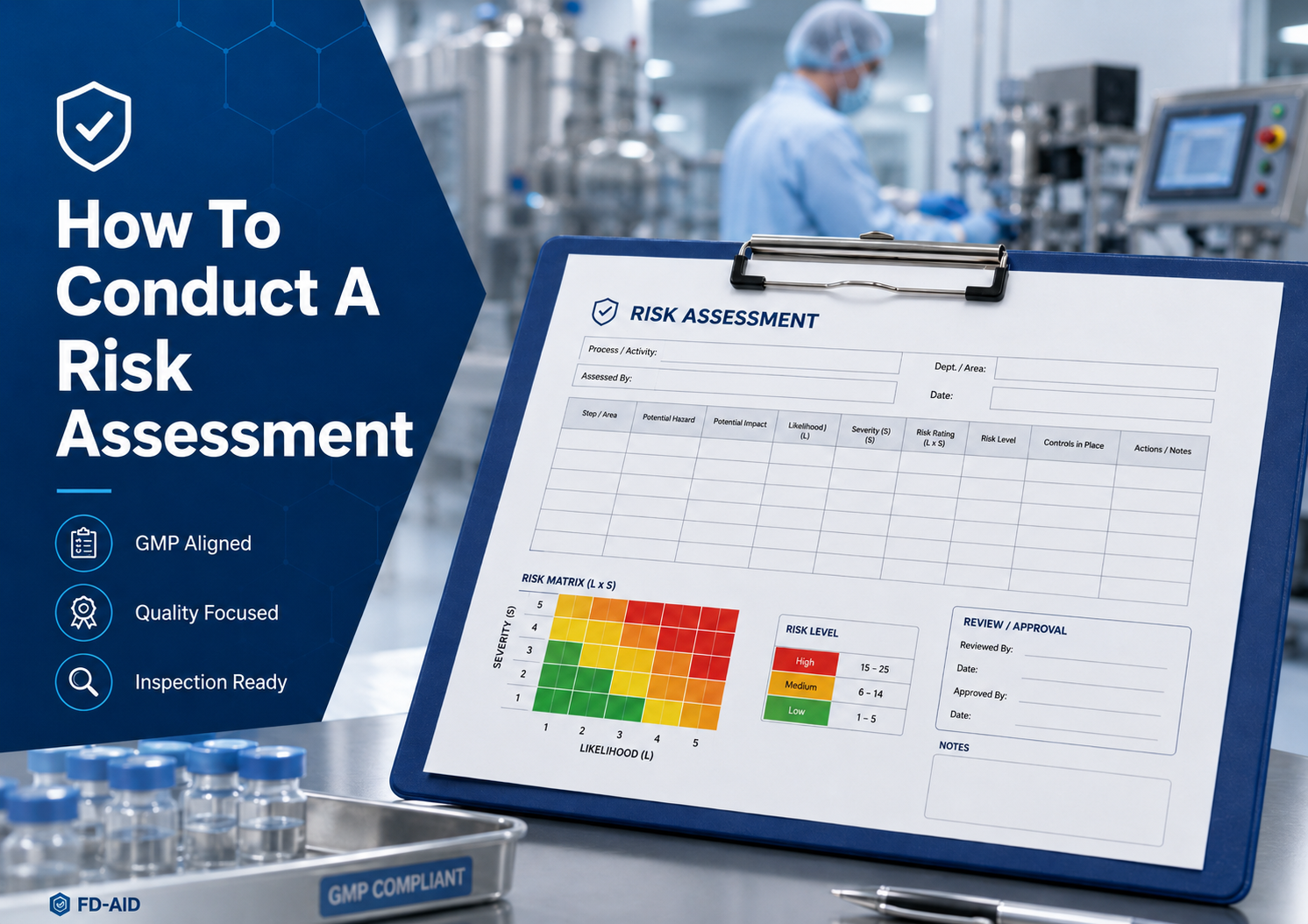
The package includes a clean, editable Microsoft Word template that can be adapted to the specific event, product, process or Quality-system concern under evaluation.
The template guides the assessment team through:
- Definition of the event and decision to be made
- Identification of potentially affected products, batches, processes and systems
- Evaluation of patient and product-quality consequences
- Review of available evidence and supporting records
- Documentation of assumptions, uncertainties and missing information
- Assessment of severity, probability, detectability and overall exposure
- Consideration of regulatory and compliance consequences
- Identification of existing and additional risk controls
- Assignment of responsibilities and follow-up actions
- Documentation of the final risk conclusion
- Quality and management review and approval
The structure is intended to help cross-functional teams reach consistent decisions while creating a record that explains not merely what the company concluded, but how and why it reached that conclusion.
Part Three: Examine a Fully Executed Example
A blank template shows where information belongs. It does not necessarily show what a defensible assessment looks like when completed.
For that reason, this system includes a fully executed pharmaceutical risk-assessment example. The example demonstrates the expected depth of analysis, the connection between evidence and assigned risk, the treatment of uncertainty, the documentation of controls and the construction of a supportable final conclusion.
The executed example allows purchasers to compare their own assessment against a completed model before submitting it for Quality approval or presenting it during an inspection.
Where This System Can Be Applied
The methodology and template may be adapted to support assessments involving:
- Deviations and unexpected manufacturing events
- OOS and OOT investigations
- Batch-disposition decisions
- Product-impact evaluations
- Validation and qualification gaps
- Equipment failures and maintenance deficiencies
- Supplier and raw-material failures
- Temperature excursions
- Complaints and adverse-event trends
- Contamination and cross-contamination concerns
- Data-integrity events
- Change-control decisions
- CAPA prioritization
- Retrospective product evaluations
- Recall and field-action considerations
- Form FDA 483 and Warning Letter remediation
Because each event presents different facts and regulatory considerations, the system does not substitute a predetermined answer for professional judgment. It provides the structure needed to apply that judgment consistently and document it credibly.
Questions an FDA Investigator May Ask
A completed risk assessment may become the beginning of FDA’s examination—not the end of it. An Investigator may ask:
- What evidence supported the probability rating?
- How were potentially affected batches and distributed products identified?
- Were previous related events considered?
- What important information was unavailable?
- How did the company account for uncertainty?
- Why were the selected controls considered adequate?
- What evidence would have caused the company to reach a different conclusion?
- Was the operational decision made before or after the assessment was completed?
- Who participated in the assessment, and did the Quality Unit exercise independent authority?
A colored risk matrix cannot answer these questions. The documented reasoning behind the assessment must do that.
What You Will Receive
Your purchase includes five downloadable files:
FD-AID Pharmaceutical Risk Assessment Methodology with Executed Example — PDF
The complete structured methodology for conducting and documenting a pharmaceutical risk assessment.
FD-AID Editable Pharmaceutical Risk Assessment Template — Microsoft Word
A clean working template that the licensed purchaser may adapt for authorized internal use.
FD-AID License and Use Terms — PDF
A concise explanation of the permitted use of the professional license.
Employer Purchase Approval Request - Microsoft Word
An editable, ready-to-use document designed to help employees request employer approval and funding for the purchase of this system.
FDA Investigator Challenge Guide — PDF
A practical companion guide that helps Quality teams pressure-test a completed risk assessment using the questions an experienced FDA Investigator may ask. It examines ten critical areas—including scope, evidence, scientific rationale, patient impact, controls and residual risk and provides a preapproval determination of ready, conditionally ready or not ready for approval.
Who Should Purchase This System?
This resource was developed for pharmaceutical and biopharmaceutical professionals responsible for consequential Quality decisions, including:
- Quality Assurance and Quality Control personnel
- Investigation and CAPA professionals
- Manufacturing and laboratory leadership
- Validation and engineering personnel
- Supplier Quality professionals
- Regulatory Affairs personnel
- Site Quality Heads and Quality executives
- Inspection-readiness teams
- Pharmaceutical consultants and auditors purchasing the appropriate license
Professional License: $450
The standard purchase provides a single-user professional license for one named purchaser. It does not authorize unrestricted distribution, placement on a company-wide shared drive, use by multiple facilities, resale, publication or distribution of the editable source file to clients or other third parties.
Single-site, enterprise and consultant licensing may be obtained separately by contacting FD-AID at devaughn@fdaid.org.
A Reusable Professional Compliance Resource
A single significant deviation, product-impact evaluation, supplier failure, validation gap or regulatory response can require hours of senior technical and Quality review. This system provides a reusable methodology for approaching those decisions consistently rather than beginning each assessment with an empty page or an inadequately explained risk matrix.
If your organization cannot clearly demonstrate how it moved from evidence, uncertainty and potential patient impact to the final risk conclusion and resulting action, an FDA Investigator may view the assessment as justification for a decision already made.
The FDA-Defensible Pharmaceutical Risk Assessment System helps your organization document the reasoning behind the decision—not merely the score assigned to it.
Questions about organizational or consultant licensing?
Contact DeVaughn Edwards at devaughn@fdaid.org.
© 2026 FD-AID, LLC. All rights reserved.