

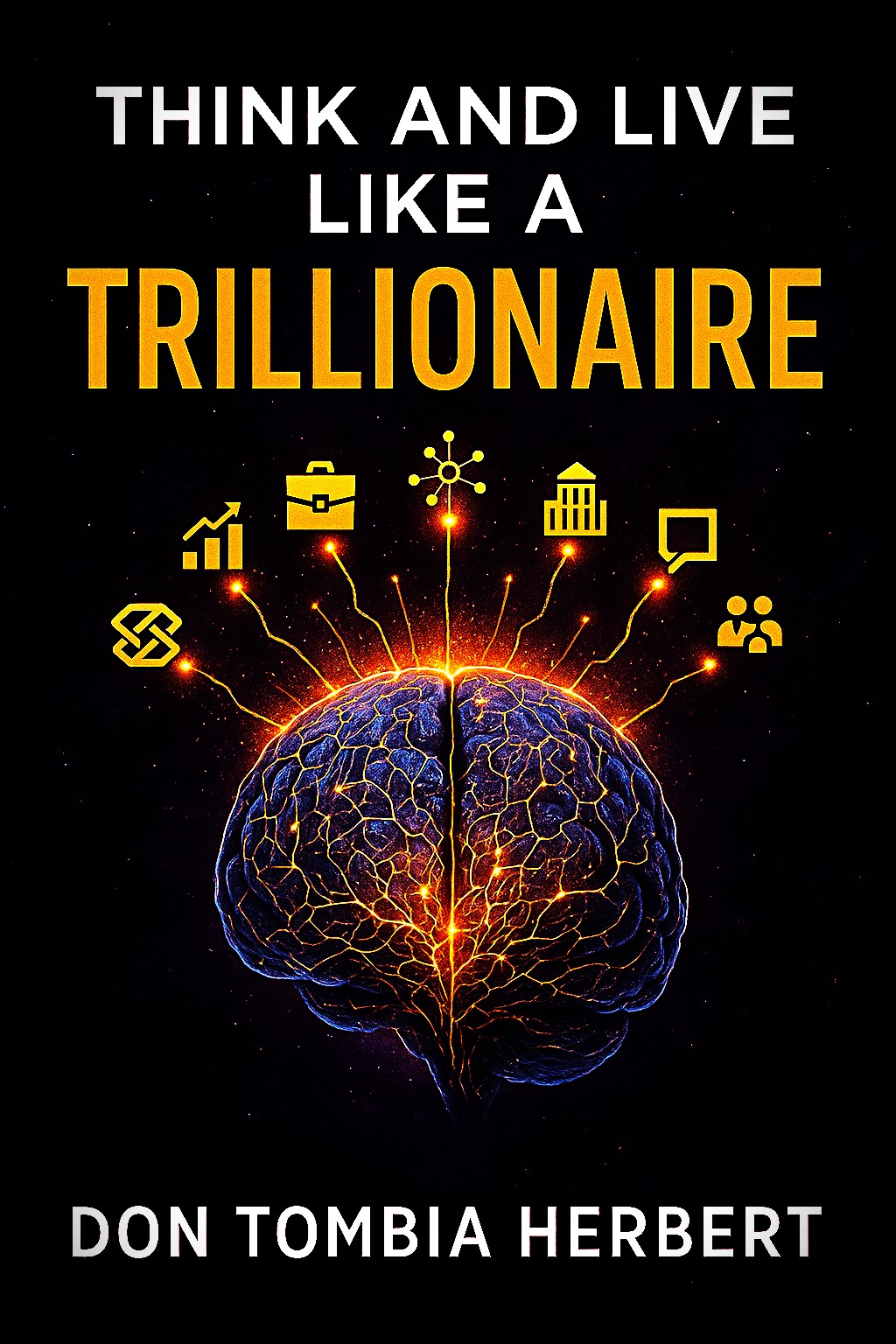
Think and Live Like a Trillionaire
THE TRILLIONAIRE-DOLLAR MANIFESTO
They said trillionaires were impossible. They were wrong.
In a world where artificial intelligence can outthink billions of people, why do 99% of human beings remain trapped in limited thinking and lifestyle? The answer lies not in your circumstances, but in your cognitive architecture or mental framing.
"Think and Live Like a Trillionaire" is not another wealth book. It is a complete operating system, an upgrade software for your mind. For the first time, the strategic patterns of the world's ten most valuable companies—$20 trillion in collective wisdom—have been decoded into an actionable mental framework. Their collective business secrets revealed!
Through ten seismic chapters, Don Tombia Herbert and Diana Edwell reveal:
v The Microsoft Mindset: How to see ecosystem dominance where others see only products.
v The Nvidia Code: Timing technological paradigm shifts with supernatural precision.
v The Apple Alchemy: Transforming commodity technology into objects of desire.
v The Amazon Algorithm: Building relentless, self-funding growth machines.
v The Google Gateway: Organizing chaos into unimaginable profit.
v The Meta Metamorphosis: Connecting humanity while capturing infinite attention.
v The Aramco Ascent: Leveraging natural advantage into geopolitical power.
v The Broadcom Blueprint: Mastering the invisible infrastructure of everything.
v The TSMC Trinity: Controlling the fundamental building blocks of civilization.
v The Berkshire Hathaway Compounding: Deploying patience as the ultimate weapon of mass creation.
This book is your invitation to the trillionaire-dollar-round table. The AI revolution has just begun! The question is: will you be among the architects or remain amongst the automated?
Upgrade your mind! The trillion-dollar class begins right now.
About the Author
Don Tombia Herbert: The Architect of Trillion-Dollar Minds
Don Tombia Herbert is not a theorist. He is a strategist who operates in the crucible of global commerce. For decades, he has served as a senior administrator and leadership coach, dissecting the anatomy of success and failure within complex human organizations. But his most significant role is as the founder of Tombia Global Strategies Enterprises and GalabaGalaba Network Enterprises Inc., two pioneering firms that are built on radical premises: the fusion of deep human wisdom with strategic artificial intelligence.
This unique position—standing at the confluence of human intuition and machine-scale analysis—granted him an unprecedented vantage point. He observed that the staggering gap between the world's wealthiest entities and all others wasn't just a matter of resources; it was a fundamental difference in cognitive architecture.
While others saw companies like Microsoft, NVIDIA, and Apple as simply successful, Don saw them as repositories of a superior mental code. He dedicated himself to a monumental task: reverse-engineering the core cognitive patterns of the world's ten most valuable companies—a collective $20 trillion in market value—and distilling them into a single, actionable operating system for the human mind.
Think and Live Like a Trillionaire is the stunning result of this mission. It is not a collection of tips or inspirational stories. It is a step-by-step guide to installing what Don calls the "Trillion-Dollar Protocols"—the same mental software used by Gates, Huang, Jobs, Bezos, and Zuckerberg to build their empires.
Working in a unique symbiotic partnership with DeepThink, the AI corporate strategist at the heart of his firms, Don has achieved what was previously thought impossible: he has codified genius into a repeatable process.
His book is your invitation to bypass years of trial and error and download the very mindsets that control the levers of the global economy. When you are done reading, you will not just understand how they think. You will think as they do.
Don Tombia Herbert lives by the principle that defines his work: true wealth is not just what you have, but what you know, and how you think. This book is the key.
TABLE OF CONTENTS
Introduction: The Trillion-Dollar Synapse:
Your Mind is the Final Frontier. It's Time for a Mental Upgrade.
Chapter 1: The Ecosystem Mindset – Microsoft.
From Code to Constellation: How to See Platforms, Not Products.
Chapter 2: The Paradigm-Shift Mindset – NVIDIA.
Building the Engine of the Future Before the Future Arrives.
Chapter 3: The Reality-Distortion Mindset – Apple.
The Alchemy of Desire: Turning Technology into Theology.
Chapter 4: The Infinite-Scale Mindset – Amazon.
The Flywheel Formula: Building a Self-Perpetuating Growth Machine.
Chapter 5: The World-Organizing Mindset – Alphabet (Google).
Mapping Chaos: The Trillion-Dollar Value of Finding Patterns.
Chapter 6: The Social-Fabric Mindset – Meta.
Weaving the Network: The Architecture of Human Connection.
Chapter 7: The Resource-Sovereignty Mindset – Saudi Aramco.
Leveraging the Lever: Turning Inherent Advantage into Geopolitical Power.
Chapter 8: The Invisible-Infrastructure Mindset – Broadcom.
Mastering the Unseen Engine Room of the Modern World.
Chapter 9: The Foundational-Layer Mindset – TSMC.
Controlling the Bedrock: The Power of Manufacturing the Impossible.
Chapter 10: The Time-Compounding Mindset – Berkshire Hathaway.
Patience as a Weapon: The Art of the Asymmetric Bet.
Conclusion: The Symbiotic Trillionaire
Your Partnership with the Future.
Your Mental Upgrade Toolkit
A 30-Day Cognitive Rewiring Program.
CHAPTER 1
THE ECOSYSTEM MINDSET – MICROSOFT.
Market Cap: $3.55 Trillion.
Founders: Bill Gates & Paul Allen.
1.1 The Foundation Myth: The Vision in the Garage.
It did not begin with a revolutionary line of code. It began with a revolutionary thought, one so audacious it seemed delusional in 1975: "A computer on every desk and in every home."
While competitors saw computers as expensive hardware to be sold, Gates and Allen saw an invisible architecture. They recognized that the true value wasn't in the machine itself, but in the operating system—the universal translator that would allow all hardware and software to communicate. They weren't selling a product; they were selling a universe, and they positioned themselves as the gods of its physics.
Your Mental Upgrade 1.1:
Identify the "physics" of your industry. What are the universal rules or platforms that everything else depends on? That is your point of maximum leverage.
1.2 The Trillion-Dollar Insight: Control the Ecosystem, Not Just the Product
Microsoft's first masterstroke was licensing MS-DOS to IBM. They didn't sell it; they licensed it. This seemingly minor detail was a genius-level play. It meant they could sell the same OS to every IBM clone manufacturer, making Microsoft the silent, indispensable standard in every PC, regardless of who built it.
This is the Ecosystem Mindset: building a network of value so essential that your success becomes synonymous with the success of thousands of other businesses. Windows succeeded because it enabled a global ecosystem of software developers and hardware makers to thrive.
Your Mental Upgrade 1.2:
Ask: "How can I make my success critical to the success of others?" Shift from being a player in an ecosystem to being the architect of one.
1.3 The Execution Engine: Strategic Monopoly and Relentless Iteration.
Microsoft was not the first, nor always the most innovative. But they were masters of strategic iteration and competitive envelopment. They observed, learned, and then built a "good enough" product that leveraged their ecosystem dominance.
When Netscape threatened with the web browser, Microsoft didn't just make a better browser; they bundled Internet Explorer with Windows for free, making the cost of entry for competitors impossible. This was not a product battle; it was an ecosystem war, and Microsoft controlled the battlefield.
Your Mental Upgrade 1.3:
Map your competitive landscape not just by competitors, but by their dependencies. What foundational need can you own that makes competition irrelevant?
1.4 The Anti-Fragile Architecture: Surviving Existential Threats.
Microsoft faced an existential threat from the US government itself—a landmark antitrust case that could have broken the company. They survived by adapting their posture, not their core strategy. They learned to wield their power with more discretion while continuing to expand their ecosystem into new domains: servers (Azure), professional software (Office 365), and gaming (Xbox).
Their resilience came from diversification within their domain of control. They built multiple pillars (Windows, Office, Cloud) that supported the same overarching ecosystem.
Your Mental Upgrade 1.4:
Build multiple pillars of value that reinforce your core ecosystem. When one pillar is threatened, the other pillars provide stability and a platform for counter-strategy.
1.5 Your Mental Upgrade: Installing the Ecosystem Protocol.
It's time to rewire your thinking. The pauper sees a transaction. The trillionaire sees a system.
Exercise: The Ecosystem Map.
1. Take a sheet of paper. Draw your business or idea in the center.
2. Map outwards: Who are your direct customers? Your suppliers? Your competitors?
3. Now, map the second layer: Who are your customers' customers? Your suppliers' suppliers? The companies that build products for your competitors?
4. The Critical Question: Where are the choke points? The universal needs? The duplicated efforts? The platform opportunity that everyone relies on but no one owns?
5. That empty space you've identified—that is your Microsoft moment.
1.6 The Trillionaire Application: From Mind to Market
Your goal is not to be the best. Your goal is to be the standard.
· If you are a writer: Don't just write a book. Create a world, a philosophy, a lexicon that others can use, reference, and build upon.
· If you are a developer: Don't just code an app. Build an API, a platform, a service that becomes foundational to other apps.
· If you are a consultant: Don't just sell advice. Create a framework, a methodology, a certification that becomes the industry standard for solving a problem.
Chapter 1 Takeaway:
Stop thinking about the tree. Start designing the forest. Bill Gates didn't get rich by planting the best tree; he got rich by owning the weather system that every tree needs to grow.