

SEALED VS PORTED VS BANDPASS:
DSP TUNING FOR BEGINNERS:
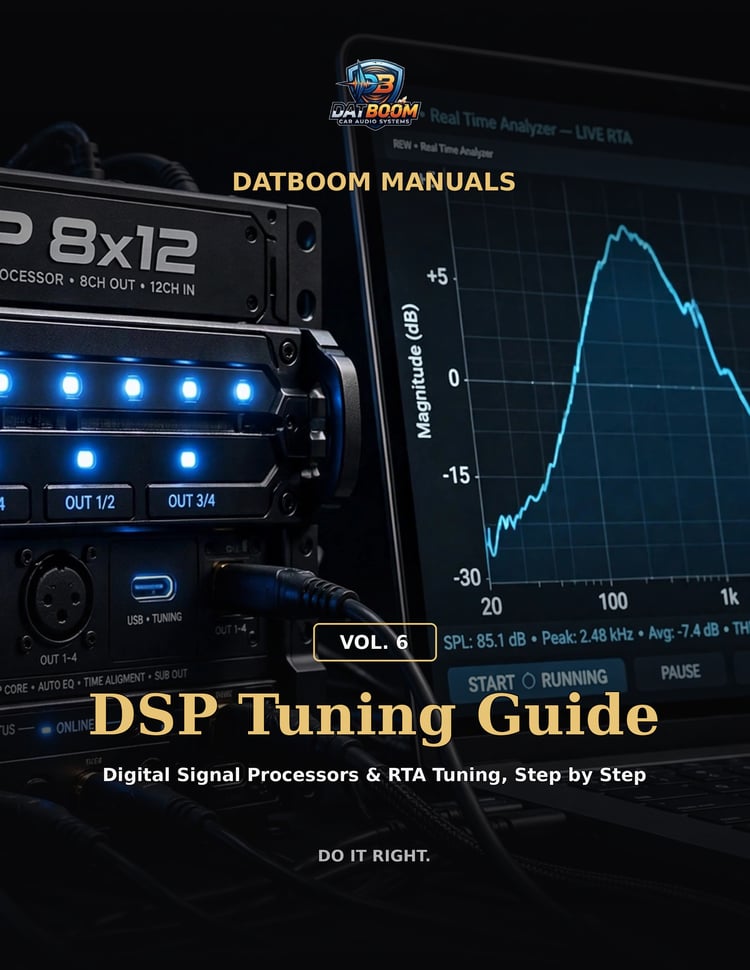
You bought the DSP. Now it's sitting in your dash, blinking at you, and every time you open the software you close it again. We've all been there.
Here's what the forums won't tell you: a DSP is not complicated. It's just four jobs — crossover, time alignment, EQ, and level matching — wrapped in software that was designed by engineers who never met a normal human being. The intimidation is the interface, not the concepts. Once somebody explains it in plain English, in the right order, you'll wonder what you were scared of.
DSP Tuning for Beginners is that somebody. It takes the most intimidating box in car audio and turns it into a step-by-step process any beginner can follow. No math-heavy theory. No engineering degree. Just hands-on tuning that works.
You'll learn what a DSP actually does and why you only need about 10% of the software to get 90% of the result. You'll learn gain structure — how to set levels from source through DSP to amplifiers so no link in the chain ever clips. You'll get crossover starting points that actually work: where to cross your subs to mids, mids to tweeters, and slopes explained so 12 vs 24 dB per octave finally makes sense. Time alignment gets boiled down to one tape measure and one simple formula. And the EQ chapter teaches the only rule that matters — cut, don't boost — before walking you through a complete tuning session, start to finish, including the second-day listen where real tuning actually happens.
It also covers the beginner mistakes hall of shame (seven ways beginners wreck their tune — and sometimes their speakers), three real case files, the five reference tracks every tuner should own, and the honest answer to "do you even need a DSP?" — plus what to look for if you're still shopping.
Inside:
- What a DSP actually does: the four jobs, in plain English
- Signal flow & gain structure: source to DSP to amps, set front-to-back, never clip a link
- Crossovers: high-pass, low-pass, and slopes — what 12 vs 24 dB/octave really means, with diagram
- Crossover starting points that work: the table for sub/mid, mid/tweet, and subsonic
- Time alignment in plain English: why your soundstage is broken, the tape-measure method, the worked example
- EQ without fear: cut, don't boost — fix peaks, ignore dips, wide and gentle
- The three frequency regions: bass, mids, treble — what each one does to the sound
- Tuning by ear: the complete session walkthrough, from levels to the walk-away
- What "done" sounds like: the five signs your tune is right
- Beginner mistakes: the hall of shame
- Three real case files: the pickup with no stage, the bass-boost sedan, the copied preset
- Reference tracks worth owning: the five-track playlist every tuner needs
- Do you even need a DSP? The honest answer — plus the buying guide
- The tuning checklist — tape it to the dash
15 pages. One tape measure. Zero fear. Your DSP is about to become your favorite tool in the car.
Fair price. Honest value. No gouging.