
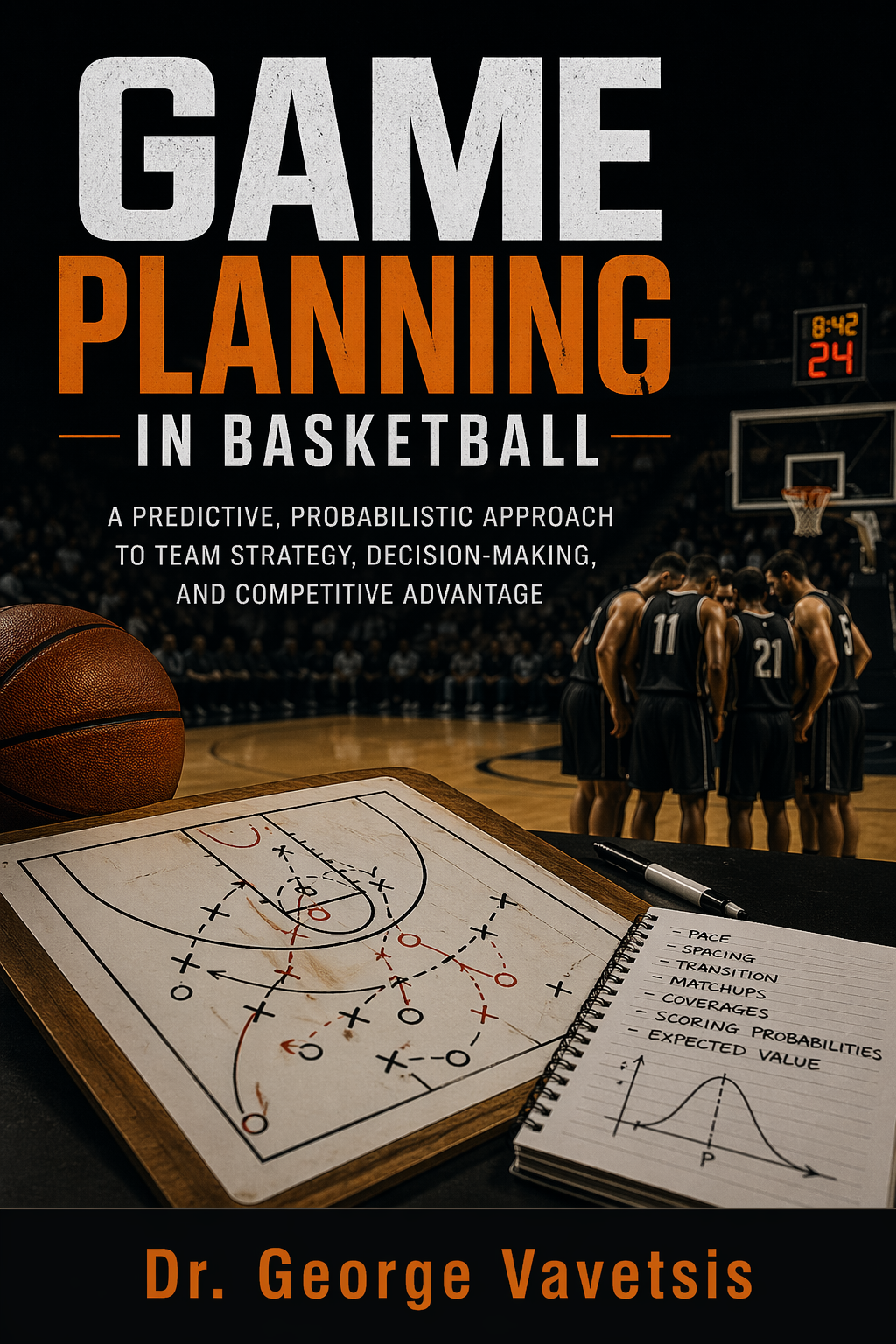
Game Planning in Basketball
Pages: 409
In the evolving landscape of elite basketball, game planning can no longer be reduced to static playbooks, deterministic diagrams, or linear sequences of tactical execution. The modern game demands a reconceptualization—one that transcends traditional coaching paradigms and embraces a multidimensional, probabilistic, and philosophically grounded approach to performance design. This book, Game Planning in Basketball, emerges from that necessity.
At its core, this work proposes a fundamental shift: from reaction-based coaching to prediction-driven systems engineering. Rather than perceiving the game as a chain of isolated events, we frame basketball as a dynamic, adaptive system governed by probabilistic states, temporal constraints, and continuous interactions between players, space, and time. As outlined in your foundational framework, game planning operates not through rigid prescriptions but through the orchestration of possession-state probabilities, shaping decisions in a way that maximizes expected advantage across evolving game contexts .
This philosophical repositioning is not merely theoretical—it is deeply practical. Coaches at the highest level are no longer tasked with scripting every possible outcome but with constructing decision architectures. These architectures function as cognitive maps, allowing players to navigate complex in-game environments through anticipatory logic, pattern recognition, and pre-activation strategies. In this sense, coaching becomes less about control and more about constraint design, where the manipulation of space, time, and information asymmetry guides emergent behavior toward favorable outcomes.
A central pillar of this book is the concept of probabilistic control. Every possession is treated as a sequence of evolving states, each carrying a distinct probability distribution of outcomes. Rather than chasing certainty—an illusion in high-performance sport—we seek to bias uncertainty. The objective is to consistently steer the game toward states where the expected value favors our system, even under conditions of chaos, pressure, and unpredictability. This aligns with a broader systems-thinking approach, where variance is not eliminated but strategically managed.
Equally critical is the integration of time–space compression as a defining characteristic of elite basketball. Decision-making windows at the highest level are often reduced to fractions of a second, forcing athletes to operate within highly constrained perceptual and motor environments. Under these conditions, traditional “read-and-react” models become insufficient. Instead, players must function within pre-activated cognitive states, anticipating actions before they fully materialize. This transition—from reaction to anticipation—represents one of the most profound evolutions in modern coaching philosophy.
Within this framework, the notion of anticipation is elevated from a tactical skill to an ontological principle. To anticipate is not simply to guess; it is to operate within a structured understanding of future states. Players and coaches engage in continuous projection—mapping not only the next action, but the subsequent layers of interaction that define the unfolding possession. This future-oriented cognition transforms the game into a predictive ecosystem, where preparation is measured not by what is known, but by how effectively one can navigate the unknown.
Another critical dimension explored in this book is the duality of offense and defense as a unified predictive system. Traditionally treated as separate domains, offense and defense are reframed here as interdependent processes within a single decision-making continuum. Offensive actions are understood as manipulations of defensive behavior, while defensive systems function as predictive models of offensive intent. This dialectical relationship creates a feedback loop in which each decision informs and constrains the next, reinforcing the importance of integrated tactical thinking.
Moreover, the book addresses the inherent tension between determinism and emergence. While structured systems and play designs provide a necessary foundation, the true nature of basketball remains nonlinear and adaptive. Emergent behaviors—those unplanned, spontaneous actions that arise from player interaction—are not anomalies but essential components of high-level performance. The challenge for the coach is not to eliminate chaos, but to design for it—to create systems robust enough to withstand unpredictability while flexible enough to exploit it.
From a methodological standpoint, this work integrates principles from multiple disciplines: systems theory, cognitive science, motor control, decision-making psychology, and performance analytics. Concepts such as possession-tree modeling, expected value mapping, and constraint-based design are translated into applied coaching frameworks, offering practical tools for implementation in elite environments. The aim is to bridge the gap between abstract theory and on-court execution, providing a language and structure that can be operationalized within daily training and competition.
Importantly, this book is written for coaches who are not satisfied with conventional answers. It is intended for those who seek to understand why certain strategies work, how decisions emerge under pressure, and what underlying principles govern successful performance. It challenges the reader to think beyond plays and systems, to engage with the deeper philosophical questions of control, uncertainty, and human behavior within competitive environments.
Ultimately, Game Planning in Basketball is not just a manual—it is a conceptual framework. It invites coaches to become architects of decision-making environments, designers of probabilistic systems, and philosophers of the game itself. In doing so, it redefines the role of the coach from instructor to strategist, from observer to predictor, and from planner to creator of dynamic, living systems.
The future of basketball coaching lies not in knowing more plays, but in understanding more deeply the nature of the game.