

LawByLak — Topic 21: Civil Courts (OCR H418, Paper 1)
Civil Courts and ADR
The topic where the marks are in the figures. Almost no case law, four tracks with their own money limits, and an examiner who wants the number and the rule that produced it.
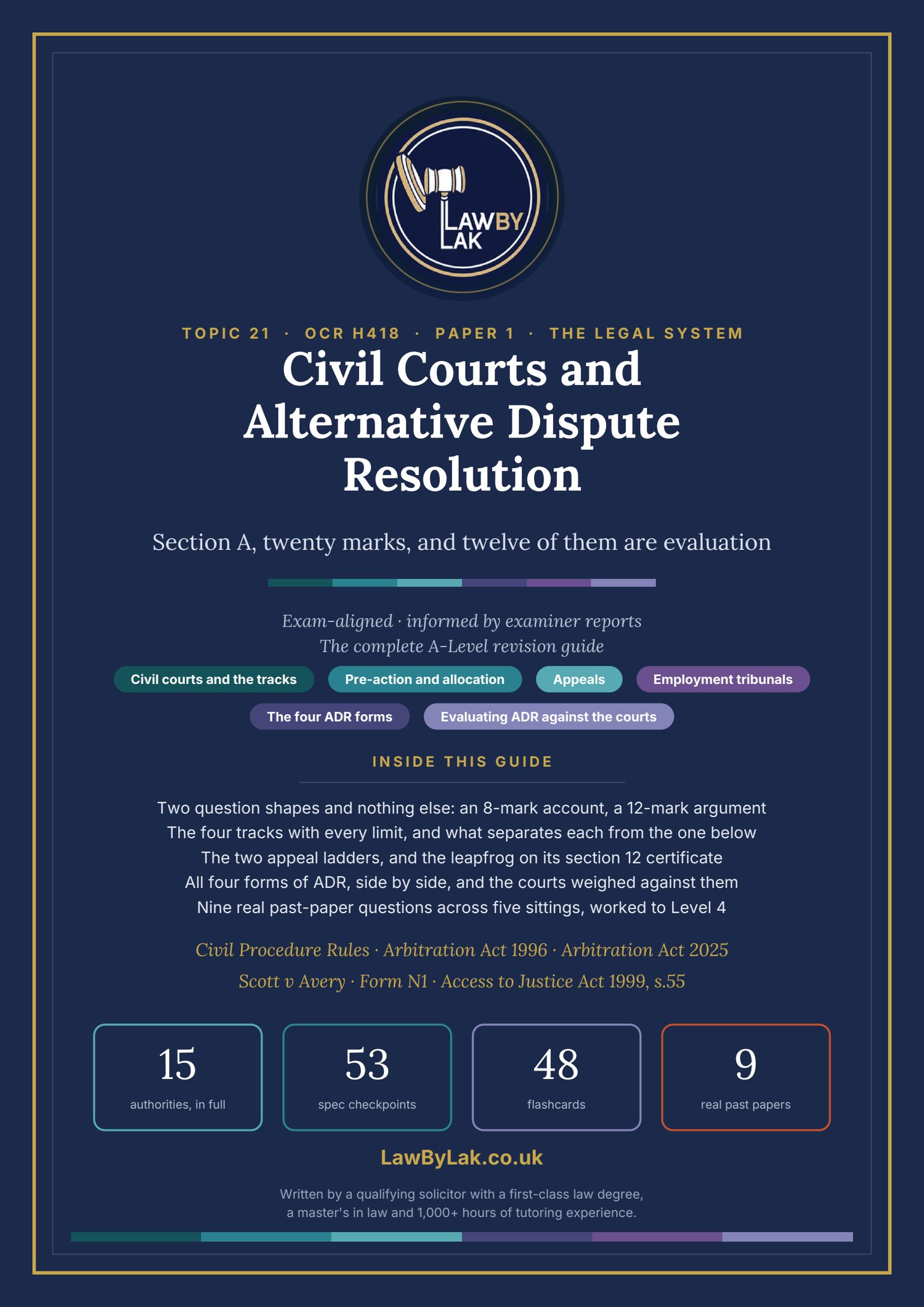
15 authority entries · 15 figures, every one checked against the Civil Procedure Rules or the legislation · 53 spec checkpoints · 48 flashcards · 72 evaluation arguments · 9 real past-paper questions
Civil Courts and ADR has been examined nine times across five sittings, which makes it one of the most reliable earners in Section A. It is also the topic where the most marks are lost to a stale number, because the figures move and the textbooks do not.
Section A means no scenario and no application. Two questions worth 8 marks for knowledge, two worth 12 for evaluation, and evaluation is a content bullet in its own right rather than an optional extra.
What is inside
- The four tracks, with every limit and every sub-limit. The three personal injury figures verbatim from rule 26.9, the fast track band with its one-day and one-expert limits, the intermediate track’s three days and two experts, and the three-party cap explained rather than asserted.
- The appeals ladder, with the eight grounds and the leapfrog built on the certificate that actually defines it, section 12 of the Administration of Justice Act 1969, not the ordinary appellant’s notice most sources confuse it with.
- All four forms of ADR in their own sub-tabs, each with a for-and-against card, plus a currency section on Churchill v Merthyr Tydfil, the October 2024 power to order ADR, and compulsory small-claims mediation running to April 2027.
- Employment tribunals, with the three statutory remedies under section 112 and a warning about the fourth one that is not a remedy at all.
- Seventy-two evaluation arguments across four banks, thirty-five of them named in OCR’s own indicative content, each built to carry all four steps rather than stopping at the assertion.
- A figures drill grouped into the five families students actually confuse, with a cover-and-check that works because the answer is not on the same line.
Eleven errors in OCR’s own materials
Named, corrected, and each one given the primary source that settles it. The County Court equity limit is £350,000, raised in 2014, not the £30,000 still in circulation. There is no CPR Part 28A: the intermediate track sits in Part 28, Section IV. The allocation questionnaire became the directions questionnaire in 2013. Every correction shows its working so you can check it yourself.
LawByLak.co.uk