
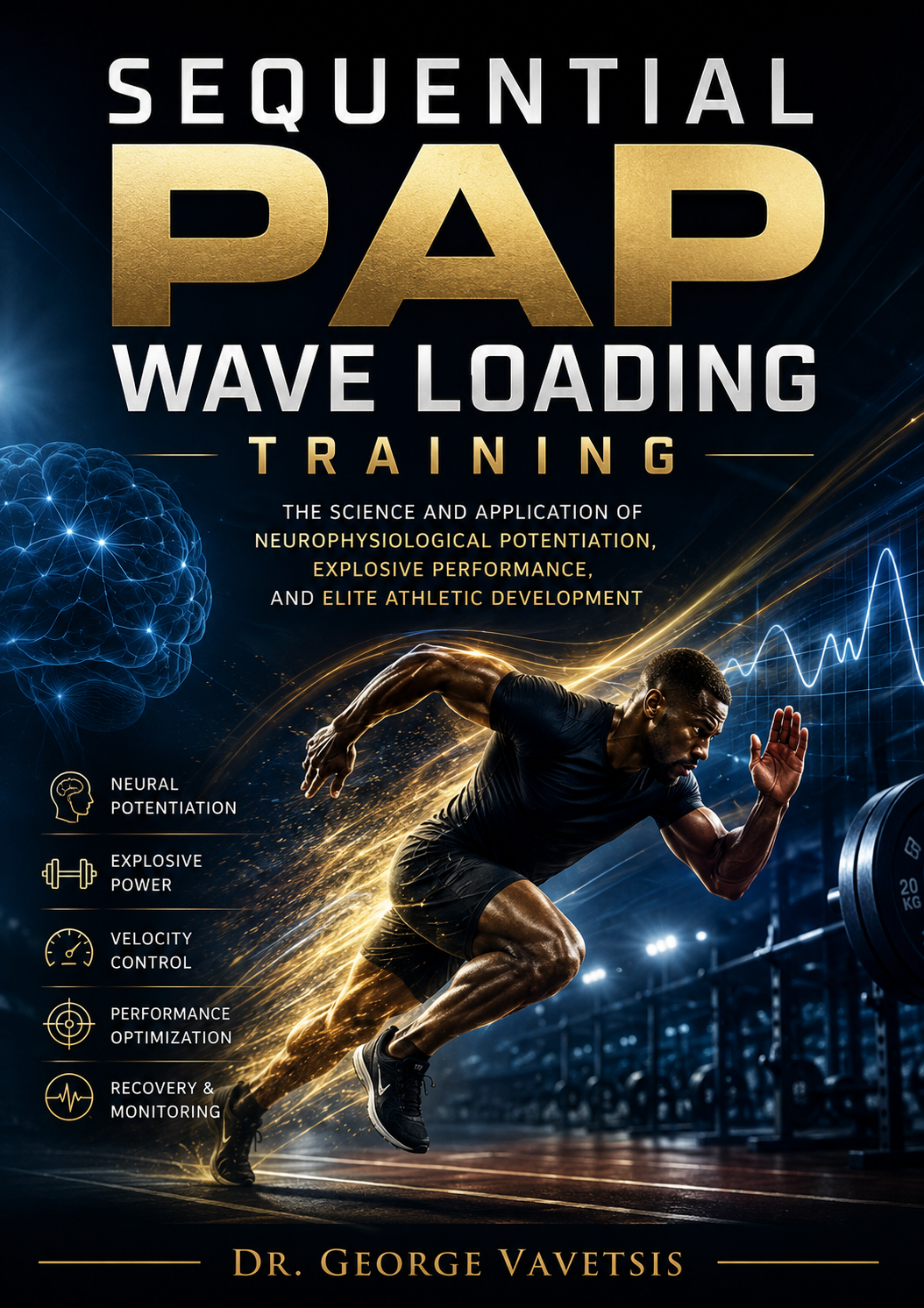
Sequential PAP Wave Loading Training
Pages: 463
Sequential PAP Wave Loading represents one of the most advanced and scientifically refined methods in modern strength and conditioning. Built upon the foundational principles of post-activation potentiation, neural priming, force–velocity optimization, and explosive motor-unit recruitment, Sequential PAP Wave Loading extends traditional potentiation methods into a far more dynamic and structured neurophysiological system. It is not merely a training method based on contrast sets or heavy-to-explosive pairings; rather, it is a complete neuromechanical architecture designed to manipulate neural readiness, corticospinal excitability, motor-unit synchronization, and force-expression efficiency through carefully organized sequential loading waves.
In elite sport performance, the difference between success and failure is often measured in milliseconds, centimeters, or extremely small fluctuations in neural readiness. Sequential PAP Wave Loading addresses this reality directly. Traditional explosive-strength training often focuses primarily on muscular output, external loading, or movement execution. However, elite athletic performance is ultimately governed by the nervous system. The ability to recruit high-threshold motor units rapidly, preserve neural drive under fatigue, maintain rapid rate coding, and repeatedly express explosive force under competitive conditions separates elite performers from subelite athletes. Sequential PAP systems are specifically designed to maximize these neurophysiological variables.
One of the most important concepts within Sequential PAP Wave Loading is the management of corticospinal excitability. Heavy loading performed at intensities above 90–95% 1RM can transiently increase neural activation and create a potentiated state where explosive performance becomes enhanced within carefully timed windows. Research and practical observations demonstrate that this potentiation window commonly appears between 3–7 minutes following the conditioning contraction. Within this period, athletes may display improved force production, faster contraction velocity, superior reactive ability, enhanced sprint acceleration, and greater explosive intent. However, these benefits exist only if fatigue accumulation is appropriately controlled. Sequential PAP Wave Loading therefore requires precise manipulation of intensity, density, volume, and recovery timing.
Another major characteristic of Sequential PAP systems is the sequential organization of neural waves. Rather than relying on isolated heavy-to-light pairings, Sequential PAP introduces progressive potentiation cycles using descending or oscillatory loading structures. For example, wave systems such as 95% → 90% → 85% 1RM create a controlled fluctuation of neural stress that allows the athlete to preserve high-threshold recruitment while minimizing inhibitory fatigue mechanisms. These sequential waves improve rate-coding density responses, motor-unit synchronization, and intermuscular coordination while maintaining explosive quality across multiple exposures.
The application of velocity-based training principles is central to the effectiveness of Sequential PAP Wave Loading. Monitoring mean propulsive velocity, velocity rebound, and velocity loss thresholds provides coaches with direct insight into the athlete’s current neural condition. Excessive velocity loss indicates central fatigue accumulation, impaired neural firing frequency, and reduced motor-unit efficiency. Consequently, velocity loss thresholds are often restricted to ≤10% during maximal neural sessions to preserve CNS integrity and maintain explosive readiness. In elite environments, these small fluctuations in bar speed can determine whether an athlete experiences potentiation enhancement or neural suppression.
Sequential PAP systems are also deeply connected to biomechanics and force-vector optimization. Explosive performance is not simply about generating force; it is about directing force efficiently through space and time. Horizontal force production during sprint acceleration, vertical force application during jumping, braking-force absorption during change-of-direction actions, and rotational torque generation during sport-specific movement patterns all require highly coordinated neuromechanical sequencing. Sequential PAP training enhances these characteristics by improving the synchronization between force production and movement velocity while simultaneously preserving elastic-reactive efficiency.
Modern elite sport further demands that explosive performance be maintained under fatigue, chaotic decision-making, and psychological stress. Sequential PAP systems therefore extend beyond physical preparation alone. They incorporate neurocognitive readiness, autonomic nervous system regulation, emotional management, and perceptual–motor efficiency. The integration of HRV monitoring, countermovement-jump diagnostics, force-plate analysis, and AI-based autoregulation allows coaches to adjust potentiation exposure according to daily readiness fluctuations. This individualized approach recognizes that every athlete possesses unique recovery kinetics, neural responsiveness, and fatigue thresholds.
The recovery dimension of Sequential PAP Wave Loading is equally important. High neural exposure creates substantial stress on both central and peripheral systems. Without appropriate management, excessive PAP loading can lead to cortical fatigue accumulation, impaired neuromuscular-junction transmission efficiency, autonomic imbalance, and decreased explosive output. Thus, recovery strategies such as parasympathetic breathing protocols, sleep extension, creatine support, glycogen restoration, hydration regulation, and neural deloading phases become essential components of the overall system.
Importantly, Sequential PAP Wave Loading is highly adaptable across sports. Basketball athletes may utilize PAP systems to improve repeated jump ability and reactive power throughout a 40-minute game. Volleyball players may apply potentiation methods to enhance spike-jump explosiveness and block-reactivity efficiency. Football athletes may use resisted sprint PAP systems to improve acceleration mechanics and repeated sprint ability. Combat-sport athletes may integrate ballistic PAP complexes to increase striking force and neuromechanical timing. Regardless of the sport, the underlying objective remains the same: optimize the nervous system’s capacity to express force rapidly, repeatedly, and efficiently under competitive conditions.
This book was written to provide strength and conditioning coaches, sport scientists, performance specialists, and elite practitioners with an advanced scientific framework for understanding and implementing Sequential PAP Wave Loading systems. The goal is not merely to describe exercises or protocols, but to present a complete high-performance model integrating neurophysiology, biomechanics, molecular physiology, force–velocity profiling, reactive strength, velocity-based monitoring, recovery science, and modern autoregulatory systems.
Sequential PAP Wave Loading represents the evolution of explosive training. It bridges the gap between strength and speed, between neural readiness and mechanical execution, and between physiological science and practical high-performance application. In modern elite sport, where performance margins continue to narrow, the ability to optimize neural efficiency while preserving explosive readiness may become one of the defining characteristics of championship-level preparation.